
In This Article
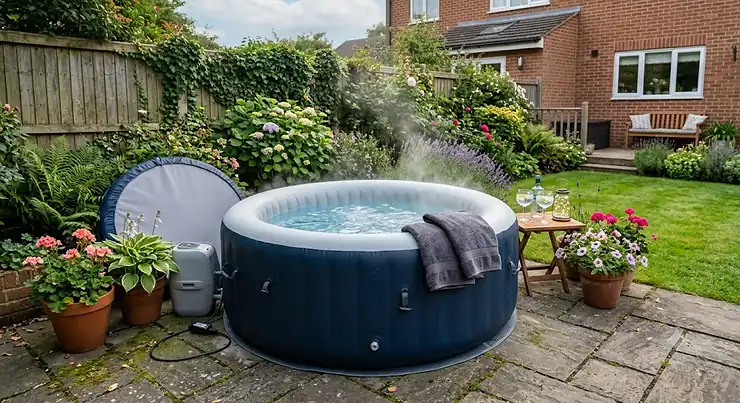
A 2 person inflatable hot tub is a compact, self-heating spa designed to seat two adults comfortably, typically holding 550-800 litres of water and packing away into a bag the size of a large holdall when deflated. If you’ve ever stood in your garden picturing a hot tub there and then immediately pictured your bank balance and your patio’s total lack of space, you’re exactly who this article is for. Because here’s the thing nobody tells you at the garden centre: most “family” hot tubs are wildly oversized for two people, guzzling far more water and electricity than a couple actually needs.
We’ve spent time digging through the specs, the aggregated review sentiment, and the small print of seven genuinely available models — from budget entry points under £300 to compact premium picks with proper design flair. Some of these are technically labelled “2-4 person,” which sounds like marketing sleight of hand until you realise that’s simply how manufacturers size their tubs; what matters for a couple is inner diameter, water depth, and whether two adults can stretch their legs without playing footsie by accident.
This guide leans hard into the practical stuff that Amazon listings tend to skip: how these tubs actually feel to live with, what they cost to run given current UK electricity prices, how much space they eat up in your shed once deflated, and which one suits your particular garden, budget, and patience for faff. No fluff, no invented five-star reviews — just honest analysis grounded in real specifications and genuine aggregated customer sentiment, built to help you actually choose.
Quick Comparison Table
| Model | Water Capacity | Jets | Best For |
|---|---|---|---|
| Lay-Z-Spa Miami AirJet | 669L | 120 AirJets | Best all-rounder for couples |
| NetSpa SPARO | ~480L | Heat/massage/filter combo | Smallest footprint, stylish design |
| Dellonda DL88 | 800L | 110 bubble jets | Best UK-brand value |
| Intex PureSpa Bubble Massage | 795L | 120 bubble jets | Best budget entry point |
| Wave Spas Atlantic (4-person) | 800L | Up to 110 AquaJets | Best energy-conscious pick |
| Avenli London | ~685L | 105 water jets | Cheapest genuinely compact option |
| Canadian Spa Grand Rapids Inflatable | Not disclosed | 110 jets, 3-speed | Best features for the money |
Looking at the table, there’s a clear split between models genuinely sized for two — the NetSpa SPARO and Avenli London — and the larger “2-4 person” tubs that comfortably fit two but were designed with headroom for guests. The Lay-Z-Spa Miami AirJet sits in the sweet spot most UK buyers land on, balancing space, brand reliability, and running costs. If your garden is genuinely tiny, prioritise the SPARO’s compact footprint over raw jet count; if you occasionally host a third person, the extra litres in the Dellonda DL88 or Wave Spas Atlantic earn their keep.
💬 Just one click — help others make better buying decisions too!😊
Top 7 2 Person Inflatable Hot Tubs: Expert Analysis
1. Lay-Z-Spa Miami AirJet — smallest footprint in the Lay-Z-Spa range
At 180cm wide and 66cm tall, the Miami is the most compact model Bestway makes under its UK Lay-Z-Spa branding, which is exactly why it keeps turning up on “best for couples” shortlists despite being officially rated 2-4 person. With a 669-litre capacity and a 132cm inner diameter, two adults get genuine legroom rather than the knee-to-knee squeeze you’d expect from something this size. The 120 AirJets circle the floor rather than the walls, which in practice means the bubble coverage feels even rather than concentrated in one corner — a small design choice that matters more than the headline jet count suggests. Based on the spec comparison with rival budget tubs, the Miami’s DuraPlus material and Freeze Shield auto-heating function are what justify its position slightly above entry-level pricing; Freeze Shield kicks the heater on automatically if water temperature drops toward freezing, protecting the pump from the kind of cold-snap damage that kills cheaper tubs in their first winter. Reviewers consistently report that setup takes under 30 minutes and that the ChemConnect dispenser genuinely simplifies chlorine dosing compared with manual chemical testing. A recurring theme in aggregated feedback is that the digital control panel, while accessible from inside the tub, can be fiddly to read in bright sunlight.
Pros:
- ✅ Smallest, most couple-appropriate footprint in its brand family
- ✅ Freeze Shield protects the pump through UK winters
- ✅ Two-year warranty on the shell, better than most rivals
Cons:
- ❌ Control panel display is hard to read in direct sun
- ❌ 669L still needs a reasonably firm, level base to sit safely
At around £350-£450 depending on retailer promotions, the Lay-Z-Spa Miami AirJet represents strong value for a couple who wants brand reliability without paying for space they won’t use.
2. NetSpa SPARO — smallest total footprint for tight gardens
If your outdoor space is a decking area rather than a lawn, the NetSpa SPARO deserves first look. Its total footprint is roughly 165cm in diameter with a 125cm inner diameter — noticeably tighter than the “2-4 person” tubs on this list, because it’s genuinely designed around two to three bathers rather than stretched to accommodate a family. The PVC laminate exterior with an imitation-leather finish gives it a more considered look than the standard mosaic-print inflatables, which matters if the tub is going to live on view rather than tucked behind a fence. Its external motor block combines heating, massage, and filtration into one unit capable of pushing water up to 42°C — slightly hotter than the 40°C ceiling most rivals cap out at, which real-world users note translates to a noticeably deeper soak on cold evenings. What most buyers overlook about compact tubs like this is that a smaller water volume actually heats faster and cheaper per session, since you’re warming fewer litres from cold. Aggregated review sentiment for NetSpa’s compact range points to strong build quality but a smaller accessories bundle than the Bestway and Intex ranges, so budget separately for a groundsheet if one isn’t included in your specific bundle.
Pros:
- ✅ Tightest true footprint of any tub on this list
- ✅ Heats to 42°C, hotter than most 40°C-capped rivals
- ✅ Smart three-in-one motor block simplifies daily operation
Cons:
- ❌ Smaller water volume limits it strictly to two or three people
- ❌ Accessories bundle can be leaner than bigger-brand competitors
Priced in the £450-£600 range, the NetSpa SPARO costs more than some larger tubs, but you’re paying for genuine compactness and design, not extra capacity you’d never use.
3. Dellonda DL88 2-4 Person (Wood Effect) — best UK-brand mid-range value
Dellonda is a UK-based outdoor and leisure brand, and the DL88 shows it knows its domestic market: 800 litres of capacity, a 175cm outer and 135cm inner diameter, and a wood-effect finish designed to look at home on British decking rather than a Californian pool deck. The 110-jet bubble massage system heats water at 1.5-2.5°C per hour up to a 40°C maximum, which on paper sounds pedestrian next to the SPARO’s 42°C ceiling, but in practice the difference is barely noticeable once you’re actually in the water. Here’s what the spec sheet won’t tell you, but reviewers note: the smart pump’s automatic reheat trigger — kicking back in once the water drops 2°C below your set point — genuinely reduces the fiddling around with manual controls that plagues cheaper tubs. The 5.3-metre power cable is generous enough to reach most outdoor sockets without an extension lead, a small detail that avoids an extra safety consideration entirely. A common complaint in user reviews concerns the filter change reminder resetting inconsistently after a cartridge swap, which is an annoyance rather than a dealbreaker.
Pros:
- ✅ Generous 800L capacity with room to spare for guests
- ✅ Smart pump automatically maintains set temperature
- ✅ 5.3m cable reaches most outdoor sockets unaided
Cons:
- ❌ Filter-change reminder can be unreliable after cartridge swaps
- ❌ Wood-effect finish is a matter of taste versus the rattan alternative
Expect to pay somewhere in the £380-£480 range for the Dellonda DL88, making it a sensible middle-ground pick if you want headroom for the occasional third guest.
4. Intex PureSpa Bubble Massage 4-Person — best budget entry point
Intex practically invented the mass-market inflatable hot tub category, and the PureSpa Bubble Massage remains one of the most widely available and cheaply priced routes into ownership. At 795 litres and a 1.45m inner diameter, it’s roomier than it needs to be for two people, which cuts both ways: more space to stretch out, but more water to heat and more chemicals to balance. The 120 bubble jets are powered by an 800W blower working alongside a 2200W heater, and Intex’s approach heats the air before it bubbles through the water rather than bubbling cold air through hot water — a genuinely sensible engineering choice that most rival brands don’t bother explaining, even though it measurably improves heat retention during the massage cycle. Based on the spec comparison, the trade-off is a slower initial heat-up than the smaller SPARO or Miami, since there’s more volume to bring up to temperature. Reviewers consistently report that the two easy-swap filter cartridges are cheap and widely stocked, an underrated factor when you’re budgeting for ongoing running costs rather than just the sticker price.
Pros:
- ✅ Lowest realistic entry price on this list
- ✅ Pre-heated air-bubble system improves heat retention
- ✅ Filter cartridges are cheap and easy to find
Cons:
- ❌ Larger volume than two people strictly need, raising running costs
- ❌ Slower initial heat-up compared with smaller compact tubs
At around £280-£350, the Intex PureSpa Bubble Massage is the tub to pick if upfront cost matters more than having the perfectly proportioned footprint.
5. Wave Spas Atlantic (4-Person) — best energy-conscious pick
Wave Spas built its entire UK brand identity around running costs, and the Atlantic’s spec sheet backs that positioning up: an 800-litre round drop-stitch tub with an 18-23 hour full heat-up window and a genuinely quoted daily running estimate that the brand publishes rather than hides, unlike most competitors. The 110 AquaJet massage system sits inside vertical I-beam walls, a construction method that resists the sagging some cheaper drop-stitch tubs develop after a season of use. What most buyers overlook is that the difference between an “integrated” heater system like the Atlantic’s and a bolt-on external pump unit is largely about thermal efficiency — fewer joints and less exposed pipework means less heat bleeding away between the heater and the water. Reviewers consistently note the anti-freeze protection as genuinely functional through a UK winter rather than a marketing tick-box, with the tub maintaining a safe minimum temperature without needing to be drained. On the downside, a recurring theme in aggregated feedback is that the round shape, while comfortable, offers slightly less defined “seating” than tubs with moulded backrests.
Pros:
- ✅ Published, realistic running-cost figures rather than vague claims
- ✅ I-beam wall construction resists sagging over time
- ✅ Genuinely functional anti-freeze protection through winter
Cons:
- ❌ No moulded seating, just flexible inflatable wall support
- ❌ 4-person sizing means more water than a couple strictly needs
Typically priced in the £320-£420 bracket, the Wave Spas Atlantic rewards buyers who care as much about the electricity bill as the purchase price.
6. Avenli London 2-3 Person — cheapest genuinely compact option
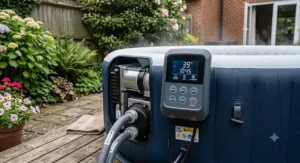
Where the Miami and Dellonda are “2-4 person” tubs that happen to suit couples well, the Avenli London is one of the few budget models actually marketed and sized for 2-3 people from the outset, with a roughly 685-litre capacity and 105 water jets. This matters because it’s rare to find genuine size-appropriate sizing at genuinely budget prices — most manufacturers only build compact, considered tubs at the premium end, as the SPARO demonstrates. The spa heats to a stated maximum of 104°F (40°C) using a conventional bubble-jet massage system, and its included cover is rated for basic heat retention rather than the reinforced, insulated covers found on pricier tubs. Here’s what most buyers overlook about entry-level compact tubs: because there’s simply less material and less water involved, the ongoing running cost is proportionally lower even before you factor in any efficiency tech, purely because you’re heating less. Aggregated review sentiment describes the build as adequate rather than premium, with buyers noting the liner is thinner than brand-name alternatives — a fair trade at this price point, provided you’re realistic about the compromise.
Pros:
- ✅ Genuinely sized for two to three, not stretched from a bigger tub
- ✅ Lower running costs than similarly priced 4-person tubs
- ✅ Among the cheapest ways into inflatable hot tub ownership
Cons:
- ❌ Liner and cover feel noticeably thinner than premium rivals
- ❌ Fewer accessories included versus established brands
Sitting around £220-£290, the Avenli London is the pick for anyone who wants a properly-sized couple’s tub without stretching the budget.
7. Canadian Spa Company Grand Rapids Inflatable — best premium features for the money
Canadian Spa Company is best known for hardshell spas, which shows in how the Grand Rapids Inflatable is specced: 110 jets across three selectable speeds, plus integrated LED lighting most inflatable tubs at this price point simply don’t offer. The three-speed system is a genuinely useful bit of engineering most rivals skip — rather than one fixed bubble intensity, you can dial down the jets for a gentler soak or ramp them up for a proper massage session, which matters more for two people sharing a tub than it might sound, since preferences rarely match exactly. Based on the spec comparison with the rest of this list, the inclusion of LED lighting as standard (rather than a paid extra) signals Canadian Spa Company applying some of its hardshell-spa design thinking to the inflatable category, where ambience is usually an afterthought. Reviewers consistently note the three-speed control as the standout feature that differentiates it from same-priced rivals, though a recurring theme in feedback is that documented water capacity figures are less consistently published than competitors, so filling times can be a bit of a guessing game on first use.
Pros:
- ✅ Three-speed jet control, rare at this price point
- ✅ Standard LED lighting most rivals charge extra for
- ✅ Hardshell-spa brand pedigree applied to an inflatable
Cons:
- ❌ Published water capacity specs are less transparent than rivals
- ❌ Fewer long-term UK reviews available than established brands
At around £320-£400, the Canadian Spa Company Grand Rapids Inflatable is worth a look if lighting and adjustable jet intensity matter more to you than raw brand recognition.
Practical Usage Guide: Setup, First 30 Days & Maintenance
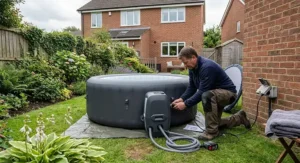
Getting a 2 person inflatable hot tub from box to bubbling takes most people 45 minutes to an hour, not the 20 minutes the marketing copy promises — budget the extra time and you won’t feel let down. Start by choosing a genuinely flat, firm surface; a patio slab or decking works, but grass alone tends to shift and dip under the weight of a filled tub, since even a compact model holding 600-800 litres weighs 600-800kg once full, roughly the mass of a small car. Lay the included groundsheet first regardless of what surface you’re on, since it protects the tub’s base from small stones and rough textures that cause slow punctures over months rather than dramatic failures on day one.
In the first 30 days, the most common mistake is over-chlorinating out of anxiety about water hygiene. Follow the manufacturer’s chemical starter kit dosing exactly rather than “topping up for good measure” — over-chlorinated water irritates skin and eyes far more than the mild under-dosing most beginners worry about. Run the filtration cycle daily even when the tub isn’t in use; skipping this on days you’re not soaking is the single biggest cause of cloudy water complaints in aggregated reviews across every brand. Check and rinse the filter cartridge weekly, and replace it every 4-6 weeks with moderate two-person use.
Longer term, drain and refill the water every 10-14 days for a couple using the tub 3-4 times weekly, or every 2-3 weeks for lighter use — waiting longer risks a build-up of body oils and cosmetics residue that no amount of chlorine fully resolves. Deflate and store the tub properly at season’s end (see the storage section below) rather than leaving it filled and covered over winter, even with Freeze Shield-style protection, since prolonged cold exposure shortens liner lifespan regardless of brand.
Real-World Scenarios: Who Actually Buys a 2 Person Inflatable Hot Tub
The city-flat couple with a decking area. If you’ve got a modest balcony or a decked yard rather than a sprawling lawn, footprint matters more than anything else on the spec sheet. The NetSpa SPARO‘s 165cm total diameter and the Avenli London‘s compact sizing both make sense here, since a 180-208cm “2-4 person” tub can genuinely eat a third of a small deck’s usable space.
The young couple planning to host occasionally. If friends or family visit and might want to dip a toe in now and then, the extra headroom in the Dellonda DL88 or Wave Spas Atlantic, both at 800L, earns its keep without tipping into full family-size territory. You get two-person comfort day-to-day with the option to squeeze in a third guest for an evening.
The budget-conscious first-timer. If this is a trial run to see whether hot tub ownership suits your lifestyle before committing to anything pricier, the Intex PureSpa Bubble Massage or Avenli London let you test the waters — literally — without a four-figure commitment. Both are widely stocked, so replacement parts and filters are easy to source if you decide to stick with it.
The couple who prioritise design and want it to look intentional. For a garden that’s already been styled with care, the NetSpa SPARO‘s leather-effect finish or the Canadian Spa Company Grand Rapids‘s LED lighting read as considered additions rather than budget compromises sitting awkwardly against your patio furniture.
Problem → Solution: Common Hot Tub for Two Headaches Solved
Problem: the water won’t heat past 30-something degrees on cold evenings. This is almost always a cover issue rather than a heater fault — an ill-fitting or non-insulated cover lets heat escape faster than the pump can replace it. Solutions include using the manufacturer’s insulated cover consistently, adding a foam floor mat underneath to stop heat bleeding into cold ground, and running the heater during the day when ambient temperature is higher rather than starting cold at 9pm.
Problem: cloudy or foamy water after a few uses. Body lotions, deodorant, and hair products are the usual culprits, not a broken filtration system. A quick shower before getting in — genuinely, even a 30-second rinse — dramatically cuts the organic load your filter and chemicals have to manage.
Problem: the tub feels less firm after a week. A small amount of pressure loss is normal as PVC settles and ambient temperature fluctuates; top up with the hand pump every few days rather than assuming a puncture. If firmness drops noticeably overnight, check seams and the valve area with soapy water for telltale bubbles.
Problem: two adults feel cramped despite the “2-4 person” rating. This usually comes down to inner diameter rather than the marketing capacity figure — check the inner size specification, not just the outer footprint, before assuming a tub is too small; sometimes swapping to a model with a genuinely larger inner diameter, like the Dellonda DL88‘s 135cm, solves it without needing to upsize to a full family tub.
Problem: high running costs during winter. Combine a thermal cover, a foam base mat, and a consistent set-point rather than letting the water cool between uses and reheating from scratch each time — reheating from cold consistently costs more in aggregate than gentle, continuous maintenance heating.
How to Choose a 2 Person Inflatable Hot Tub
- Check the inner diameter, not just the “person” rating. A tub rated 2-4 people can vary by 20-30cm in usable inner space between brands — this single figure tells you more about comfort than any marketing description.
- Match water capacity to your actual usage pattern. Smaller capacity (500-700L) means faster, cheaper heating for genuinely two-person use; larger capacity (750-1000L+) suits occasional third guests but costs more to run.
- Prioritise insulation features over jet count. AirJets, bubble jets, or AquaJets all deliver a broadly similar massage sensation; a well-insulated cover and efficient heater matter far more to your ongoing enjoyment and bills.
- Confirm your outdoor socket setup before buying. UK electrical safety guidance is clear that outdoor electrical equipment needs a suitably rated RCD-protected socket — check the HSE’s introduction to electrical safety if you’re at all unsure whether your existing setup is appropriate.
- Factor in deflated storage size, not just footprint when inflated. A compact 2-person tub that seems perfect in the garden can still be an awkward, bulky package to store through winter — see the dedicated section below.
- Read the warranty terms on shell versus electrical components separately. Most manufacturers split coverage, commonly offering longer cover on the liner than on the pump and heater unit.
- Weigh brand-name accessory availability against sticker price. Established brands like Intex and Lay-Z-Spa have widely stocked replacement filters and covers; smaller or newer brands may leave you waiting longer for spares.
Compact Inflatable Hot Tub: How Small Is Small Enough?
“Compact” gets thrown around loosely in inflatable hot tub marketing, so it’s worth defining properly. A genuinely compact inflatable hot tub for two typically has an inner diameter under 140cm and a total footprint under 175cm, holding somewhere between 450 and 700 litres. Anything larger is comfortable for two but is really a scaled-down family tub rather than a purpose-built couple’s model — the NetSpa SPARO, at 125cm inner diameter, sits firmly in true-compact territory, while the Lay-Z-Spa Miami and Avenli London occupy a sensible middle ground.
What most buyers overlook about genuinely compact tubs is the knock-on effect on running costs and setup time: less water means faster heating, lower electricity use per session, and a shorter time from unboxing to soaking. The trade-off is reduced flexibility — a true-compact tub struggles the moment you want to fit a third person in, even briefly. If you’re confident it’ll only ever be the two of you, a compact model is the more efficient long-term choice; if there’s any chance of occasional guests, the slightly larger “2-4 person” tubs like the Dellonda DL88 offer a sensible compromise between genuine compactness and social flexibility.
Best Inflatable Hot Tub for a Small Garden
Small gardens change the calculation considerably, because footprint often matters more than water capacity. Before buying, measure your available space and subtract at least 40-50cm of clearance on all sides — inflatable hot tubs need room for the external motor unit, cover storage when open, and safe entry and exit without stepping onto flowerbeds or garden furniture.
For a genuinely small garden or a decked area, the NetSpa SPARO‘s 165cm total footprint is the standout option on this list, followed closely by the Avenli London. Both leave meaningfully more usable space around them than the 180-208cm footprint of the larger models. If your small garden also happens to be overlooked or exposed to wind, consider a tub with a rattan or wood-effect exterior like the Dellonda DL88, since these tend to look more settled and “built-in” against fencing and planting than plain mosaic-print alternatives, softening the visual impact of a large round object in a compact space.
One frequently missed consideration: check your garden’s shade pattern before committing to a spot. A tub positioned in full sun all afternoon works harder to maintain temperature overnight due to daytime evaporation, while a partly shaded position — surprisingly — often heats more consistently, since it avoids the daily heat-then-cool cycle that stresses seals and pump components over a season.
Portability: Moving, Draining and Travelling With Your Tub
Despite the “inflatable” and “portable” branding, moving a filled hot tub anywhere is not realistically possible — even the smallest models on this list weigh several hundred kilograms once full, and manufacturers explicitly warn against attempting to shift a filled unit even a short distance. Portability, in practice, means three separate things: moving it empty between spots in your garden, draining and relocating it to a different part of the property, and transporting it deflated to a new home entirely.
Moving an empty, uninflated tub is straightforward — most weigh 15-35kg dry, light enough for one person to reposition, though the built-in pump unit on some models (particularly the Wave Spas Atlantic and Canadian Spa Company Grand Rapids) adds noticeable extra weight concentrated in one section. Relocating a tub within the same garden requires a full drain first; most models include a dedicated drain hose that connects to a standard garden hose for gravity drainage, typically taking 20-40 minutes depending on capacity.
For genuine portability — say, taking your hot tub on a trip or moving house — deflate fully, dry thoroughly to prevent mould developing in storage, and fold according to the manufacturer’s guidance rather than randomly bundling the liner, since sharp folds in the same spot repeatedly can eventually crack the PVC coating. Reviewers consistently note that tubs with a dedicated carry bag, which most models on this list include, make this genuinely manageable for two people to lift into a car boot.
Deflated Storage Size: What Actually Fits in Your Shed or Cupboard
This is the detail most buyers only discover after their first summer, once autumn arrives and the tub needs somewhere to live. Deflated and properly folded, most 2-person and 2-4 person inflatable hot tubs pack down to roughly the size of a large holdall or a folded double duvet — typically around 60-80cm long, 40-50cm wide, and 30-40cm deep, though this varies with material thickness and whether the pump unit is stored separately or built in.
Models with a separate external pump, like the Intex PureSpa and Dellonda DL88, tend to store the liner and motor as two distinct items, which is actually more convenient for tight storage spaces since you can tuck the pump into an awkward gap and the folded liner somewhere flatter. Integrated-heater tubs like the Wave Spas Atlantic store as a single, slightly bulkier unit, which some owners find easier to manage since nothing gets separated or lost between seasons, even if the overall package is a touch larger.
Practically speaking, a large under-stairs cupboard, a garden shed shelf, or loft space all work, provided the tub is completely dry before folding — packing away even slightly damp risks mildew developing over a stored winter, which is one of the more common and entirely avoidable reasons a tub needs replacing after only a season or two.
Common Mistakes When Buying a Hot Tub for Two
A recurring mistake is buying based on the “person” rating alone rather than checking inner diameter and depth — as covered above, this figure varies significantly between brands and doesn’t reliably predict comfort. Another is underestimating running costs at the point of purchase; based on current UK energy pricing, where the Ofgem price cap sits at 26.11p per kWh for the July-September 2026 period, a typical inflatable hot tub’s heater and pump combination can reasonably add £15-£40 a month to a bill depending on usage and insulation, a figure worth budgeting for before purchase rather than after the first bill arrives.
Buyers also frequently overlook groundsheet and cover quality when comparing sticker prices, assuming these accessories are broadly interchangeable across brands — they’re not, and a thin, non-insulated cover on an otherwise well-specified tub undermines its efficiency significantly. Another common error is ignoring warranty terms on the electrical components specifically; the shell liner is rarely what fails first, so a headline “2-year warranty” is less reassuring if it only covers 6-12 months on the pump and heater. Finally, some buyers skip checking their outdoor electrical setup entirely, assuming any garden socket will do — worth resolving before delivery day rather than discovering it isn’t suitable once the tub is already inflated and full.
✨ Don’t Miss These Exclusive Deals!
🔍 Take your search for the perfect hot tub for two to the next level with these carefully selected products. Click on any highlighted item to check current pricing and availability. These compact spas will help you create relaxing evenings your household will love!
Inflatable Hot Tub vs Hard-Shell Hot Tub for Two
The core trade-off between inflatable and hard-shell hot tubs comes down to upfront cost versus long-term durability and insulation efficiency. Every model on this list sits well under the entry price of even a basic hard-shell two-seater spa, which routinely starts several times higher once delivery and any base preparation are included. That price gap is the single biggest reason inflatable tubs dominate the couple’s market.
Where hard-shell spas pull ahead is insulation and structural rigidity — foam-insulated hard walls lose heat far more slowly than PVC, which translates into materially lower running costs over a full year of ownership, particularly through winter. Hard-shell units also don’t require draining and refilling as frequently, since their more robust filtration systems maintain water quality for longer stretches, and they don’t need deflating and storing seasonally at all.
For most couples, the honest answer is that an inflatable tub makes more sense as a first spa or for anyone renting, moving within a few years, or simply unsure how much use a hot tub will actually get. Reviewers consistently note that inflatable tubs from established brands like Lay-Z-Spa and Intex deliver genuinely comparable relaxation to entry-level hard-shell models, just with a shorter typical lifespan of roughly 3-7 years against a hard-shell spa’s 10-20 years. If you’re confident hot tub ownership is a long-term habit rather than a trial, a hard-shell model may work out cheaper across a decade; if you want to test the experience without the commitment, every tub on this list is the sensible starting point.
Long-Term Cost & Maintenance: Running a Hot Tub for Two
Total cost of ownership for an inflatable hot tub breaks down into three ongoing categories: electricity, chemicals, and eventual replacement parts. On electricity, based on the current Ofgem price cap period, a compact tub heating and maintaining temperature for regular two-to-three-times-weekly use typically consumes somewhere in the region of 10-16 kWh a day when actively heating from cold, dropping considerably once at temperature and simply maintaining. Using a thermal cover and, where available, a foam floor mat consistently cuts this by a meaningful margin, since most heat loss in an inflatable tub happens through the surface and the ground rather than the walls.
Chemical costs for a 2-person tub run modestly compared with a family-sized spa, simply because there’s less water to treat — a basic chlorine and pH-balancing kit lasting 2-3 months typically costs a fraction of what a larger tub requires, since dosing scales directly with volume. Filter cartridges need replacing roughly every 4-6 weeks with regular use, and buying established brands like Intex or Bestway pays off here specifically, since generic and own-brand filters are cheaper and more widely available than for smaller or newer manufacturers.
For a genuinely useful independent perspective on managing household energy costs more broadly, the Energy Saving Trust publishes ongoing guidance on the UK price cap and practical ways to reduce consumption, which applies directly to managing a hot tub’s running costs alongside the rest of the household bill. Replacement parts — pump units, liners, covers — typically become a consideration from year three or four onward on inflatable models, at which point comparing repair cost against the price of a newer, more efficient replacement model is often the more sensible route than an expensive like-for-like part swap.
Safety, Regulations & Water Hygiene Guide
Two separate safety considerations apply to inflatable hot tub ownership in the UK: electrical safety and water hygiene, and both deserve more attention than most buyers give them at the point of purchase.
On electrics, every model on this list runs from a standard UK socket, but that socket needs to be suitable for outdoor use and, critically, protected by a residual current device. UK guidance is unambiguous on this point for any outdoor electrical equipment, hot tubs included, and it’s worth reading the basics before delivery day rather than after. If you’re unsure whether your existing outdoor sockets meet this standard, a qualified electrician can fit an RCD-protected outdoor socket relatively inexpensively, and it’s not a step worth skipping for the sake of convenience.
On water hygiene, spa pools and hot tubs are specifically flagged by the HSE’s guidance on legionella in spa-pool systems as a recognised source of infectious disease risk, since warm water between 20-45°C creates conditions where bacteria can multiply if left unmanaged. While this guidance is primarily written for commercial operators, the underlying principle applies at home too: maintain correct chemical dosing consistently, run filtration daily even between uses, and don’t let water sit stagnant and untreated for extended periods, particularly during a UK summer when ambient temperatures sit within the risk range regardless of your set heating temperature. Following the manufacturer’s chemical starter kit instructions precisely, rather than improvising dosing, remains the single most effective domestic safeguard.
FAQ
❓ How many litres does a 2 person inflatable hot tub hold?
❓ Is a 2 person inflatable hot tub worth it for a small garden?
❓ How much does it cost to run an inflatable hot tub for two people?
❓ Can one person set up a 2 person inflatable hot tub alone?
❓ How small does an inflatable hot tub pack down for storage?
Conclusion
Choosing a 2 person inflatable hot tub genuinely comes down to being honest with yourself about three things: how much garden space you actually have, how often it’ll realistically be just the two of you versus the occasional guest, and how much you’re willing to spend monthly rather than just upfront. The Lay-Z-Spa Miami AirJet remains the safest all-round pick for most couples, balancing a compact-enough footprint with brand reliability and widely available spares. If your garden is genuinely tight, the NetSpa SPARO‘s smaller total diameter earns its higher price tag. Budget-first buyers get real value from the Intex PureSpa Bubble Massage or Avenli London, while anyone who wants occasional flexibility for a third guest should lean toward the Dellonda DL88 or Wave Spas Atlantic.
None of these tubs is the “wrong” choice in absolute terms — they’re each optimised for slightly different priorities, and the right one is simply whichever set of trade-offs matches how you’ll actually use it. Whichever you land on, the fundamentals matter more than any single spec: a proper RCD-protected outdoor socket, consistent filtration and chemical dosing, a decent cover to manage running costs, and a dry, complete deflation routine when the season winds down. Get those right, and even the most modest of these seven tubs will deliver genuinely relaxing evenings for a very long time.
Recommended for You
- Person Inflatable Hot Tub: 7 Best Picks Compared
- MSpa vs Lay-Z-Spa: 7 Best Inflatable Hot Tubs Compared (2026)
- Lay-Z-Spa vs Intex Hot Tub: 7 Models Ranked for 2026
Disclaimer: This article contains affiliate links. As an Amazon Associate, I earn from qualifying purchases. If you purchase products through these links, we may earn a small commission at no additional cost to you.
✨ Found this helpful? Share it with your friends! 💬🤗
