
In This Article
Here’s the awkward truth about the 1hp vs 1.5hp hot tub air blower decision: that extra half a horsepower rarely makes your soak better. More often it makes the blower louder, hotter-running and harder on your water temperature. Sometimes it’s exactly what a tub needs. Often it’s an expensive way to blow cold air at your shoulders.
So how do you tell which camp you’re in? Not by the number on the label. Sizing depends on jets, pipe runs, bends, water depth and the size of the air holes. Horsepower is only the headline. This guide unpacks all of it for UK tubs, which means 230V supplies, British garden weather and the very real way a 1.5hp blower can nibble at your heating.
If you’re new to the wider picture, Which? covers the basics in its hot tub buying guide. It notes, for example, that inflatable models pair an external heater with an air blower that inflates the walls and drives the jets. What it can’t tell you is which blower to buy. That’s the job here.
Below you’ll find a quick comparison, seven real blowers from budget to premium, and dedicated sections on heated vs unheated hot tub air blower options, air channel size, the cooling question and what suits a hot tub air blower for 4 person tub. Short version? Bigger isn’t automatically better. Read on and you’ll see why.
1hp vs 1.5hp Hot Tub Air Blower at a Glance
Before the deep dive, here’s the side-by-side. The figures come from sizing guidance in the trade press and from the spec sheets of the models covered later.
| Factor | 1hp blower | 1.5hp blower |
|---|---|---|
| Typical jet guideline | Around 4-6 jets | Around 6-8 jets |
| Air delivery | Gentler, finer bubbling; enough for most compact tubs | More volume and pressure for long pipe runs, deeper water, larger air channels |
| Electrical draw (230-240V) | Lower; check the rating plate | Roughly 3.3-4.2A on the models covered below |
| Noise and motor heat | Tends to run cooler and quieter | Moves more air faster, so more noise and more heat to shed |
| Effect on water temperature | Less cold air entering the water | More cold air, so faster cooling if left running |
| Best For | Compact tubs, short pipe runs: Air Supply Ultra 9000 1HP, Waterway 705-1150 | Larger tubs, long runs, big air channels: Air Supply Ultra 9000 1.5HP, Waterway Santanna-II |
Looking at the table, the dividing line is resistance rather than luxury. A Waterway 705-1150 (1.0hp) has plenty of muscle for a compact tub with short plumbing, whereas a Waterway Santanna-II (1.5hp) earns its keep when pipes are long or the water is deep. If your tub sits in the grey zone around six jets, pipe length and bends should settle it, not the price tag.
💬 Just one click — help others make better buying decisions too!😊
What Is the Difference Between a 1hp vs 1.5hp Hot Tub Air Blower?
A 1hp vs 1.5hp hot tub air blower comparison is really a question of airflow capacity. Both are electric fans that push ambient air through pipework into the tub’s air channel or jets to create bubbles. The 1.5hp unit moves more air against more resistance. The 1hp suits smaller, simpler plumbing.
Here’s the catch, though. Horsepower on blower labels is a nominal rating, not a precise measure of what reaches your bubbles. The LX Air APW700-2 is sold as a 1.5hp blower yet is rated at 700 watts, and the Spatex SX 800 also has a 700W motor. Davey’s SpaPOWER range lists its blowers in watts, from 750W to 1,380W, with no horsepower figure at all. So compare watts, amps and manufacturer airflow curves, not just “1” versus “1.5”.
Real owners run into this. One forum poster with a 1.5hp 220V blower complained that the bubbles were erupting above the water surface. They wondered whether a 1hp model from the same maker would help, noting that the published flow curve was lower but hard to translate into real life. That’s the honest answer to the whole debate: the difference is real, but you often can’t feel it until you try. Matching the blower to your tub’s resistance gets you most of the way there.
Top 7 Hot Tub Air Blowers: Expert Analysis
Seven real blowers follow, covering both horsepower classes, one heated model and a spread of budgets. Blowers are specialist parts, so I couldn’t verify live amazon.co.uk stock for every model while researching. If a listing isn’t there, look for the same specification (voltage, plug type, outlet size) from a UK spa-parts supplier. Prices below are loose indicative ranges converted from overseas listings, so check current price before buying.
1. Air Supply Ultra 9000 1HP — rubber-mounted motor for calmer running
The Ultra 9000 range is built around a rubber-mounted motor, the maker’s route to less noise and vibration. That matters on a 1hp unit, which you often choose precisely for a gentler, quieter soak.
The A3910220 version is a 1hp, 240V model supplied with an AMP plug. That’s the connector commonly used with Balboa and Gecko-style controllers, so check yours before ordering. In practice, 1hp is the sweet spot for tubs in the four-to-six-jet bracket, where it can feed an air channel with an even curtain of bubbles without fighting heavy resistance.
Based on the sizing guidance, this suits a compact four-seater with a short pipe run from the cabinet. It’s also sensible if you’d rather keep the water warm than win a bubble-intensity contest. It’s less suited to long runs or deep, jet-heavy tubs. I couldn’t verify a meaningful pool of independent reviews for this exact part number, so this verdict rests on the spec sheet and sizing logic rather than star ratings.
Pros:
- ✅ Rubber-mounted motor aimed at lower noise
- ✅ Sensible size for compact and mid-size tubs
- ✅ Same range steps up to 1.5hp if needed
Cons:
- ❌ Runs out of puff on long pipe runs
- ❌ AMP plug must match your controller
Price: check current price; expect it to sit below its 1.5hp sibling, likely under £200. Good value if your tub is small.
2. Air Supply Ultra 9000 1.5HP — the step-up for bigger plumbing
Same family, more muscle. The 3915231 version is rated 1.5hp at 230V and 4.2A, and ships with a 4ft AMP cord for compatible setups.
That 4.2A rating is the highest on this list, so the practical meaning is simple: this blower is built for resistance. Long runs, extra 90-degree bends and deeper water all put back-pressure on the fan, and a stronger blower copes better. The trade-off is more motor heat and more cold air entering the water.
On paper, this suits a six-to-eight-jet tub or one with the blower mounted well away from the shell. It is overkill for a compact patio tub. Prospective buyers should also remember that oversizing can overheat a blower rather than improve it, which makes the sizing homework non-negotiable. I couldn’t verify a robust set of independent reviews for this exact model, so treat it as spec-led.
Pros:
- ✅ Handles longer, more restrictive pipe runs
- ✅ Includes a 4ft AMP cord
- ✅ Matches UK 230V supplies
Cons:
- ❌ Overkill for compact tubs
- ❌ Pulls more cold air into the water
Price: around £150-£200 at the time of research. Fair for the output, provided your plumbing genuinely needs it.
3. Waterway 705-1150 — dependable 1hp for 230V tubs
Waterway is a name you’ll meet on the plumbing of many spas, and this 230V, 1.0hp motor blower is built as a replacement for compatible systems.
The key spec is the pairing of 1hp with 230V. That’s the correct electrical match for UK supplies, and it avoids the 115V variants that crop up in US-centred listings. What it means in real life is a mid-power blower comfortable on a typical four-to-six-jet tub with sensibly sized pipework.
My take: this is the “swap like for like” choice when an old 1hp unit dies and you don’t want to experiment. Confirm the outlet size and orientation, and check the plug or hardwiring against your controller. Independent review data for this part was thin when I looked, so there’s no star rating to lean on here.
Pros:
- ✅ 230V match for UK supplies
- ✅ Familiar brand for like-for-like swaps
- ✅ Right size for compact tubs
Cons:
- ❌ Outlet and plug details need checking
- ❌ Limited for deep, jet-heavy layouts
Price: around £120-£160 at the time of research. Solid value for a straightforward replacement.
4. Waterway Santanna-II — outdoor-rated 1.5hp with flexible mounting
The Santanna-II (750-3152-280) is described as a 1.5hp, 230V, 4A outdoor blower that can be bottom- or side-mounted.
Mounting flexibility is the headline spec, and it matters more than it sounds. Where a blower sits relative to the water line decides whether you need a check valve or a Hartford loop, and a blower mounted below water level is the classic recipe for water reaching the motor. A bottom-or-side option gives you more ways to keep things tidy and safe.
This is the model I’d shortlist for a larger tub with an awkward plumbing layout. The 4A rating tells you it expects real work to do. For a small tub, it’s more blower than you need. I couldn’t verify a reliable pool of independent reviews for this model, so the recommendation is spec-based.
Pros:
- ✅ Bottom or side mounting options
- ✅ Outdoor-rated 1.5hp at 230V
- ✅ Strong fit for long plumbing runs
Cons:
- ❌ Priciest 1.5hp option on this list
- ❌ Excess power for compact tubs
Price: roughly the mid-£200s to mid-£300s at the time of research. Premium money, justified only for demanding layouts.
5. Spatex SX 800 — heated blower for chilly gardens
Warm air is the whole pitch here. The Spatex SX 800 pairs a 700W motor with a 180W heater element and a dual-stage fan, and it’s rated for water depths up to 1,000mm.
The heater is limited to roughly 40°C air and performs best with the right amount of back-pressure in the plumbing. In practice, that softens the cold-air shock when bubbles start, which is why it’s the sensible pick for winter use. It uses a 40mm barrel union (48mm outside diameter), so check your pipework before you buy.
Two caveats from the manufacturer’s own notes. It’s designed to switch off after a maximum run time of 20 minutes, and it isn’t meant for constant running. A heated blower also doesn’t replace your tub heater, so manage expectations. The listing I found was from a retailer with a sale price shown, but I couldn’t verify independent reviews.
Pros:
- ✅ Heated air softens the cold-bubble effect
- ✅ Dual-stage fan for higher-pressure operation
- ✅ AMP plug version for Balboa/Gecko
Cons:
- ❌ Heat is limited to roughly 40°C air
- ❌ 20-minute maximum run time
Price: around £150-£200 at the time of research. Worth it if your tub lives outdoors all winter.

6. LX Air APW700-2 — lean 1.5hp rating with modest current draw
The LX Air APW700-2 is the second version of a 1.5hp blower used in brands such as Strong Spas and Clearwater Spas, according to its listing. It’s rated 700W, 230V and 3.3A.
Those numbers tell an interesting story. Alongside the 4.0-4.2A of the other 1.5hp units here, 3.3A suggests a leaner draw. That’s good news for an overworked circuit and for running costs, though it also means you shouldn’t assume it’ll behave like a heavyweight 1.5hp in a punishing layout.
I’d point this at owners replacing an OEM unit in a compatible tub, where the stated brand-fit is the selling point. Independent reviews were not available when I checked, so use the listing’s compatibility claim as a starting point and confirm dimensions before buying.
Pros:
- ✅ Lower current draw than other 1.5hp units
- ✅ Listed as used by several spa brands
- ✅ 230V rating suits UK supplies
Cons:
- ❌ 700W is modest for a 1.5hp label
- ❌ Fit needs confirming against your tub
Price: around £110-£135 at the time of research. Strong value if it’s a direct fit.
7. Easy-Air High-Output 1.5HP — budget turbo design with real user feedback
At the budget end, the Easy-Air High-Output 1.5HP (BX1008, 240V) is marketed on a turbo design for more air output and low noise.
The standout practical detail is the maker’s advice to fit a new check valve to avoid water backing up and damaging the motor. That’s sound, because backflow is a classic blower killer. For a budget model, this honesty is a plus.
This is the one on the list with some visible review data. On the listing I found, 17 of 19 reviews appeared to sit in the top rating bracket, and the other two a notch lower. That’s a small sample from one retailer, so read it as encouraging, not conclusive. I’d pick this for a budget replacement on a mid-size tub where you accept a brand with a smaller footprint than the big names.
Pros:
- ✅ Lowest price on this list
- ✅ Turbo design aimed at higher output
- ✅ Positive early review signals
Cons:
- ❌ Small review sample to go on
- ❌ Stock can be limited
Price: around £70-£100 at the time of research. Excellent value if it fits.
Top 7 at a Glance
| Product | Power | Electrical | Heated? | Price range | Best For |
|---|---|---|---|---|---|
| Air Supply Ultra 9000 1HP | 1hp | 240V | No | Under £200 | Compact tubs |
| Air Supply Ultra 9000 1.5HP | 1.5hp | 230V, 4.2A | No | £150-£200 | Long runs |
| Waterway 705-1150 | 1.0hp | 230V | No | £120-£160 | Like-for-like 1hp swaps |
| Waterway Santanna-II | 1.5hp | 230V, 4A | No | £260-£340 | Awkward layouts |
| Spatex SX 800 | 700W motor, 180W heater | AMP plug | Yes | £150-£200 | Cold gardens |
| LX Air APW700-2 | 1.5hp, 700W | 230V, 3.3A | No | £110-£135 | OEM replacement |
| Easy-Air High-Output 1.5HP | 1.5hp | 240V | No | £70-£100 | Budget buyers |
Looking at the table, the Air Supply Ultra 9000 1HP and Waterway 705-1150 are the smart choices when plumbing is short and simple, while the Air Supply Ultra 9000 1.5HP and Waterway Santanna-II suit tubs that really do put air under pressure. The Spatex SX 800 is the outlier, and its heater justifies itself only if winter comfort matters. Budget buyers should note that the Easy-Air High-Output 1.5HP and LX Air APW700-2 undercut the premium names but ask more of you on fit-checking.
✨ Don’t Miss These Exclusive Deals!
🔍 Take your soak to the next level with these carefully selected blowers. Click on any highlighted product to check current pricing and availability. The right match will give you the bubbly, relaxing evenings your whole household will love!
How to Choose a 1hp vs 1.5hp Hot Tub Air Blower
Picking between a 1hp and 1.5hp unit is less mystical than the labels suggest. Work through these steps in order.
- Count your jets and air holes. Trade guidance puts four to six jets in 1hp territory, six to eight in 1.5hp territory, and eight or more at 2hp. Treat that as a starting point rather than a rule.
- Measure the pipe run. The longer the run, the more power the blower needs. A blower mounted well away from the tub works harder than one next to it.
- Count the 90-degree bends. Every elbow adds resistance. Three bends can matter as much as an extra metre of pipe.
- Consider water depth. Water pressure pushes back against the air, so deeper tubs need a stronger blower.
- Match voltage and plug. UK tubs need 230-240V. Check the plug against your controller, too.
- Decide on heated or unheated. If you soak in winter, the warm-air option is worth weighing.
- Plan for run time. Most residential blowers suit short sessions of roughly 15-20 minutes. Don’t buy one for hours of continuous use.
The most useful source I found on all of this is Pool & Spa News’ blower basics. It stresses that proper sizing of the blower to the air piping system is the most critical factor, and that most blower problems trace back to getting it wrong. It also warns that an oversized blower can overheat and fail. That’s why the old “bigger is safer” instinct is wrong.
Air Channel Size: Why Pipe and Hole Dimensions Matter More Than Horsepower
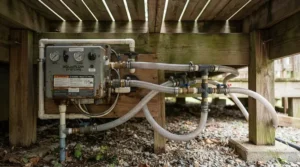
Air channel size is the unglamorous factor that decides whether your blower is happy. The air channel is the ring or run of small holes that releases bubbles, and its dimensions (hole count, hole size and pipe diameter) set how hard the blower has to push.
Too few or too small air holes starve the blower, making it work harder and hotter. Overheating is a leading cause of blower failure, and a telltale sign is weak bubbling. The usual cause is back-pressure from undersized plumbing, which trade guidance says can often be fixed with 1½-inch plumbing. Long runs can need 2-inch pipe or larger. In metric terms, that is roughly 40mm and 50mm.
Check valves matter too. Blower check valves typically have light springs, and a standard check valve with a stiff spring can be too hard for a blower to open properly. There’s also a simple diagnostic: compare the blower’s amp draw in normal operation against its free-flow reading with the air pipe disconnected. For most blowers, a gap of more than 1½ amps points to an undersized blower or restricted pipework. If you suspect that, ask the manufacturer before you buy a bigger unit. A larger blower on restrictive pipework is often the wrong fix.
Hot Tub Air Blower for 4 Person Tub: What Size Works?
A hot tub air blower for 4 person tub almost always lands in the 1hp zone, and here’s why. Four-seat tubs tend to have fewer jets and shorter plumbing runs, which keeps resistance low. Under the jet-count guideline, a typical four-to-six-jet layout falls squarely in 1hp territory.
That said, jets aren’t the only variable. A deep four-person tub, a cabinet with the blower mounted far from the shell, or a generous air channel ring could push you toward 1.5hp. Based on the spec comparison, the Air Supply Ultra 9000 1HP or Waterway 705-1150 is the sensible default. If your layout is more demanding, the Air Supply Ultra 9000 1.5HP gives headroom without drifting into overkill.
Inflatable four-seaters are a different story entirely. Models such as the Lay-Z-Spa New York 4 Person AirJet, a 196cm-wide tub with a pump unit that adds to its footprint, come with bubble pumps built in, so there’s no 1hp-versus-1.5hp choice to make. If your four-person tub is inflatable, skip ahead to the blower versus air pump section.
Heated vs Unheated Hot Tub Air Blower: Is the Warm Air Worth It?
A heated vs unheated hot tub air blower decision comes down to comfort and climate. Unheated blowers move ambient air into the water, while heated ones warm that air first to reduce the cold-air sensation. Neither replaces the tub’s main heater, and a heated blower isn’t designed to heat the water by itself.
The Spatex SX 800 is the practical example here. Its 180W heater element is limited to air of roughly 40°C, and it works best with proper back-pressure in the plumbing. That’s helpful but modest. Cold installation spaces can still leave the air feeling cool, so the benefit shrinks if your blower sits in an unheated outdoor cabinet.
Heated models are also a niche. Davey’s SpaQuip heated 1,240W blower, for instance, is listed as obsolete with an unheated replacement suggested, which tells you heated blowers aren’t the default. If you’re swapping a heated blower in an existing tub, don’t downgrade to an unheated one unless the manufacturer allows it. My view: choose heated if you soak mainly between October and April in an exposed garden, and unheated if you use bubbles in short bursts.
Water Temperature Loss From Air: How Much Heat Do Bubbles Really Strip?
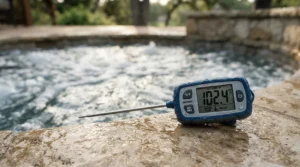
Water temperature loss from air is real, and it can be quick. Air entering a tub is usually much cooler than the water, so every minute of bubbles pulls heat out. The effect grows with colder weather, more airflow and longer sessions.
Some numbers make this concrete. One owner of a bubble-only inflatable tub on a pool forum reported losing about 4°F (roughly 2°C) in 20 minutes with the ambient air around 50°F (10°C). That’s one anecdote, not a lab result, but it’s consistent with the advice you’ll see from tub makers and retailers. UK inflatable manufacturers generally advise against use below about 10°C because the heater can’t keep pace with the cooling.
The cost angle is mixed. The electricity the blower itself uses is small: a 700W blower draws 0.7kWh per hour, so a 20-minute session is about 0.23kWh, which at an illustrative 25p per kWh is only a few pence. The expensive part is the heater working to recover lost temperature afterwards. That’s why a 1.5hp blower running for long periods in winter costs more than its label suggests. In practice, the lesson is to run bubbles in short bursts, keep the cover on between sessions, and don’t buy more blower than you need.
Do Blowers Cool the Tub?
Short answer: yes, they do, and in two different ways. First, they cool the water by adding cooler air. Second, they cool you, which is a separate effect worth understanding.
Trade technicians quoted in Aqua Magazine’s blower feature explain that the cooler air is noticeable on the skin, partly because evaporation from wet skin has its own cooling effect. Interestingly, the same piece notes that routing air through a twisting path can warm it slightly, narrowing the gap between air and water temperatures. That’s the engineering idea behind heated blowers, too.
So does a bigger blower cool you more? Generally yes. More air means more bubbles, more cold contact and more evaporation. If you feel chilly with a 1.5hp unit, a 1hp blower or a heated model such as the Spatex SX 800 may feel noticeably kinder. Also consider moving the blower to a sheltered spot, since air drawn from a cold, windy location arrives colder. The cooling is a trade-off, and for many owners the sensation is the whole point of the bubbles.
Hot Tub Air Blower vs Air Pump: Not the Same Thing
A hot tub air blower vs air pump question usually comes from terminology. Retailers sometimes call a blower an air pump or a bubbler, so the words overlap. But a water pump is something quite different, and mixing them up leads to costly mistakes.
A blower creates airflow and a water pump creates water flow. A blower cannot replace a pump, and a pump cannot replace a blower. Some hydrotherapy jets draw air in through an air-control line using the moving water, so they don’t need a separate electric blower at all.
For inflatables, the air pump or blower is built into the system. Lay-Z-Spa’s AirJet models provide bubbles rather than water-jet massage, and the wider range also includes HydroJet Pro models for stronger water-driven jets. Running costs for inflatable bubble functions have been quoted at roughly £0.34-£0.35 per hour by UK suppliers, which fits with the modest wattage involved. One marketplace listing for a replacement air blower motor for a Lay-Z-Spa AirJet pump showed a price around £30 at the time of research.
| Option | How it works | Control | Best For |
|---|---|---|---|
| Dedicated blower | Electric fan feeds an air channel or boosts jets | Separate button | Larger hard-shell tubs: Air Supply Ultra 9000 1.5HP, Waterway Santanna-II |
| Venturi air-induction | Moving water draws air through jets | Air-control knobs | Small amounts of air and lower running cost |
| Built-in air pump (inflatables) | Integrated pump blows ambient air through bubble ring | App or panel | Inflatable tubs, where blower choice is fixed |
The comparison shows why a dedicated blower wins on power. Moving air with a motor-driven blower gives you far more bubble volume than venturi jets can manage. It also costs more to run in cold weather. For a hard-shell tub where you want a proper bubble bath effect, the Waterway 705-1150 or Air Supply Ultra 9000 1HP is the cleaner solution.
Practical Guide: Setting Up and Maintaining Your New Blower
Buying the right blower is half the job. Installing and looking after it decides how long it lasts.
Before you fit it. Confirm voltage, plug type and outlet size. Then have a qualified electrician handle any wiring, because this is mains electricity next to water.
First-use checklist:
- Fit a proper check valve above the waterline, or create a Hartford loop, to stop water running back into the blower.
- Confirm the check valve will open easily with light air pressure.
- Run the blower for short bursts and watch for even bubbling.
- Listen for rattles, which often signal poor mounting.
Maintenance schedule. Keep the air intake clear and dry. Check air lines for pinches. If bubbling weakens, don’t assume the motor has failed: air leaks, clogged injectors or water in the lines can cause the same symptom.
Common mistakes in the first 30 days:
- Running the blower for long sessions. Most residential blowers aren’t built for it, and the Spatex SX 800 switches off after 20 minutes by design.
- Buying a 1.5hp blower “just in case” and then overheating it on short plumbing.
- Mismatching voltage. A 120V unit on a 240V supply can fail dangerously.
Real-World Scenarios: Which Blower for Which Tub?
These are illustrative scenarios built from the specs and sizing guidance, not real customer stories.
Scenario 1: the compact patio four-seater. A small tub on a short pipe run with a modest budget. The Air Supply Ultra 9000 1HP or Waterway 705-1150 suits this best. You’ll get a gentle bubble layer, lower noise and less heat loss. Frequency of use: a few evenings a week.
Scenario 2: the family six-seater with long plumbing. A bigger tub, eight jets and a blower tucked away in a far corner of the cabinet. This is Waterway Santanna-II or Air Supply Ultra 9000 1.5HP territory. The extra pressure overcomes bends and distance. A budget-conscious owner here could look at the Easy-Air High-Output 1.5HP or LX Air APW700-2, after confirming fit.
Scenario 3: the all-year garden soaker. Someone who uses the tub through winter in an exposed spot. A Spatex SX 800 keeps the air warmer, and short bubble sessions keep water temperature stable. Pair it with a good thermal cover.
In every scenario, the rule is the same: match the blower to the resistance, not the ego.
Long-Term Cost and Maintenance: What the Blower Really Costs You
The blower itself is cheap to run, but the heat it removes isn’t free. Working it through shows where your money goes.
On electricity, a 700W unit such as the LX Air APW700-2 or Spatex SX 800 uses about 0.7kWh per hour, which is pennies per session. The bigger expense is reheating the water. Hydropool’s guide to running a hot tub economically advises limiting air use in cold weather because the cold air you draw in makes the heater work harder. That’s the real total cost of ownership: a stronger blower costs more to buy and more to compensate for.
Maintenance matters, too. Motor brushes wear, and heavy or continuous use isn’t covered by warranty on the Spatex SX 800. Blowers are also built for short sessions, so a 1hp unit that rarely overheats will often outlast a stressed 1.5hp unit. On cost-per-use, the Easy-Air High-Output 1.5HP is cheapest up front, but a higher-priced Waterway Santanna-II may pay back through easier mounting and fewer water-ingress headaches.

FAQ: Hot Tub Air Blower Questions
❓ How much does a 1.5hp hot tub air blower cost in the UK?
❓ Will a 1.5hp hot tub air blower be noisier than a 1hp?
❓ Can I use a 110V or 120V blower in a UK hot tub?
❓ Do I need an electrician to fit a replacement hot tub air blower?
❓ Is a heated blower worth paying extra for?
Conclusion
So, 1hp vs 1.5hp hot tub air blower: which wins? Neither, until you’ve measured your tub. A 1hp unit suits compact tubs with short, simple plumbing, and it’s gentler on water temperature and noise. A 1.5hp unit earns its place when pipes are long, water is deep or the air channel is generous. Beyond that, extra power just means extra cold air and extra motor heat.
If I had to boil the whole guide down, it would be four rules. Size to resistance, not to horsepower. Check voltage and plug before anything else. Keep bubble sessions short, especially in winter. And treat heated blowers like the Spatex SX 800 as a comfort upgrade, not a heating system.
For compact tubs, the Air Supply Ultra 9000 1HP and Waterway 705-1150 are the safe, sensible starting points. For demanding layouts, the Air Supply Ultra 9000 1.5HP and Waterway Santanna-II have the headroom. On a budget, the Easy-Air High-Output 1.5HP and LX Air APW700-2 are worth a look once you’ve confirmed fit.
✨ Ready to upgrade your bubbles?
🛁 Check current prices and availability on the blowers above, confirm your voltage and plug, and give your tub the airflow it deserves. Your next soak is about to get a lot more satisfying!
Recommended for You
- Quiet Hot Tub Air Blower: 7 Best Picks For UK Gardens (2026)
- Hot Tub Air Blower: 7 Best Replacements For UK Spas (2026)
- 1.5hp Vs 2hp Hot Tub Jet Pump: 7 Ultimate Picks (2026)
Disclaimer: This article contains affiliate links. As an Amazon Associate, I earn from qualifying purchases. If you purchase products through these links, we may earn a small commission at no additional cost to you.
✨ Found this helpful? Share it with your friends! 💬🤗
