
In This Article
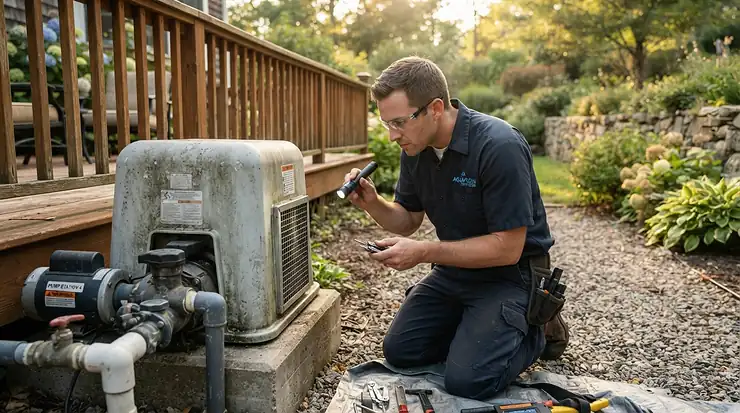
A hot tub air blower is a small electric fan unit that pushes air through dedicated pipework into the water, creating the fizzy, champagne-style bubbles you feel around your legs and back. It is separate from the pumps that drive the main jets. That is why a spa can run happily and still feel strangely lifeless.
Nobody thinks about a hot tub air blower until the bubbles stop. The jets still pump, the water still heats, and yet the whole experience feels like a fizzy drink left open overnight. Fixing it is rarely dramatic. It does demand precision, though. A blower with the wrong wattage, voltage or outlet size for your cabinet is an expensive paperweight.
This guide is written for UK owners, so everything assumes 230V, 50Hz mains. It compares seven real units, from budget to premium, then goes where listings rarely bother to go: blower hose and fittings, air line check valves, and how long air blowers last. Manufacturers publish their ranges openly. Balboa Water Group’s Genesis blower range runs from 500W to 1,200W in 230-240V/50Hz versions, which shows how power tiers are normally structured.
A word on method. I haven’t handled these units, and I won’t pretend otherwise. What follows is analysis built from published specifications, UK retailer listings and installer guidance gathered at the time of research. Prices are ranges, they move, and you should check the current price before buying.
Quick Comparison: Hot Tub Air Blower Options at a Glance
| Product | Power | Heated? | Best For |
|---|---|---|---|
| LX AP400 V2 | 400W | No | Small, low-jet-count spas |
| LX AP700 V2 | 700W | No | Medium to large spas on a budget |
| LX AP900 V2 | 900W | No | Larger LX-fitted spas wanting more air |
| LX APR800 V2 | 700W motor + 180W heater | Yes | Winter soaking and deeper tubs |
| CG Air SLE 900W | 900W | No | Like-for-like swaps on SLE-90 spas |
| CG Air SLO 900W (Heated) | 900W motor + 300W heater | Yes | Warm bubbles with a built-in silencer |
| Balboa Genesis G90-2AN-S | 900W | No | Pneumatic (air button) setups wanting documented specs |
Looking at the comparison above, the LX AP700 V2 is the value anchor for most medium and large spas, while the LX APR800 V2 is the cheapest route to heated air. The CG Air SLO 900W (Heated) and Balboa Genesis G90-2AN-S sit at the premium end and suit owners who want an OEM-style part with fuller documentation. Notice how the power ratings overlap. Matching your old blower’s label matters far more than picking the biggest number.
💬 Just one click — help others make better buying decisions too!😊
Top 7 Hot Tub Air Blower Picks: Expert Analysis
Every entry below turns the spec sheet into everyday meaning. I confirmed LX-family listings on Amazon UK at the time of research. For the other models, check whether amazon.co.uk lists your exact part number before assuming it does, because UK specialist stockists carry several of them.
1. LX AP400 V2 — gentle bubbles for smaller spas
Not every tub needs a hurricane, and the LX AP400 V2 suits compact spas where a bigger motor would simply overwhelm the plumbing.
It is rated at 400W, 240V and 2.5A, with a 1 inch socket connection. The Amazon UK listing names Danz Spas and other Chinese spas as typical homes. A UK stockist’s data table puts its airflow at about 1.7 m³ a minute, roughly three-quarters of what the 700W model manages. In practice that means a softer, lower-volume fizz. The modest 2.5A draw also keeps the load on your spa pack gentle.
Here is the honest analytical take. This is a like-for-like part for owners whose old label already says 400W. If your tired blower was rated higher, downsizing will leave you with sulking bubbles. Upsizing is no cure either, since installers advise matching the original specification rather than chasing horsepower.
On reviews, the Amazon UK listing carried a single 4.0-out-of-5 rating when I looked. That is far too thin to call a trend, so treat it as unproven rather than endorsed.
Pros:
- ✅ Low 2.5A draw is kind to spa packs
- ✅ Compact body suits tight equipment cabinets
- ✅ Widely used as a replacement on Chinese spas
Cons:
- ❌ Noticeably less airflow than the larger LX models
- ❌ Review evidence on Amazon UK is very thin
Expect roughly £90-£110 across the sources I checked, with specialists a little below Amazon. Prices may vary, so check the current price. It is fair value only if the smaller output genuinely matches your spa.
2. LX AP700 V2 — the sensible all-rounder
At 700W, the LX AP700 V2 hits the sweet spot that medium and large spas tend to need. It is the model most replacement shoppers end up with.
The published figures are 700W, 3.3A, 230V, about 2.2 m³ a minute of airflow and a maximum pressure of 0.02 MPa. A distributor data table lists noise at 73 dB(A). The “V2” denotes a double-impeller design. The supplier-side claim is that this softens the high-frequency whine even though the headline decibel figure barely changes. Treat that as a manufacturer-side claim, but it is plausible, because two smaller impellers generally produce a lower-pitched hum.
Connection details vary by seller. One UK retailer supplies a three-core cable with ring terminals in UK colours for direct connection to a spa control board. Another version comes with an AMP plug. Check which one your spa pack expects before you order.
The analytical take is simple. If your old label says 700W, this is the least risky swap in the LX family, and spares are easy to find. I could not retrieve a verifiable review summary for it on Amazon UK, so I won’t invent one.
Pros:
- ✅ Strong airflow for medium and large spas
- ✅ Double impeller gives a softer-sounding hum
- ✅ Usually supplied with a 32mm union
Cons:
- ❌ Cable and connector type varies by seller
- ❌ Not designed for continuous running
Roughly £80-£140 depending on seller, with the Amazon UK listing starting around the £120 mark. Good value when you shop around.
3. LX AP900 V2 — most air in the LX family
The LX AP900 V2 is for tubs that genuinely want more air, but the numbers show diminishing returns.
It is a 900W, 4.5A, non-heated unit with an angled mounting bracket, so it can sit upright or on its side. A UK retailer lists a 1.5 m cord with an AMP plug, a 32mm union and variable-speed compatibility. Its data table shows about 2.4 m³ a minute at 0.022 MPa, with noise around 76 dB(A).
Here is the arithmetic that matters. Compared with the LX AP700 V2, you draw roughly 36% more current for about 9% more airflow and 10% more pressure. That is a poor trade unless your plumbing is long, your jet count is high, or your old blower really was 900W. Check your spa pack’s blower output rating before fitting it.
One practical tip from a UK retailer is worth keeping. A non-heated blower positioned carefully in the cabinet can draw in warm air from the pumps and heater, which takes the chill off the bubbles for free.
I couldn’t verify a meaningful review pool on Amazon UK, so this verdict rests on specs and installer logic.
Pros:
- ✅ Highest airflow in the LX family
- ✅ Angled bracket allows flexible mounting
- ✅ Variable-speed compatible per a UK retailer
Cons:
- ❌ 4.5A draw for modest gains over 700W
- ❌ Loudest LX model on published figures
Around £80-£130, with the Amazon UK listing sitting near the top of that band. Worth it only if the original was 900W.
4. LX APR800 V2 — heated air with a dual-stage fan
The LX APR800 V2 is the budget route to warm bubbles, and it carries a two-stage fan for deeper tubs.
It is rated 230V, 50Hz, 880W total at 4A, split into a 700W motor and a 180W heater element. The dual-stage fan builds pressure for water depths up to about 1,000mm. A 40mm (48mm outside diameter) barrel union is standard. A comparable Spatex unit caps heater output at roughly 40°C and expects the blower to switch off after a 20-minute maximum run, so the heated air takes the edge off rather than turning bubbles into a hot bath.
The analytical take is that heat matters most in winter, when ambient air in an unheated cabinet is bitter. Check that your controller’s blower timer respects that 20-minute ceiling.
One caution applies. The same “APR800” part number exists in variants, including air-switched versions and one sold for Davey controllers. Confirm the exact variant before ordering. I found no verifiable review data for this unit.
Pros:
- ✅ Warmer air for cold-weather soaks
- ✅ Dual-stage fan copes with deeper tubs
- ✅ Low price for a heated unit
Cons:
- ❌ Heater element adds another failure point
- ❌ Variants share the same part number
Under £100 at the UK specialist I found. Strong value for heated air, provided the variant matches.
5. CG Air SLE 900W — like-for-like for European-spec spas
If your existing blower reads SLE-90, the CG Air SLE 900W (SLE-90-230/50-AMP-CE-8) is the cleanest swap.
It is a 900W, 230V, 50Hz, single-phase unit with an AMP-style lead. A UK stockist says it is commonly fitted to Jacuzzi, Sundance, Hot Spring and other European-spec spas, with the caveat that you check the old part details first. The fitting advice is plain. Isolate the spa, disconnect the blower cable at the control box, undo the outlet, remove the fixings and reverse the process.
The analytical take is that you are paying for fit and provenance rather than raw power. A branded like-for-like unit removes plumbing surprises, and surprises are what turn a ten-minute job into a weekend. It costs roughly double the LX equivalents, so if your spa already uses LX parts there is little reason to pay it.
Reviews? The stockist’s review tab was empty at the time of research, so there is no sentiment to summarise honestly.
Pros:
- ✅ Direct like-for-like fit for SLE-90 units
- ✅ Built to UK-style 230V 50Hz supply
- ✅ AMP lead suits plug-in connections
Cons:
- ❌ Costs roughly double comparable LX units
- ❌ Outlet and connector still need matching
Roughly £180-£235 depending on retailer and date. Worth it when the old label matches exactly.
6. CG Air SLO 900W (Heated) — warm air with a published brush-life figure
Most listings tell you nothing about longevity, so the CG Air SLO 900W (Heated) stands out by actually quoting a number.
It combines a 900W motor with a 300W heater, 1,200W in total, behind a 1.5 inch smooth socket (about 48mm inside diameter). An integrated silencer limits noise in the equipment bay. The motor uses graphite carbon brushes, which the stockist says should last around 1,500 hours in domestic use. It also lists alternative part numbers, including SLO-3-90 and certain Sunrise Spas references, subject to matching plug and voltage.
The analytical take is that 1,500 hours sounds modest until you run the sums, which I do in the lifespan section below. The 1,200W combined load also demands a pack that can feed it, and the stockist advises an RCD-protected supply and room around the body for cooling.
It is a premium, heated, OEM-style replacement. Don’t swap a heated unit for a non-heated one unless your spa’s design permits it. I found no verifiable review data on the listing.
Pros:
- ✅ Heated airflow for cold equipment bays
- ✅ Published brush-life figure is rare
- ✅ Integrated silencer limits cabinet noise
Cons:
- ❌ Highest combined load of the seven
- ❌ Priciest unit in this round-up
Roughly £270-£325. A sound choice if your original is an SLO-3-90.
7. Balboa Genesis G90-2AN-S — documented 900W with air-button switching
The Balboa Genesis G90-2AN-S is the premium option for spas built around Balboa-style gear and pneumatic switching.
Balboa’s published range shows this as a 900W, 230-240V/50Hz, non-heated blower with pneumatic control. That means an air button on the spa rim switches it directly, which suits tubs without an electronic panel. Unions are sold separately, so budget for one. Balboa’s installation guidance calls for a double air loop with a check valve on the water side so the pipe passes twice above the water line. It also says the blower shouldn’t be fixed directly to the floor.
The analytical take is that you pay for documentation, a family of power tiers and manuals. A retailer claims Balboa fits roughly 70% of hot tub systems worldwide. That is a marketing figure, but the standard connectors do make matching easier.
I found no verifiable UK review pool for this exact variant, so the verdict rests on specs and installation guidance.
Pros:
- ✅ Manufacturer-documented specs and manuals
- ✅ Pneumatic switching suits air-button spas
- ✅ Wide family makes power matching easier
Cons:
- ❌ Unions are sold separately
- ❌ Costs far more than LX equivalents
In the mid-£200s on the one UK listing I found, so check the current price. Best for owners who value paperwork and a known brand.
Spec Comparison Table
| Product | Current Draw | Outlet / Connection | Price Range | Review Evidence | Best For |
|---|---|---|---|---|---|
| LX AP400 V2 | 2.5A | 1 inch socket | £90-£110 | One 4.0 rating on Amazon UK | Small spas |
| LX AP700 V2 | 3.3A | 32mm union (seller-dependent) | £80-£140 | Not verified | General replacement |
| LX AP900 V2 | 4.5A | 32mm union | £80-£130 | Not verified | Big LX-fitted tubs |
| LX APR800 V2 | 4A (880W total) | 40mm (48mm OD) union | Under £100 | Not verified | Winter use |
| CG Air SLE 900W | Not stated | Match existing outlet | £180-£235 | None on stockist page | SLE-90 swaps |
| CG Air SLO 900W (Heated) | Not stated (1,200W total) | 1.5 inch smooth socket | £270-£325 | None found | SLO-3-90 swaps |
| Balboa Genesis G90-2AN-S | Not stated | Union sold separately | Mid-£200s | Not verified | Pneumatic Balboa setups |
Read the table above as a map of risk. The LX AP700 V2 and LX AP900 V2 offer the lowest entry cost, but the connector and union depend on the seller. The CG Air SLE 900W, CG Air SLO 900W (Heated) and Balboa Genesis G90-2AN-S cost more in exchange for tighter documentation. Where review evidence is thin, which is most of this table, the spec match to your old label is your best protection.
How to Choose a Hot Tub Air Blower: 7 Steps
To choose a hot tub air blower, match your old unit’s label for wattage, voltage, heated or non-heated design, outlet size and connector before you compare price. Work through these steps in order:
- Read and photograph the old label. Wattage, amps, voltage and any part number are your starting point. Installers recommend photographing every label and connection before you remove anything.
- Match the wattage rather than upsizing. A bigger motor does not guarantee stronger bubbles and can overload the spa pack.
- Confirm 230V, 50Hz. UK supply is 230V at 50Hz, so avoid imported 115V units.
- Decide heated or non-heated. Don’t replace a heated model with a non-heated one unless your spa’s design allows it.
- Check outlet size and union. Common sizes include 32mm, 40mm and 1.5 inch. Some units, such as the Balboa Genesis G90-2AN-S, ship without a union.
- Match the connector. AMP plugs and bare ring terminals are not interchangeable without work.
- Check mounting and space. Dimensions, cooling clearance and the position of your check valve and air loop all matter.
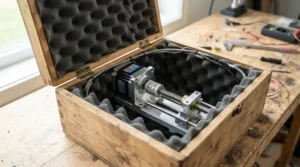
Hot Tub Air Blower 230v: Voltage, Plugs and UK Electrical Rules
Let’s settle voltage first, because it is the one mistake a screwdriver can’t undo. UK mains is 230V at 50Hz, and every unit in this guide is specified for it. LX data describes motors accepting 220-240V at 50 or 60Hz, while Balboa’s Genesis range is listed for 230-240V/50Hz. A hot tub air blower 230v unit is the only sensible kind here. Imported 115V or 120V blowers turn up in marketplace listings and should be avoided.
Then there is the supply feeding the spa. The IET’s Wiring Matters guidance on hot tubs explains that BS 7671 doesn’t specifically define hot tubs. Designers therefore apply engineering judgement and often borrow Section 702 ideas, such as zoning and 30 mA RCD protection.
In practice, the blower sits inside your cabinet, powered from the spa pack. The practical checks are whether the whole spa is on a 30 mA RCD (CG Air’s own listing asks for an RCD-protected supply), whether the plug type matches, and whether the cable is undamaged.
Swapping like-for-like on a plug-in connector is one thing. Altering fixed wiring is another, and it can be notifiable under Part P. If you see ring terminals feeding a circuit board, bring in a competent person.
Buy Hot Tub Air Blower Replacement: Match These Details First
If you plan to buy hot tub air blower replacement parts online, treat the part number as sacred. Photograph the label, note any markings on the plug, and compare every specification against the listing rather than relying on the horsepower figure alone.
Shop around, because channels differ. At the time of research, UK specialist prices for LX units sat noticeably below some marketplace listings. Don’t assume any single channel is cheapest, and don’t assume a link gives you a better price.
Check the warranty too. One UK stockist quotes a one-year warranty and a 30-day returns window on its own parts, and another listing included an extended one-year warranty on the LX AP900 V2. Marketplace listings are less predictable.
Watch the wording. Some listings are for “motor only” spares or for specific inflatable models. Those are different products from a complete hot tub air blower. Lead times also vary, so confirm stock before you drain the tub for a repair.
✨ Ready to Get the Bubbles Back?
🔍 Compare your old blower label against the specs above, then click any highlighted product name to check current pricing and availability. Match it carefully, and your spa will feel brand new again!
How to Replace a Hot Tub Air Blower: A Practical Step-by-Step Guide
This is a general outline for a like-for-like swap on a plug-in connector. Follow your manufacturer’s instructions, and use a qualified electrician for anything involving fixed wiring.
- Isolate the spa at the supply and confirm it is dead before opening the cabinet.
- Photograph everything: the label, the plug, the pipe route and the fixings.
- Disconnect the blower cable from the control box and release the outlet connection.
- Remove the old unit, then inspect the pipework for cracks and debris.
- Replace the check valve while you are in there. Cheap parts like this fail quietly and then flood your motor.
- Mount the new blower as high as the space allows, ideally with the outlet pointing downward. That adds a little extra protection against moisture entering.
- Mind the glue. One LX listing warns never to start the blower after gluing the union, because solvent fumes inside the housing can ignite. Let cement cure and vent fully first.
- Reconnect and test briefly with the spa full, listening for rattles and checking for leaks.
If anything looks scorched, wet or unfamiliar, stop and call a professional.
Real-World Scenarios: Matching a Hot Tub Air Blower to Your Spa
These are illustrative profiles, not reported customer cases.
The weekend two-seater. A small Danz-style spa used on Fridays and Saturdays, with a tight budget. If the old label says 400W, the LX AP400 V2 is the logical swap. Spending more on a bigger motor would only strain the pack, and the environment is mild enough that heating the air is a luxury.
The year-round northern garden. A larger spa with an exposed cabinet, soaked in all weathers. Warm air genuinely matters here. If the original blower was heated and in the 850-1,200W stated range, the LX APR800 V2 is the economical choice. If the label reads SLO-3-90, the CG Air SLO 900W (Heated) is the like-for-like match. Check your controller’s timer, since heated units are designed for short runs.
The European-spec premium spa. A Jacuzzi or Sundance-style tub where originality and clean fit matter. The CG Air SLE 900W suits an SLE-90 original. If the spa uses an air button and Balboa-style gear, the Balboa Genesis G90-2AN-S is the natural match. Both cost more, but a clean fit saves you hours of re-plumbing.
Problem → Solution: Hot Tub Air Blower Faults and Fixes
Many “dead blower” calls turn out to be air-system problems. Check the following before ordering a replacement.
- Runs but no bubbles. Suspect a disconnected outlet hose, a blocked line or water trapped in the air pipework. Reconnect, clear and test before blaming the motor.
- No sound at all. Check the supply, relay, fuse, wiring and control settings first.
- Weak bubbles in one area only. That points to a local blockage, leak or damaged injector. Weak bubbles everywhere suggest reduced blower output or restricted plumbing.
- Grinding or squealing. Worn bearings or motor parts are likely. Rattling often means loose mounting feet or vibrating pipes, so tighten the fixings before condemning the unit.
- Trips the RCD. Never keep resetting it. Moisture or a short circuit is likely, so isolate the spa and call an electrician.
- Water inside the housing. Replace the blower and correct the check valve, loop or mounting position, otherwise the new one will suffer the same fate. If you are fitting a CG Air SLE 900W or LX AP700 V2, fix the cause first.
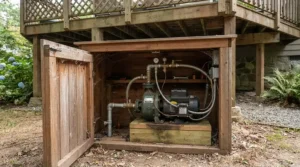
Blower Hose and Fittings: Sizes, Unions and What Not to Glue
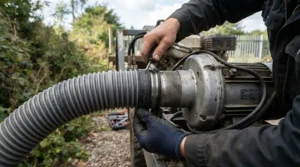
Blower hose and fittings cause more confusion than the motor itself, because sizes vary between families. The LX AP700 V2 and LX AP900 V2 typically arrive with a union for 32mm pipework. The LX APR800 V2 uses a 40mm (48mm outside diameter) barrel union. The CG Air SLO 900W (Heated) has a 1.5 inch smooth socket of roughly 48mm inside diameter. The Balboa Genesis G90-2AN-S doesn’t include a union at all.
Think of the system in two halves. Between the blower and the check valve is the dry side. Between the check valve and the spa is the wet side. Installers advise cementing the wet side to prevent water leaks. On the dry side, tiny air leaks matter less, and a set screw or clamp is a common way to connect the pipe to the valve. Some sockets, such as those on certain CG Air units, are designed for the pipe to slip in and be secured with a screw rather than glued.
Longer runs generally call for larger pipe. Waterway’s manual shows 2 inch PVC for typical installations 5 to 25 feet from the spa. Whatever you choose, keep flexible sections free of kinks, because pinched or cracked blower hose and fittings are classic causes of weak or leaking air.
Air Line Check Valves: Cheap Insurance for Your Blower
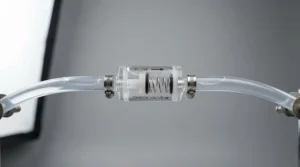
Air line check valves are small, humble and the difference between a ten-year blower and a flooded one. They let air flow towards the spa but stop water travelling back to the motor. Waterway Plastics’ installation manual states that a check valve and a Hartford loop must both be used when plumbing a blower to the jets.
The loop lifts the air line above the water level. The check valve adds a mechanical barrier. Balboa’s Genesis guidance goes further, recommending a double air loop with the valve on the water side.
Stiffness matters. A US supplier explains that a typical blower check valve uses a 1/4 lb spring, and that stronger 1 lb or 2 lb versions add too much resistance for most blowers, risking early motor failure. Fit the valve with the arrow pointing in the direction of airflow, and don’t glue it in place, because it will need replacing eventually.
If you own an inflatable tub, the spares are different. Marketplace non-return valve replacements for Lay-Z-Spa models sat around £15 at the time of research, and blower motors for specific inflatables were under £30. Always replace the check valve whenever you replace the blower.
How Long Do Air Blowers Last? Lifespan and Long-Term Cost
How long do air blowers last? Honestly, there is no universal figure, but the evidence gives a sensible planning range.
The most concrete number comes from the CG Air SLO 900W (Heated) listing, which quotes around 1,500 hours of brush life in domestic use. Here is my arithmetic. At a 20-minute blast every day, that is roughly 122 hours a year, or about 12 years of brush life. At three 20-minute sessions a week, it stretches far longer. Brushes are therefore rarely the limiting factor. Water ingress, heat, bearings and neglect usually are.
Broader figures are more cautious. A hot tub maker puts equipment and plumbing at roughly 5 to 10 years, and a US service directory says motors typically last 5 to 10 years. One manuals site gives the same range for a different Balboa blower. Treat 5 to 10 years as a planning figure, not a promise.
Spatex also warns that premature brush wear isn’t covered by warranty on its heated blowers, which are intended for short runs of 20 minutes at most.
Running cost is small. At an illustrative 30p per kWh (check your own tariff), a 900W blower running 20 minutes uses 0.3 kWh, roughly 9p per session. Over a year of daily use that is only about £33. The real money is in avoiding failures, so a good check valve and sensible run times are worth more than shaving £20 off the purchase price.
Hot Tub Air Blower vs Venturi Air Induction
Some spas don’t use a separate blower at all. Instead, water flowing through the jets pulls air in through an air-control valve. The two approaches create very different experiences.
| Feature | Dedicated Hot Tub Air Blower | Venturi Air Induction |
|---|---|---|
| Air source | Electric fan pushing air through its own pipework | Air drawn in by water flow at the jet |
| Bubble character | Fine, fizzy, independent of jet pressure | Mixed into jet streams |
| Extra electrical load | Yes, a separate motor | None |
| Parts that can fail | Motor, brushes, check valve, hose | Valves and jets |
| Best For | Gentle full-body bubbles, such as with the LX AP700 V2 | Simpler, quieter, lower-maintenance tubs |
The table shows that a dedicated blower buys you an independent bubble layer at the price of an extra motor, extra plumbing and an extra failure point. Venturi systems are simpler but can’t deliver that champagne effect on their own. Some owners also find that running a blower alongside the jets adds noise, so it comes down to taste. If you already have a blower and miss the bubbles, replacing it is cheaper than rebuilding the air system.
Common Mistakes When Buying a Hot Tub Air Blower
Most disappointments come from a handful of avoidable errors.
- Upsizing the wattage. Bigger doesn’t mean better. A LX AP900 V2 draws far more current than a LX AP700 V2 for only a modest airflow gain.
- Ignoring heated or non-heated design. Swapping a heated unit for a non-heated one without checking leaves you with colder bubbles and possibly a mismatched control setup.
- Overlooking outlet size and connector. A 32mm union will not magically fit a 1.5 inch socket, and a ring-terminal cable won’t plug into an AMP socket.
- Reusing a tired check valve. A cheap part can ruin an expensive blower, and a failed valve can damage a new unit if it isn’t corrected.
- Assuming one part number means one product. The LX APR800 V2 exists in variants that differ in switching and controller compatibility.
- Forgetting total load. NAPIT’s electrician guidance notes that hot tubs either use a standard 13A plug or need a 32A or 40A supply. A blower is one piece of a bigger electrical picture.
FAQ: Hot Tub Air Blower Questions
❓ How much does a hot tub air blower replacement cost in the UK?
❓ Can I fit a hot tub air blower myself?
❓ Is a heated hot tub air blower worth the extra money?
❓ Will an LX hot tub air blower fit my Balboa spa pack?
❓ Why is my hot tub air blower so loud?
Conclusion
The best hot tub air blower is the one that matches your old label. Everything else is detail. For most medium and large Chinese-built spas, the LX AP700 V2 is the least risky and most economical swap. If your tub is small, the LX AP400 V2 fits. If you want warm air on a budget, the LX APR800 V2 is the entry point, while the CG Air SLO 900W (Heated) suits owners whose original unit is an SLO-3-90. For European-spec spas and pneumatic setups, the CG Air SLE 900W and Balboa Genesis G90-2AN-S offer tighter documentation at higher prices.
Remember the supporting cast. Correct blower hose and fittings, fresh air line check valves and a properly protected 230V supply protect your investment far more than a few pounds saved on the motor. Plan for a lifespan of roughly 5 to 10 years, run heated units for short sessions only, and never skip the check valve.
Reviews were thin for nearly every model here, so I have leaned on specifications and installer guidance rather than invented sentiment. Verify the part number, check the current price and match every detail before you buy.
Recommended for You
- 1.5hp Vs 2hp Hot Tub Jet Pump: 7 Ultimate Picks (2026)
- Hot Tub Jet Pump For Strong Massage: 7 Best UK Picks (2026)
- Hot Tub Jet Pump: 7 Proven UK Replacements (2026)
Disclaimer: This article contains affiliate links. As an Amazon Associate, I earn from qualifying purchases. If you purchase products through these links, we may earn a small commission at no additional cost to you.
✨ Found this helpful? Share it with your friends! 💬🤗
