
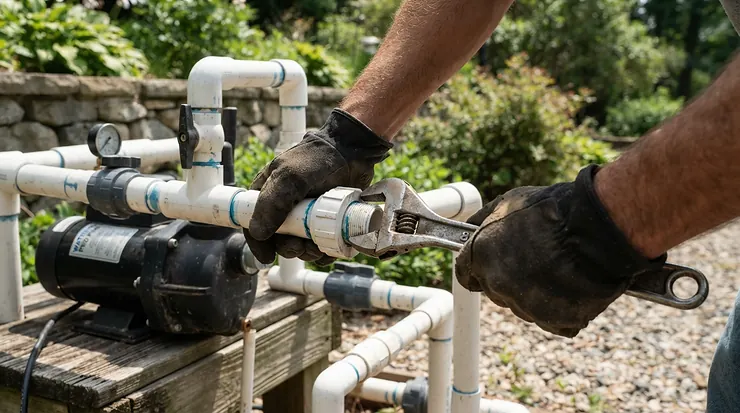
In This Article
A single speed hot tub circulation pump runs at one fixed speed whenever it is switched on, while a variable speed pump can slow down or speed up to suit the task. In the variable speed vs single speed hot tub circulation pump debate, the real question is simple: how many kilowatt-hours does each one burn per year?
It’s a fair question, because the circulation pump is the unglamorous heart of your tub. It never gets a shiny marketing campaign, yet it quietly pushes water through the heater and filter for hours, sometimes all day and night. Do that with a thirsty motor and you’ll feel it on your bill. Do it with a frugal one and you’ll barely notice.
Here’s the twist most guides skip. In a typical domestic tub, the 24-hour circulation pump is a small, low-wattage unit that is single speed by design. “Variable speed” mostly shows up in two other places: two-speed jet pumps, and pool-style pumps that adjust rpm in fine steps. So the smart question isn’t “variable or not?” It’s “which pump gives me the least waste for the job my tub actually asks of it?”
Electricity is the yardstick. The Ofgem price cap’s October to December 2026 electricity rate is 26.32p per kWh, with VAT on domestic electricity temporarily removed until 31 March 2027. Ofgem resets that cap every three months, so your tariff may differ.
One honest note on method. This is a specification-and-review analysis, not a lab test. Where I could verify real buyer feedback, I summarise it. Where I couldn’t, I say so.
Variable Speed vs Single Speed Hot Tub Circulation Pump at a Glance
| Single speed | Variable speed (including two-speed) | |
|---|---|---|
| Speed behaviour | One fixed speed whenever on | Steps down for easy jobs, up for heavy ones |
| Typical hot tub role | Small 24-hour circulation pump | Jet pump with a low-speed mode, or pool-style adjustable pump |
| Power profile | Low and steady (tens of watts, if electronically commutated) | Low speed far cheaper than high, but the motor is bigger |
| Upfront cost | Lower | Higher |
| Best for | Year-round filtering on a budget: Laing E10, Watkins SilentFlo E5, LX WTC50M | Heavily jetted tubs or big water volumes: Aqua-Flo Flo-Master XP2e, Speck BADU Eco Touch-Pro |
Read the table as a division of labour, not a duel. Single speed circulation pumps win where the job is gentle and constant. Variable and two-speed designs win where demand swings between “idle” and “full-power jets”. Most households need the first kind for filtering and already own the second kind for the jets.
💬 Just one click — help others make better buying decisions too!😊
Top 7 Variable Speed vs Single Speed Hot Tub Circulation Pump Options: Expert Analysis
These seven span budget, mid-range and premium, and the two jobs a tub’s pumps do. Availability on amazon.co.uk varies by variant and seller, so always confirm voltage, port size and fittings against your existing pump before you buy. Prices below are ranges and were checked at the time of research; check current price on the listing.
1. Laing E10 — the 24-hour benchmark for quiet efficiency
The Laing E10 does one job well: slow, steady, round-the-clock circulation on a miserly power budget.
Retailer listings put its draw at roughly 60-70W, depending on voltage and fitting. Maximum flow is around 14 US gallons a minute (about 53 litres), with a maximum head of 20 feet (around 6 metres). That’s modest, but 24-hour circulation is about gentle, constant turnover, not brute force. The electronically commutated motor is the efficiency trick, and it’s why a pump listed as single speed can still sip power. An open impeller resists clogging, and dry-run protection forgives the air-lock that often follows a refill.
Based on the spec comparison, this is the sensible like-for-like swap for tubs plumbed with 3/4-inch barbs. At 65W nonstop it uses about 570 kWh a year, roughly £150 at the October 2026 cap rate. What the spec sheet won’t tell you: it isn’t variable speed in the pool-pump sense, so don’t pay a premium on that assumption.
Verified feedback was thin. One buyer on a retailer’s 230V listing reported satisfactory flow but slightly more noise than the pump it replaced. Treat the marketing claim of whisper-quiet running with caution.
Pros:
- ✅ Low draw for true 24-hour running
- ✅ Dry-run protection and clog-resistant open impeller
- ✅ Light, compact, widely used as a replacement
Cons:
- ❌ Modest flow for large, high-flow heaters
- ❌ Limited verified review data
Expect roughly £150-£250 depending on variant. Good value if your plumbing matches; poor value if it doesn’t.
2. Watkins SilentFlo E5 — lowest draw on this list
The Watkins SilentFlo E5 is the frugality champion here, built to circulate constantly while using less power than a small light bulb.
It’s rated at 39W and works across 115V/230V and 50/60Hz. It was introduced in 2008 as an upgrade for older single-speed and two-speed circulation pumps on Hot Spring, Tiger River and Limelight tubs. At 39W nonstop, expect about 340 kWh a year, roughly £90 at today’s cap rate. That is the lowest figure in this guide.
The catch is specificity. Based on the fitment lists, this pump is tuned to particular tub designs, and the aftermarket versions copy its dimensions rather than its engineering. If your tub isn’t from that family, match the plumbing and flow needs carefully. Low watts only help if the water still passes through the heater properly.
The OEM listing shows six reviews, but I could only verify one owner’s comment, from someone who inherited an older Hot Spring tub. I can’t responsibly summarise a trend from that.
Pros:
- ✅ Rated at only 39W for continuous duty
- ✅ Multi-voltage and multi-frequency design
- ✅ Replaces older single-speed and two-speed circ pumps
Cons:
- ❌ Fitment is brand-specific
- ❌ Reviews difficult to verify
Prices vary between OEM and aftermarket versions, roughly £100-£200. Excellent value in a compatible tub.
3. Gecko Aqua-Flo Circ-Master HP — highest flow for heater-hungry tubs
The Gecko Aqua-Flo Circ-Master HP trades a little efficiency for serious flow, aimed at tubs whose heaters want water moving fast.
The 230V version lists 0.6A and a flow of about 40 US gallons a minute (roughly 150 litres), with 1.5-inch quick-release compression fittings. The seal is a carbon-graphite design built for continuous duty, and the warranty is two years. Gecko claims the high flow enables more efficient heating and more filtration. That’s plausible, since more turnover means more passes through the filter.
Analysis time. At 230V, 0.6A means up to roughly 138 VA of apparent power. Real watts depend on motor efficiency, so assume somewhere around 100-140W. Run nonstop, that’s roughly £230-£320 a year. Compared with the Laing E10, you’re buying flow, not thrift.
I found no verifiable buyer reviews for this exact variant, so I won’t invent a consensus. It suits tubs designed around a high-flow circulation system, not a casual swap.
Pros:
- ✅ Very high flow for a circulation pump
- ✅ Continuous-duty seal and sturdy 48-frame build
- ✅ Two-year warranty
Cons:
- ❌ Higher running cost than ECM-style pumps
- ❌ No verified review data found
Roughly £180-£280. Worth it only if your system truly needs the flow.
4. Grundfos 59896292 — easy priming with an air-bleed
The Grundfos 59896292 is the practical choice for anyone who has fought a stubborn air-lock.
It’s a 230V pump with 1-inch barbs, listed at 0.74A and 12-18 US gallons a minute (about 45-68 litres). That 0.74A implies up to roughly 170 VA, so expect a higher draw than the Watkins SilentFlo E5 or Laing E10. The listing I found doesn’t publish real watts, so verify before assuming it’s frugal.
Where it shines is service life and ease. Priming is the most common headache after a drain, and a pump with an air-bleed fitting can save an evening of swearing at a hosepipe.
A small eBay review pool gave it 4.6 out of 5 across eight ratings. Buyers described it as quieter than the original pump, an exact replacement and easy to prime, and one even preferred it to a Laing. Eight ratings is a small sample, so read that as encouraging, not conclusive.
Pros:
- ✅ Air-bleed fitting simplifies priming
- ✅ Buyers report quieter operation
- ✅ Fits 1-inch barbed plumbing directly
Cons:
- ❌ Real wattage not stated in the listing
- ❌ Small review sample
Roughly £110-£180. Solid value as a replacement where fitment matches.
5. LX WTC50M — budget swap for Chinese-built spas
The LX WTC50M is the budget route for tubs built with 1.5-inch plumbing, common on many Chinese-manufactured spas.
It’s a 0.35 HP, 230V pump with a 1.5-inch port and a quoted maximum flow of around 63 US gallons a minute. A 0.35 HP rating equals roughly 260W of motor power. That’s a rating, not a measured draw, but it’s several times a Watkins SilentFlo E5. Run 24 hours, it would cost around £600 a year, so this pump is best on programmed filter cycles. Four hours a day comes to roughly £100 a year.
My analysis: a cheap, flexible swap for a failed pump, not an efficiency upgrade. The sweet spot is a weekend-use tub on short filter cycles.
Seller summaries say reviewers praise quiet running and a straightforward swap, but durability reports are mixed. A US buyer also warned that mounting-hole spacing differed from the diagram, so measure first.
Pros:
- ✅ Low purchase price
- ✅ Fits 1.5-inch spa plumbing
- ✅ Reviewers highlight quiet running
Cons:
- ❌ Mixed durability reports
- ❌ Poor fit for 24-hour running costs
Generally budget-tier, often under £100. Value depends on short run times.
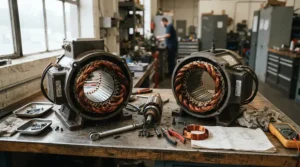
6. Aqua-Flo Flo-Master XP2e — two-speed jet muscle, low-speed circulation
The Aqua-Flo Flo-Master XP2e is a jet pump with a low-speed mode, the closest mainstream hot tub equivalent of variable speed.
Gecko pitches it as an energy-conscious pump that moves more water than the older XP2, so tubs can run more jets per pump. Retailer listings disagree on its horsepower label for some part numbers, so match the part number to your existing pump. For electrical context, a Waterway EX2 replacement listing shows 11.0A on high speed and 3.3A on low, at 3450 and 1725 rpm.
Pure physics says halving speed cuts power to about one-eighth. The listed amps show about 30%, so real-world gains are smaller. Still, low speed at around 0.76 kVA for four hours daily costs roughly £290 a year, while high-speed jets for 30 minutes a day add around £120.
I found no verified reviews for this model. It’s a jet pump first and not a replacement for a dedicated circulation pump.
Pros:
- ✅ Low-speed mode slashes demand versus high speed
- ✅ Greater flow supports more jets
- ✅ Two-year warranty
Cons:
- ❌ Not a 24-hour circulation pump
- ❌ Part-number and horsepower confusion
Roughly £400-£550. Worth it only when replacing a failed jet pump.
7. Speck BADU Eco Touch-Pro — true variable speed, 1000-2830 rpm
The Speck BADU Eco Touch-Pro shows what real variable speed looks like, even though it’s built for pools.
It has three presets of 2000, 2400 and 2830 rpm, and each can be reprogrammed from 1000 to 2830 rpm in 50 rpm steps. Night mode runs slow, filtering runs medium and backwashing runs fast. It’s designed for average-sized swimming pools, so a standard six-seater tub is overkill.
Where it makes sense: swim spas, large plunge pools and custom builds with heavy water volumes. The US Department of Energy-backed research and engineering guides on pool pumps suggest big savings from slowing a motor, and that logic transfers best to big, long-running installations.
I found no verified reviews, so I can’t summarise sentiment. Treat it as a reference point rather than a typical tub upgrade.
Pros:
- ✅ Genuinely adjustable speed in fine steps
- ✅ Programmable presets for different jobs
- ✅ Ideal for large water volumes
Cons:
- ❌ Oversized for standard tubs
- ❌ Premium pool-pump pricing
Pool-grade pumps typically start in the mid-hundreds. Value depends on volume and run hours.
Top 7 Comparison Table
| Pump | Speed type | Power spec | Flow | Price range | Best for |
|---|---|---|---|---|---|
| Laing E10 | Single (ECM) | ~60-70W | ~14 US gpm | £150-£250 | Efficient 24-hour circulation |
| Watkins SilentFlo E5 | Single (ECM) | 39W | Tub-specific | £100-£200 | Lowest running cost in compatible tubs |
| Gecko Aqua-Flo Circ-Master HP | Single | 0.6A at 230V | ~40 US gpm | £180-£280 | High-flow heating systems |
| Grundfos 59896292 | Single | 0.74A at 230V | 12-18 US gpm | £110-£180 | Easy priming and quiet swaps |
| LX WTC50M | Single | 0.35 HP | ~63 US gpm | Often under £100 | Budget filter-cycle use |
| Aqua-Flo Flo-Master XP2e | Two-speed | High and low amps | Jet-level flow | £400-£550 | Heavily jetted tubs |
| Speck BADU Eco Touch-Pro | Variable | Adjustable rpm | Pool-level | Mid-hundreds upward | Swim spas, big volumes |
The pattern is clear: the lowest-draw pumps are small single-speed units, while the two adjustable-speed options are built for much bigger flows. If your tub is a standard domestic model, the Watkins SilentFlo E5 and Laing E10 deliver most of the saving. The Aqua-Flo Flo-Master XP2e and Speck BADU Eco Touch-Pro earn their keep only when volume or jet count is high.
How to Choose a Variable Speed vs Single Speed Hot Tub Circulation Pump
- Identify your pump architecture. Some tubs have a dedicated circulation pump; others use the low speed of the main jet pump for filtering.
- Match voltage, frequency and fittings. Check 3/4-inch barb, 1-inch barb or 1.5-inch compression before ordering.
- Respect the heater’s flow needs. A heater that wants high flow won’t be happy with a trickle, however frugal the motor.
- Compare watts, not horsepower. Ask for amps or real watts. Horsepower tells you little about continuous running cost.
- Check control compatibility. Single-speed and two-speed pumps are wired differently, so don’t swap one for the other without confirming your control box supports it.
- Weigh warranty and parts. A two-year warranty and available seals matter more than a small price gap.
- Do the payback sum. Multiply the watts you’d save by 8,760 hours and by your tariff before paying a premium.

Hot Tub Circulation Pump vs Filter Pump: What Is the Difference?
The two terms overlap, and that causes endless confusion. A hot tub circulation pump is a small pump dedicated to moving water through the filter and heater, often continuously. A filter pump is usually not a separate device at all. In many tubs, it’s simply the low-speed mode of the main jet pump.
Balboa’s control documentation describes it neatly: the pump handling heating and filtration is the low-speed jet pump on systems without a circulation pump, or the dedicated circulation pump on systems with one. In practice, that means the pump you choose depends on how your tub is plumbed, not on a marketing label.
Mixing them up is a costly mistake. Parts specialists warn against swapping a dedicated circulation pump for a two-speed jet pump, or the other way round, because the wiring and control logic differ.
Inflatable tubs with built-in heater-pump units are a different animal and fall outside this guide.
24 Hour Hot Tub Circulation Pump: Should It Really Never Stop?
Opinions split. Hot Spring’s UK guidance argues you should leave the tub running even if you only use it weekly, because it keeps the water warm and the chemicals balanced. Other manufacturers say continuous running isn’t strictly necessary and can raise costs, since good systems already cycle their pumps.
Both camps have a point. A very low-wattage pump running constantly costs little: a 39W unit adds roughly £90 a year, according to the arithmetic above. A heavier pump running constantly can easily triple that, and in a summer heatwave it may even push water temperature up.
Control systems help. On Balboa-style controllers, a 24-hour circulation pump may pause for 30 minutes at a time in hot environments, and freeze protection restarts it when water drops to roughly 6.7°C.
My take: if you own a frugal pump, run it. If you own a thirsty one, schedule it.
ECO Mode Filtration Cycles: Where the Pump Meets the Control Box
ECO mode filtration cycles decide when your pump runs, and therefore how much of its draw you actually pay for. Names vary by brand, including Economy, Eco, Rest and Sleep, but the principle is shared.
On Balboa-style controls, Economy mode heats to the set temperature only during filter cycles, while Sleep mode heats to within about 10°C (20°F) of the set temperature. Filter cycles can typically be programmed for 2, 4, 6 or 8 hours, or continuous filtration. One guide describes a default of a two-hour cycle every 12 hours. Gecko controls take a similar approach, with two daily filter cycles by default, a boost mode after heavy use and an economy mode that lowers the set point.
Here’s the practical point. A 24-hour circulation pump ignores most of this, because it runs regardless. ECO mode filtration cycles matter most with two-speed or higher-draw pumps, where shortening run time is your main saving.
One tip from controller manuals: schedule cycles at off-peak hours where you can, and avoid times that interfere with sleep.
Energy Efficient Hot Tub Circulation Pump: kWh Running Cost Per Year
An energy efficient hot tub circulation pump is judged by one number: kWh running cost per year. Here’s that number at 26.32p per kWh, based on listed power figures.
| Pump and scenario | Approx. kWh per year | Approx. cost per year | Best for |
|---|---|---|---|
| Watkins SilentFlo E5, 39W, 24 hours | ~340 | ~£90 | Lowest-cost circulation |
| Laing E10, 65W, 24 hours | ~570 | ~£150 | Balanced efficiency |
| Laing E10, 70W, 24 hours | ~610 | ~£160 | Higher-wattage variants |
| Gecko Aqua-Flo Circ-Master HP, up to ~138 VA, 24 hours | up to ~1,210 | up to ~£320 | High-flow systems |
| LX WTC50M, ~260W rating, 4 hours daily | ~380 | ~£100 | Filter-cycle use |
| Aqua-Flo Flo-Master XP2e low speed, up to ~0.76 kVA, 4 hours daily | ~1,110 | ~£290 | Tubs filtering via low speed |
Two caveats. VA figures are upper bounds, not real watts. And pump electricity isn’t entirely wasted: it ends up as heat in the water, so in winter it partly offsets the heater, while in summer it’s just a cost.
Heating usually dominates a tub’s bill, with typical tubs using roughly 3.5 to 6 kWh a day overall. Even so, engineering guidance on pool pumps shows how large pump savings can be. The lesson carries over to tubs: don’t ignore the part that runs the longest.
Is a Variable Speed Pump Worth the Extra Money?
Is a variable speed pump worth the extra money? For a pool, usually yes. For a standard hot tub, it’s far less clear.
Pool research is strong. The US Department of Energy’s NREL measure guideline evaluates replacing single-speed pool pumps with variable speed models, and related guides cite potential reductions of 50% to 90%. But pool pumps are big motors running for hours, so there’s a lot to save.
A hot tub’s 24-hour circulation pump already sips tens of watts. There’s little left to trim.
| Option | Efficiency | Upfront cost | Noise and upkeep | Best for |
|---|---|---|---|---|
| Older single-speed circulation pump | Lowest | Low | Often noisier | Emergency repairs |
| ECM single-speed pump | High for its size | Low-mid | Quiet | Laing E10, Watkins SilentFlo E5 |
| Two-speed jet pump | High saving at low speed | Mid-high | Low speed quiet | Aqua-Flo Flo-Master XP2e |
| True variable speed | Highest, with scale | High | Very quiet at low rpm | Speck BADU Eco Touch-Pro |
Where it pays: if an old circulation pump draws, say, 130W and you replace it with a 39W unit, you’d save roughly 800 kWh a year, around £210. That’s a hypothetical, and winter heat offset reduces the real saving. Still, payback inside a couple of years is realistic. A pool-grade variable speed pump rarely repays itself in a standard tub.
✨ Ready to upgrade your pump?
🔍 Compare the Laing E10 and Watkins SilentFlo E5 first, because most tubs gain the most from a frugal, correctly fitted circulation pump. Click any highlighted pump name to check current pricing and availability, and match fittings before you order.

Practical Usage Guide: Setting Up and Maintaining Your New Pump
Most failures after a pump swap are installation errors, not faulty hardware.
Before you start: Isolate the power, drain below the pump, and photograph the wiring and plumbing. Hard-wired tubs need a qualified electrician.
First start-up: Prime the pump. Open the unions slightly to bleed air, or use an air-bleed fitting if fitted. Dry running is the quickest way to damage a seal.
First 30 days: Check unions for weeping, listen for rising bearing noise and rinse filters monthly. A pump that suddenly gets louder is telling you something.
Optimise: Where your control box allows, schedule filter cycles for cheaper tariff hours. If you’re on an overnight tariff such as Economy 7, shifting longer cycles there trims cost without changing how clean the water gets.
Common mistakes: Forgetting to confirm voltage, mixing up barb sizes, and replacing a two-speed pump with a single-speed one without checking the control box.
Real-World Scenarios: Three Tubs, Three Pumps
The year-round couple. A four-seater used a few evenings a week, kept hot through winter. Budget is tight, flow needs are modest. A Watkins SilentFlo E5 (if compatible) or Laing E10 is the logical pick, at roughly £90-£150 a year in running cost.
The family with a six-seater. Heavy jet use, kids, frequent drain-and-fill. The main jet pump matters most here, and an Aqua-Flo Flo-Master XP2e with sensible filter cycles keeps jet power high without running at full speed all day.
The big-volume builder. A swim spa or custom plunge pool holds far more water. Here, Speck BADU Eco Touch-Pro shows its worth, with slow night circulation and faster modes only when needed.
The summer weekender. A budget-minded owner with a Chinese-built tub might choose the LX WTC50M and use short filter cycles, keeping costs near £100 a year.
Buyer’s Decision Framework: If This, Choose That
- If your tub has a dedicated 3/4-inch circulation pump and you run it 24 hours, choose an ECM unit like the Laing E10, because the saving comes from low watts.
- If you own a compatible Hot Spring-family tub, consider the Watkins SilentFlo E5, because it has the lowest draw here.
- If your heater needs lots of flow, choose the Gecko Aqua-Flo Circ-Master HP, because flow beats thrift in that design.
- If priming has been a nightmare, choose the Grundfos 59896292, because reviewers like the air-bleed.
- If your tub has 1.5-inch plumbing and you’re on a tight budget, choose the LX WTC50M and schedule cycles.
- If your jet pump has failed, choose the Aqua-Flo Flo-Master XP2e replacement and match part numbers.
- If you have a swim spa or huge volume, consider the Speck BADU Eco Touch-Pro.
Safety, Wiring and Compliance Guide
Replacing a pump means touching mains electricity near water, so treat it seriously.
In the UK, hot tubs aren’t specifically defined in BS 7671. Electricians use engineering judgement, and the IET’s Wiring Matters guidance on hot tubs explains the approach, including Section 702 zoning for outdoor basins and the IEC 60335-2-60 product standard for the appliance itself.
Practically: use RCD protection of 30mA or less, keep sockets outside the zones, and let a qualified electrician handle any hard-wired work. When buying parts, look for UKCA or CE marking and match voltage to 230V/50Hz. Many replacement listings come from overseas, so check that the frequency and plug are right for the UK.
Finally, don’t swap single-speed and two-speed pumps without confirming that your control box supports the change.

Frequently Asked Questions
❓ Can I replace my single speed hot tub circulation pump with a variable speed pump?
❓ How many watts does a 24-hour hot tub circulation pump use?
❓ Which circulation pump is cheapest to run per year?
❓ Is it cheaper to switch a hot tub circulation pump off overnight?
❓ How much does a replacement hot tub circulation pump cost in the UK?
Conclusion
So, variable speed vs single speed hot tub circulation pump: who wins? For most UK domestic tubs, a quality low-wattage single speed pump wins. The Watkins SilentFlo E5 and Laing E10 show that a single-speed pump with an efficient motor can circulate all day for roughly £90-£150 a year. Spending far more on a true variable speed pump rarely repays itself unless you’re running big volumes, as with a swim spa and the Speck BADU Eco Touch-Pro.
Where adjustable speed does matter is the jet pump. A two-speed unit like the Aqua-Flo Flo-Master XP2e lets you filter at low speed and save high speed for the fun part. The Gecko Aqua-Flo Circ-Master HP, Grundfos 59896292 and LX WTC50M fill the gaps for high flow, easy priming and tight budgets.
Before you spend a penny, check your tub’s plumbing, voltage and control system, and do the payback sum with your own tariff. Every pound saved on a pump that runs 8,760 hours a year compounds quietly.
Recommended for You
- Swim Spa Vs Traditional Pool: 7 Best Alternatives (2026)
- Quiet Hot Tub Circulation Pump: 7 Best Silent Picks (2026)
- Hot Tub Circulation Pump: 7 Best Replacements For UK Tubs (2026)
Disclaimer: This article contains affiliate links. As an Amazon Associate, I earn from qualifying purchases. If you purchase products through these links, we may earn a small commission at no additional cost to you.
✨ Found this helpful? Share it with your friends! 💬🤗
