

In This Article
There’s a particular kind of silence you only appreciate once it’s gone. You sink into the water, the garden is still, and then it starts: a low, nagging drone from the cabinet, like a fridge motor in a library. More often than not, the culprit isn’t your jets. It’s the circulation pump, the small workhorse that runs for hours every day while everything else sits idle. Choosing a quiet hot tub circulation pump is, pound for pound, one of the cheapest ways to win back your peace.

This guide is written for UK owners. We compare seven real pumps, from budget to premium, and translate the specs into everyday meaning. You’ll learn what a decibel rating really tells you, how turnover rate shapes water clarity, what to look for in a circulation pump for 6 person hot tub setups, and where Waterway-style spa pumps fit in.
A quick warning about noise numbers. Decibels are logarithmic: every 3 dB roughly doubles the acoustic energy, while a 1 dB difference is about the smallest change the ear notices, as this university physics explainer on the decibel sets out. A pump labelled 56 dB isn’t automatically “louder” than one labelled 50 dB in your garden. Mounting, cabinet design and distance matter just as much.
One honesty note: I haven’t hands-on tested any of these pumps. Everything below is analysis of published specifications and aggregated review themes, and I flag the gaps wherever reviews couldn’t be verified.
Quiet Hot Tub Circulation Pump Quick Comparison
Short on time? Here’s the field at a glance. Flow figures are published maximums, so real-world flow will be lower once your heater, filter and pipework add resistance.
| Pump | Type | Power draw | Max flow (published) | Best For | Price range |
|---|---|---|---|---|---|
| LX WTC50M | Single-speed circulation | 250 W (1 A) | 240 L/min | Budget like-for-like swaps | £80–£130 |
| Gecko Aqua-Flo Circ-Master CMHP | Single-speed, 48-frame | 0.6 A | ~150 L/min | High flow, 24-hour filtration | £150–£250 |
| Laing E10 | Low-flow EC pump | 65–70 W | ~55 L/min | Lowest running cost | £150–£250 |
| Balboa 1-Amp Circulation Pump | Single-speed | ~1 A | Not published | OEM-style replacements | £175–£275 |
| Davey SpaPower QB035 | Single-speed | 250 W (1.6 A) | 150 L/min | Published noise data | £150–£250 |
| Waterway Executive 48-Frame 2-Speed | Two-speed jet/circulation | 1.8–9.3 A (2 hp, 50 Hz) | 100–150 US gal/min | All-in-one tubs | £250–£450 |
| LX WE10 | Single-speed circulation | ~218 W (1.8 A label) | ~130 L/min | Flow on a budget | £100–£170 |
Looking at the comparison above, the LX WTC50M delivers the best value under £150 for a straightforward replacement. The Laing E10 justifies its higher price if running costs rule your decision. Budget buyers should note that the LX WE10 trades quietness for flow, and owners of all-in-one tubs should remember the Waterway Executive 48-Frame 2-Speed is a jet pump first and a circulation pump second.
💬 Just one click — help others make better buying decisions too!😊
Top 7 Quiet Hot Tub Circulation Pump Picks: Expert Analysis
Prices below are ranges from retailer listings at the time of research, so check current prices before you buy. Availability on amazon.co.uk also varies, and several of these are mainly stocked by specialist spares sellers.
1. LX WTC50M — budget quiet workhorse
If one pump explains why the budget end of this market is so crowded, it’s the LX WTC50M. Countless imported tubs were designed around it, so replacements and fitments are easy to find. Published figures list 250 W (1 A) on 220–240 V at 50 Hz, a 240 L/min maximum flow and a 3.8 m maximum head. That’s generous headroom for circulation duty. The motor turns at roughly 1,400 rpm, slower than a typical jet pump, which is the main reason circulation pumps hum rather than roar. A thermal cut-out and an IPX5 splash rating add a sensible safety margin.
Based on the spec comparison, the LX WTC50M suits owners replacing a tired pump on a small-to-mid tub who want a quiet hot tub circulation pump without premium money. What the spec sheet won’t tell you is that this OEM maker sells several quality grades under one model name. One Australian spares specialist warns that cheaper versions use lower-grade seals, so ask the seller what’s inside. Aggregated review themes on a UK marketplace listing highlight quiet running and easy fitting. The same summary flags mixed durability reports, and at least one buyer found the mounting holes didn’t match the diagram.
Pros:
- ✅ Generous 240 L/min published maximum flow
- ✅ Slow-turning motor suits continuous running
- ✅ Thermal protection and splash-resistant rating
Cons:
- ❌ Seal quality varies between sellers
- ❌ Mixed durability reports from some buyers
Expect roughly £80–£130 depending on seal grade. Verify the seal and it’s the best-value entry point here.
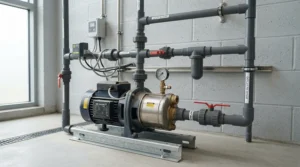
2. Gecko Aqua-Flo Circ-Master CMHP — big flow on tiny amps
Moving plenty of water on very little electricity is the whole pitch of the Gecko Aqua-Flo Circ-Master CMHP. The manufacturer’s literature even claims the highest flow of any spa recirculation pump, which is marketing rather than gospel. Distributor listings give 1/15 hp, 0.6 A on 230 V, a 48-frame motor, 1.5-inch connections and up to 40 US gallons per minute, around 150 L/min. At 0.6 A you’re looking at roughly 140 VA, against about 230 VA for a 1 A pump. Front and rear ball bearings and a self-lubricating carbon-graphite seal are aimed at continuous duty, and quick-release compression fittings make servicing less of a wrestling match.
Here’s what to weigh. That flow supports a high-flow heater and a healthier turnover rate in a big tub, so the Gecko Aqua-Flo Circ-Master CMHP is a sensible circulation pump for 6 person hot tub setups with heavy bather loads. The catch for UK buyers is that the listings I found are 60 Hz, so confirm a 50 Hz-suitable variant before ordering. I couldn’t verify a meaningful pool of customer reviews on the distributor pages I checked, so I won’t invent a sentiment summary. The spec sheet and the two-year warranty on one listing are the evidence here.
Pros:
- ✅ High published flow from a small motor
- ✅ Built for continuous 24-hour operation
- ✅ Quick-release fittings ease servicing
Cons:
- ❌ No independent decibel figure published
- ❌ Listings found were 60 Hz, so check variant
Roughly £150–£250 is typical, which is fair value if flow rather than bargain pricing is your priority.
3. Laing E10 — lowest wattage on the list
Electrical frugality is where the Laing E10 stands apart. Its electronically commutated motor is listed at just 65–70 W, which retailers describe as around 40% less than comparable circulation pumps. It delivers the same flow on 50 or 60 Hz and tops out at roughly 14–15 US gallons per minute (about 55 L/min) with a 20 ft (around 6 m) head. It weighs under 5 lb and has an open impeller that resists clogging, plus dry-run protection. That light weight makes it easy to mount on rubber isolators, which helps with vibration hum.
The honest analysis is that modest flow makes the Laing E10 a low-flow heater-loop specialist, not a filtration powerhouse. If it’s the only pump pushing water through a big tub’s filter, turnover rate stretches out considerably (see the sizing table later). In a tub designed around it, it’s a superb quiet hot tub circulation pump. Forced into a high-flow plumbing layout, it will disappoint. Reviewers on a US retailer page are few. One found it slightly noisier than the pump it replaced but satisfactory on flow, and another was delighted with the fit on a 20-year-old spa. That’s too small a sample to call a trend.
Pros:
- ✅ Remarkably low 65–70 W power draw
- ✅ Same flow on 50 Hz or 60 Hz
- ✅ Lightweight with dry-run protection
Cons:
- ❌ Modest maximum flow of around 55 L/min
- ❌ Many connector variants confuse buyers
Expect around £150–£250. It offers strong long-term value when its flow suits your plumbing.
4. Balboa 1-Amp Circulation Pump — like-for-like OEM-style swap
For owners of compatible tubs, the appeal of the Balboa 1-Amp Circulation Pump is simple. It’s sold as a low-energy, continuous-run replacement that keeps water moving through heater and filter so chemicals spread evenly. The “1-amp” in the name is the headline spec. That’s roughly 230 VA at UK voltage, similar to the label figure on the LX WTC50M, and it signals a pump meant to run for hours without spinning the meter. Published detail is thin, though. The listing I found offered no flow curve and no decibel figure.
My analytical take is that you buy the Balboa 1-Amp Circulation Pump because it matches what’s already in the cabinet, not because a datasheet dazzled you. A like-for-like swap keeps the plumbing, wiring and noise character you already know, which is ideal if the old pump was quiet until it wore out. If yours was loud from day one, a different design such as the Laing E10 is the smarter fix. I couldn’t verify real customer reviews for this exact listing, so there’s no sentiment summary to offer. Compare part numbers carefully.
Pros:
- ✅ Designed for continuous circulation duty
- ✅ Direct swap for compatible tubs
- ✅ Low 1-amp electrical draw
Cons:
- ❌ Few published flow or noise figures
- ❌ Seen mainly via specialist parts suppliers
Around £175–£275 is a fair range, and it’s worth paying only when it’s a genuine like-for-like match.
5. Davey SpaPower QB035 — a published decibel rating
Manufacturers rarely print noise figures for circulation pumps, which makes the Davey SpaPower QB035 refreshing: the maker’s data lists 56 dBa. You also get a 250 W single-speed motor, 150 L/min maximum flow, 6 m maximum head and a 1.6 A rating. Davey says large suction and discharge ports allow higher performance at lower noise. It also offers optional mounting pads to cut vibration, and the 316 stainless steel shaft sits in a housing that rotates 180° for tidier pipework.
Here’s what the numbers mean. 56 dBa sits a little below normal conversation (around 65 dB, according to an EU glossary) but it isn’t silent, which is why those mounting pads matter. Vibration through a cabinet panel often annoys more than airborne noise. Check the test conditions on the datasheet, because the figure isn’t directly comparable with another maker’s number. Two practical flags: the Davey SpaPower QB035 is listed with an AMP-type lead, and a related Davey model’s retailer notes that this style of plug doesn’t suit Balboa controllers, so confirm compatibility. UK stock also tends to come via importers. No verifiable review pool turned up for this model, so I’m leaning on the datasheet.
Pros:
- ✅ Manufacturer-published 56 dBa noise rating
- ✅ Stainless shaft and rotatable housing
- ✅ Optional vibration-reducing mounting pads
Cons:
- ❌ AMP lead may not suit every controller
- ❌ Limited UK stock; check importers
Roughly £150–£250 where stocked, and decent value if documented noise matters to you.

6. Waterway Executive 48-Frame 2-Speed — the Waterway-style spa pumps benchmark
The Executive wet end is the design many Waterway-style spa pumps are compared against, which makes the Waterway Executive 48-Frame 2-Speed the reference point for this category. In 2 hp form, a US-spec listing quotes 10.5 A on high and 2.6 A on low, with 2-inch intake and discharge and flow capability of 100–150 US gallons per minute. Waterway’s own Euro 50 Hz catalogue lists 2 hp two-speed units at 9.3 A and 1.8 A. The large intake is designed to reduce noise, the wet end rotates in 90° steps, and the Viton shaft seal protects against ozone and minerals.
This is not a dedicated quiet hot tub circulation pump. It’s a jet pump that can moonlight as one on low speed. At 1.8 A, low speed still draws three times the 0.6 A of the Gecko Aqua-Flo Circ-Master CMHP, so don’t buy the Waterway Executive 48-Frame 2-Speed for efficiency. Buy it if your tub already uses a two-speed pump for filtration, heating and jets and you want a widely supported replacement. Low speed then becomes your quiet mode. Review evidence I could verify for this exact variant was too thin to summarise, and warranty terms differ by seller. Some list two years, while another lists one year on the motor and three on the wet end.
Pros:
- ✅ Large intake aimed at reducing noise
- ✅ Two speeds cover circulation and jets
- ✅ Rotatable wet end eases fitting
Cons:
- ❌ Heavier current draw than dedicated pumps
- ❌ Overkill if you only need circulation
Around £250–£450 depending on horsepower and seller. It’s excellent for all-in-one tubs and poor value as a pure circulation pump.
7. LX WE10 — high flow on a budget, with a noise caveat
Flow is the selling point of the LX WE10. The listing quotes a 230 V motor with copper windings and a maximum of 35 US gallons per minute (about 130 L/min). One reviewer reading the label reported 1.8 A, or roughly 218 W. Strong flow means faster filtration and a quicker turnover rate, which helps when cloudy water is your problem.
The honest read is that the LX WE10 isn’t the quietest option. Marketplace reviewers are split. One owner of a 20-year-old tub would buy it again. Others describe it as larger than the original pump and noticeably louder than a previous Italian-made unit. In one case a failure left the tub cold and prompted a replacement order. Fitment is the other theme, since the bigger body meant relocating a heater for one owner. If a quiet hot tub circulation pump is the priority, rank the LX WE10 below the LX WTC50M. If flow matters most and the tub sits well away from bedrooms and neighbours, it earns a place.
Pros:
- ✅ High published flow, around 130 L/min
- ✅ Budget-friendly pricing
- ✅ Copper-wound motor listed
Cons:
- ❌ Several reviewers find it loud
- ❌ Larger than many original pumps
Around £100–£170, which is good value only if you can live with the extra hum.
✨ Ready to Quieten Your Tub?
🔍 Take your soak to the next level with these carefully selected pumps. Click on any highlighted product to check current pricing and availability, and give your garden back its calm. 🌙
Setting Up Your Quiet Hot Tub Circulation Pump: First-30-Days Guide
A good pump can still sound terrible if it’s installed badly. Here’s the sequence that protects both your ears and your warranty.
- Read the old label first. Match voltage, 50 Hz rating, frame size, port size and thread type (barb, buttress or NPT) before ordering. A 60 Hz motor on UK mains turns slower and can underperform.
- Isolate and drain. Switch off at the consumer unit and drain only what’s needed. Hard-wiring should be done by a competent electrician.
- Decouple the vibration. Sit the pump on rubber isolation feet, and don’t clamp it rigidly to cabinet panels. The Davey SpaPower QB035 even offers optional pads for this.
- Hand-tighten unions, then a quarter turn. Overtightening distorts seals and creates whistles.
- Prime and bleed air. Dry running damages seals. The Laing E10 has dry-run protection, but don’t rely on it.
- Log the first 30 days. Re-check unions after the first few heat cycles, listen for bearing changes, and note filter condition monthly.
The mistake I’d flag most is fitting a LX WTC50M or similar with the old pump’s cracked mounts reused. Cheap brackets transmit hum. Replace them and the same pump can sound noticeably calmer. Also keep your filter clean from day one, because a clogged filter starves the pump and makes it whine.

Noisy Pump Problems and Fixes: A Problem-Solution Guide
Most “loud pump” complaints fall into five buckets. Match your symptom to the likely fix before spending money.
Problem 1: A droning hum at night. This is usually vibration. Check loose cabinet panels, add rubber isolation and make sure pipework isn’t touching the shell.
Problem 2: A high-pitched whine. Suspect air or restricted suction. Clean the filter, bleed air and confirm isolation valves are fully open.
Problem 3: Grinding or rattling. That points to worn bearings. Replace the pump rather than nursing it, because a failing bearing only gets louder.
Problem 4: Cloudy water despite constant running. Flow may be too low for your volume. A higher-flow option like the Gecko Aqua-Flo Circ-Master CMHP can help, as the sizing table later shows.
Problem 5: The pump is fine but you can still hear it. Reduce run hours at night, or move to a two-speed arrangement. The Waterway Executive 48-Frame 2-Speed on low is far gentler than on high, and a Davey two-speed model’s published figures (55 dBa low, 72 dBa high) show just how big that gap can be.
One caution on the cheapest fix. If a replacement still sounds harsh, check the seal grade on a LX WE10 or LX WTC50M before blaming the design, because that’s where the budget variants differ.
What Is a Quiet Hot Tub Circulation Pump?
A quiet hot tub circulation pump is a low-power, continuous-duty pump that moves water through your tub’s filter and heater at a gentle flow, separate from the loud jet pump. Built for long run times, it uses slow motors, large ports and low water velocity to keep noise down while keeping water filtered, heated and sanitised.
Why does it matter? A dedicated circulation pump keeps water gently moving whether or not anyone is in the tub. Master Spas notes that a 24-hour circulation pump is more efficient than running the main therapy pump, which draws more current and wears faster when the tub isn’t being used. Keeping water slightly warm also helps the tub heat up faster before you get in.
Think of it as a night-shift worker. The jet pump is the loud, high-energy performer you switch on for a soak. The circulation pump is the quiet colleague who keeps everything ticking over unnoticed. When that colleague starts droning, you notice it every hour of the day.
How to Choose a Quiet Hot Tub Circulation Pump
Use these steps in order. They save you from the most expensive errors.
- Match the electrical spec. Check 230 V, 50 Hz and amperage on your old label. A mismatch can mean poor flow or an overheating motor.
- Match the plumbing. Port size (1.5-inch or 2-inch), thread type and suction position decide whether it bolts in or needs adaptors.
- Size the flow to your volume. Divide tub litres by flow (L/min) to estimate turnover. The sizing table later in this guide shows examples.
- Check the published decibel rating and its test conditions. A rating with no distance or standard is only a rough guide.
- Compare running cost. Multiply watts by hours. A 70 W pump and a 250 W pump differ enormously over a year.
- Check seal grade and warranty. Budget OEM pumps vary, so ask the seller what seal is fitted.
- Plan the install. Budget for isolation pads and a competent electrician if hard-wiring is needed.
Common Mistakes When Buying a Quiet Hot Tub Circulation Pump
Buying on horsepower alone. Bigger isn’t quieter. A high-horsepower jet pump on high speed will always out-shout a small circulation motor.
Ignoring 50 Hz versus 60 Hz. Several listings for the Gecko Aqua-Flo Circ-Master CMHP and LX WE10 are US-oriented. Verify UK suitability.
Treating decibel figures as directly comparable. The Davey SpaPower QB035 lists 56 dBa, while one marketplace listing for the LX WTC50M states 50 dB with no distance given. Without matching test conditions, that 6 dB gap proves little.
Hard-mounting the pump. Metal-to-cabinet contact turns a modest motor into a drum.
Using a jet pump as a circulation pump on its high setting. Running a Waterway Executive 48-Frame 2-Speed on high all day is both noisy and costly.
Overlooking the seller. The same model name can hide different seal grades, so buy from sellers who state specifications clearly.
Decibel Rating Explained: What the Numbers Really Mean
A decibel rating tells you how intense a sound is at a stated distance and weighting, not how annoying it is at 11pm. dB(A) weighting adjusts for how the ear perceives frequencies. Because the scale is logarithmic, 3 dB doubles acoustic intensity, and a Davey two-speed model’s published 55 dBa on low versus 72 dBa on high is a 17 dB gap, roughly fifty times the acoustic intensity. That model is listed as discontinued by one retailer, but it neatly illustrates why low-speed running is so much calmer.
| Pump | Published noise information | How to read it | Best For |
|---|---|---|---|
| Davey SpaPower QB035 | 56 dBa in maker data | Documented, but check test conditions | Buyers who want a number |
| LX WTC50M | 50 dB on one marketplace listing | Indicative only, no distance stated | Budget swaps |
| Laing E10 | None found | Low wattage suggests restraint; one reviewer found it slightly noisier than a predecessor | Efficiency seekers |
| Gecko Aqua-Flo Circ-Master CMHP | Marketed as quiet, no dB found | Treat claims cautiously | High-flow tubs |
| Waterway Executive 48-Frame 2-Speed | None found | Low speed is the quiet mode | All-in-one tubs |
Read the table as a map of evidence, not a league table. Only the Davey SpaPower QB035 has a manufacturer figure. For the others, reviewer themes and design logic fill the gaps. Treat a pump with no published dB figure as an unknown, not as silent.
Real-world noise also depends on distance, which is why a pump tucked behind a solid fence sounds gentler than one beside a bedroom window. Normal conversation sits around 65 dB, so a 50–56 dB pump is quieter than talking. At night, though, ambient noise drops and even that can be heard.

Turnover Rate: How Fast Should Hot Tub Water Circulate?
Turnover rate is the time it takes for the tub’s full volume to pass through the filter once. The formula is simple: volume in litres divided by flow in litres per minute gives minutes. Public-spa rules in some places, such as Arizona’s code, require a turnover of at least once every 30 minutes, because bather loads per litre are high. UK private tubs have no equivalent statutory number, but the HSE’s guidance on spa-pool systems covers domestic-type tubs used in business settings and treats effective circulation as central to controlling infection risk.
Why does this matter for noise? Because chasing a fast turnover rate with a big, loud pump defeats the purpose. A smart quiet setup balances flow with calm. A mid-flow pump running for longer cycles will often be gentler than a high-flow pump sprinting briefly.
Two practical rules help. First, headline flow figures are free-flow maximums, so expect lower results once the heater and a dirty filter push back. Second, 24-hour circulation lets a lower-flow pump complete many turnovers a day. A pump moving 55 L/min can still turn over 1,400 litres more than fifty times in 24 hours, though not quickly in any single cycle.
Circulation Pump for 6 Person Hot Tub: Sizing Guide
Six bathers means more sweat, oils and skincare in the water, which is why a circulation pump for 6 person hot tub setups should be chosen with care. Typical 6-seat tubs hold somewhere around 1,200–1,600 litres, so check your manual. The table below uses 1,400 litres and published maximum flows, so these are best-case figures.
| Pump | Published max flow | Theoretical turnover (1,400 L) | Best For |
|---|---|---|---|
| LX WTC50M | 240 L/min | ~6 minutes | Large tubs, budget |
| Gecko Aqua-Flo Circ-Master CMHP | ~150 L/min | ~9 minutes | Heavy bather loads |
| Davey SpaPower QB035 | 150 L/min | ~9 minutes | Documented noise |
| LX WE10 | ~130 L/min | ~11 minutes | Flow-first, remote tubs |
| Laing E10 | ~55 L/min | ~25 minutes | Low-flow heater loops |
For a 6-seater, the LX WTC50M, Gecko Aqua-Flo Circ-Master CMHP and Davey SpaPower QB035 have comfortable headroom. The Laing E10 only makes sense where the tub’s design pairs it with separate filtration. Remember that real flow will be well below these maximums.
Consider three buyer profiles. A family of five using the tub most weekends and sitting close to neighbours would lean towards the Gecko Aqua-Flo Circ-Master CMHP, with isolation mounts. A cost-conscious owner replacing a failed pump on a mid-age tub would pick the LX WTC50M with a verified seal. Someone running an integrated two-speed system would keep a Waterway Executive 48-Frame 2-Speed and rely on its low setting overnight.
Waterway-style Spa Pumps vs Dedicated Circulation Pumps
Waterway-style spa pumps are the 48-frame and 56-frame, single- or two-speed units built around the Executive wet end. Waterway’s catalogue says its EX2 series is the same physical size as the Aqua-Flo XP2 range and can retrofit it. They’re designed to do everything: filtration, heating and jets. Dedicated circulation pumps do one job quietly.
| Option | Noise behaviour | Running-cost logic | Best For |
|---|---|---|---|
| Dedicated pump (LX WTC50M, Gecko Aqua-Flo Circ-Master CMHP) | Consistently low, built for long runs | Low draw (0.6–1 A) | Quiet 24-hour circulation |
| Waterway-style spa pumps on low (Waterway Executive 48-Frame 2-Speed) | Quiet on low, loud on high | Around 1.8 A on low (2 hp, 50 Hz) | All-in-one tubs |
| Jet pump used as circulation pump | Loud, wears faster | High draw | Nobody, ideally |
Analysis: dedicated pumps win on efficiency and noise for all-day duty, while Waterway-style spa pumps win on versatility and parts support. The numbers tell the story. A Waterway Executive 48-Frame 2-Speed on low draws roughly three times the current of a Gecko Aqua-Flo Circ-Master CMHP, though still far less than its own high-speed figure. If your tub was designed around one two-speed pump, keep that architecture. If you’re choosing freely, add a dedicated circulation pump and let the jet pump sleep.
Quiet Hot Tub Circulation Pump Running Costs and Maintenance
Running cost is where pump choice becomes real money. At an illustrative 25p per kWh (check your own tariff), a 70 W Laing E10 running 24 hours uses about 1.7 kWh a day, roughly £150 a year. A 250 W pump such as the LX WTC50M or Davey SpaPower QB035 uses about 6 kWh a day, around £550 a year. That £400 gap is a worst-case, round-the-clock figure. Some pump heat ends up in the water, which softens the blow in winter. Even so, the difference can repay a pricier pump if the flow suits your plumbing.
Maintenance is mostly about the seal and the filter. Carbon-graphite seals, as used on the Gecko Aqua-Flo Circ-Master CMHP, are designed for continuous running, but any seal deserves a periodic look. Clean the filter regularly, check unions for weeping and listen for bearing changes. For tubs used in business settings, the HSE’s HSG282 guidance sets out inspection and cleaning expectations. Home owners can borrow its logic as good practice.
Warranty length also affects total cost. Listings show two years for the Gecko Aqua-Flo Circ-Master CMHP and one year for the LX WE10, with variation by seller, so read the terms.
Safety, Regulations and Neighbour Noise in the UK
Electricity and water demand respect. Have hard-wired work done by a competent electrician who knows the wiring rules for pools and similar basins, and use appropriate RCD protection. Check the product carries the conformity marking that applies in the UK (UKCA or accepted CE marking), particularly with imported pumps like the LX WE10 or the Davey SpaPower QB035.
Noise is a legal matter too. Under the Environmental Protection Act 1990, councils must investigate noise that amounts to a statutory nuisance, and there’s no set decibel level at which that happens. In one Local Government Ombudsman case about a hot tub’s low-frequency hum, the council asked the neighbour to log pump run times and the complainant to keep a noise diary. If a council does serve an abatement notice, GOV.UK explains that breaching it for noise from a home can lead to a fine of up to £5,000.
The practical lesson is to avoid the problem. Choose a quiet pump, isolate vibration, site the tub away from boundary fences where possible, and schedule louder jet use sensibly.

Frequently Asked Questions
❓ How loud is a quiet hot tub circulation pump?
❓ Is it OK to run a quiet hot tub circulation pump 24 hours a day?
❓ Can I swap my noisy pump for one of the Waterway-style spa pumps?
❓ Does a bigger pump always mean a better turnover rate?
❓ Why does my hot tub pump seem louder at night?
Conclusion
Silence isn’t luck, it’s engineering plus a little patience. For most UK owners, the LX WTC50M is the sensible budget starting point, provided you confirm the seal grade. The Laing E10 is the efficiency champion, with a 65–70 W draw that can slash running costs where its modest flow suits your tub. The Gecko Aqua-Flo Circ-Master CMHP brings strong published flow on 0.6 A, which suits a circulation pump for 6 person hot tub, though you’ll need to confirm a 50 Hz variant. The Davey SpaPower QB035 offers a rare manufacturer-published decibel rating, and the Balboa 1-Amp Circulation Pump makes sense as a like-for-like swap. The Waterway Executive 48-Frame 2-Speed is the benchmark among Waterway-style spa pumps for all-in-one tubs, and the LX WE10 is a flow-first option for tubs far from bedrooms.
Whatever you choose, remember the three levers: published decibel rating (read with care), turnover rate (sized to your volume) and installation (isolate that vibration). Check current prices and availability before you buy, because both change often.
✨ Ready to Pick Your Pump?
🔍 Compare the seven options above, check current pricing and availability, and give your next soak the calm it deserves. 🌙💦
Recommended for You
- Hot Tub Circulation Pump: 7 Best Replacements For UK Tubs (2026)
- Best Swim Spa Kit: 7 Proven Picks For UK Gardens (2026)
- Swim Spa Under £5,000: 7 Honest Options & Reality Check (2026)
Disclaimer: This article contains affiliate links. As an Amazon Associate, I earn from qualifying purchases. If you purchase products through these links, we may earn a small commission at no additional cost to you.
✨ Found this helpful? Share it with your friends! 💬🤗
