
In This Article
A hot tub circulation pump is the small, low-power pump that moves your tub’s water slowly and continuously through the filter, heater and sanitiser, usually 24 hours a day. Unlike the noisy jet pumps that power the massage, it’s the unglamorous workhorse that keeps the water clean, warm and safe. If you want the wider background on how a hot tub works, Wikipedia is a decent starting point.

Nobody thinks about this pump until the water goes cold, the heater throws a flow error, or a faint grinding sound starts coming from the cabinet. Then you discover the real problem: buying the replacement is harder than fitting it. Ports come in 1.5 inch and 2 inch flavours, hose barbs in ¾ inch and 1 inch, and flow ratings in litres per hour, US gallons per minute, or not at all. Inflatable tubs add a twist, because their pump is welded into the heater unit.
I haven’t bench-tested any of these pumps, and I won’t pretend I have. What follows is spec-sheet analysis, honest reasoning about what the numbers mean, and aggregated buyer feedback, flagged clearly wherever it’s thin. Prices appear as ranges only. Availability on amazon.co.uk changes constantly, so check current price and stock before you commit. This post contains affiliate links; the full disclosure is at the end.
Quick Comparison: 7 Hot Tub Circulation Pump Options at a Glance
| Pump | Type | Fitting | Flow (as listed) | Price range | Best For |
|---|---|---|---|---|---|
| LX WTC50M | Budget 0.35 HP pump | 1.5″ port, 230V | Not published | Budget tier, check current price | Generic budget tubs |
| LX WTC200 | 2 HP single-speed | 1.5″ unions included | Not published | £125–£170 range | Storm Force 9 or Blue Whale-style tubs |
| Lay-Z-Spa Heater Pump Unit | Integrated inflatable unit | Bestway hose connections | 1,325 L/h (tub spec) | Varies by seller | Inflatable owners |
| Waterway Iron Might | 24-hour high-flow circ pump | 1.5″ unions | 40 GPM (~151 L/min) | ~£170–£240* | Like-for-like swaps |
| Gecko Aqua-Flo Circ-Master | OEM-grade circ pump | 2″ MBT (50Hz variant) | High-flow class (~40 GPM on 60Hz sheets) | ~£195–£260* | 2 inch pipework |
| Laing E10 | Low-flow efficiency pump | ¾” or 1″ barb | 10–15 GPM | ~£185–£255* | Low-flow heater loops |
| Hot Spring Wavemaster | 2.5 HP two-speed jet pump | 3″ ports for 2″ pipe | Up to 670 L/min | Around £700 | Premium jet-pump swaps |
*Converted from US listings; UK retailer prices vary, so check current price.
Looking at the table, the budget LX WTC50M and LX WTC200 are cheap partly because they publish so little, so you’re trusting the seller’s compatibility claims. The Waterway Iron Might and Gecko Aqua-Flo Circ-Master are the proper high-flow circulation pumps, with the Gecko Aqua-Flo Circ-Master being the one to watch if your pipes are 2 inch. The Laing E10 serves an entirely different breed of tub, and mixing up low-flow and high-flow designs is the most expensive mistake on this list.
💬 Just one click — help others make better buying decisions too!😊
Top 7 Hot Tub Circulation Pump Options: Expert Analysis
1. LX WTC50M — budget 1.5 inch swap for small spas
Think of the LX WTC50M as the sensible shoes of the pump world: not thrilling, but it gets you home. Its appeal is simplicity: a 0.35 HP, 230V single-speed pump with a 1.5 inch port, sold in a “long snout” variant.
A 1.5 inch port matches the plumbing on a huge number of budget and mid-market tubs, which is why this pump turns up so often as a like-for-like swap. The 0.35 HP motor is meatier than the 1/15 HP motors in many dedicated circulation pumps, so treat it as a robust all-rounder rather than a delicate heater-loop part. One retailer listing itself cautions against fitting it to smaller spas because of possible over-boosting, which is a polite way of saying “don’t put this on a tiny tub”.
Based on the spec comparison, it suits mid-sized budget tubs where the original was a generic pump. The seller doesn’t publish a flow rate, so read your old pump’s rating plate and compare the “long snout” dimensions with your pump bay before ordering. Retailer review summaries lean towards quiet running and easy fitting, but also flag mixed reports on durability. I couldn’t verify individual review counts, so treat that as a loose steer.
Pros:
- ✅ Quiet running reported by reviewers
- ✅ 1.5 inch port common on budget tubs
- ✅ 230V spec ready for UK supply
Cons:
- ❌ Durability reports are mixed
- ❌ No published flow rate
Price: budget tier, so check current price. Verdict: sensible stopgap value, but not a fit-and-forget pump.
2. LX WTC200 — 2 HP drop-in for Storm Force-style tubs
The LX WTC200 is the loud cousin in the family: a compact 1.5 kW (2 HP) single-speed pump spinning at 2,900 RPM, sold as a direct drop-in for Storm Force 9, Blue Whale and various Chinese-built spas.
It’s built for UK supply (230V/50Hz) and arrives with a pre-attached cable and 1.5 inch unions, which removes two of the usual fitting headaches. Those extras are why it earns a spot here despite the spec’s one big caveat: 1.5 kW is jet-pump territory. If your tub uses a single pump for both massage and filtration, this is the right class of part. If your tub has a separate low-power circulation pump, this is the wrong part entirely, and running 1.5 kW around the clock would cost roughly 36 kWh a day.
Based on the maths, I’d only choose it where your controller cycles the pump or where the original was a same-class pump. The seller publishes no flow rate, and I couldn’t find verifiable customer reviews for this model, so there’s no sentiment to report.
Pros:
- ✅ Cable and 1.5 inch unions included
- ✅ UK 230V/50Hz specification
- ✅ Strong jet-class motor
Cons:
- ❌ Very high power draw if run continuously
- ❌ No flow rate or review data published
Price: roughly the £125–£170 range at a UK retailer. Verdict: good value for the right tub, a costly mistake for the wrong one.
3. Lay-Z-Spa Heater Pump Unit — the practical route for inflatables
For inflatable owners, an inflatable hot tub replacement circulation pump isn’t a separate part. The Lay-Z-Spa Heater Pump Unit (with Freeze Shield technology and a UK plug) replaces the whole heater-pump block that heats, filters and runs the massage system.
The listing says it’s compatible with all Lay-Z-Spa models, with one catch: it has no Wi-Fi capability, so Milan, Havana, Singapore and Barbados 2021 owners would lose app control. Bestway quotes 1,325 litres per hour for its heater pumps, which is about 22 L/min, enough to turn over an 800-litre tub roughly every 36 minutes. That’s modest, which is why inflatables rely on long heating and filtering cycles rather than raw flow.
The honest view: if your tub is old, weigh the unit against the cost of a new tub. If it’s relatively young and the liner is sound, this is the simplest fix. Buyers of spare and reconditioned units describe fiddly fitting because the valves can be larger than the old pump’s, so warm the hoses before pushing them on.
Pros:
- ✅ Replaces the whole heater-pump block
- ✅ Timer and Freeze Shield functions retained
- ✅ Fits all models, per the listing
Cons:
- ❌ No Wi-Fi on app-enabled tubs
- ❌ Fitting reported as fiddly
Price: varies widely by seller, so check current price. Verdict: the sensible default for inflatables if the tub itself is in good health.
4. Waterway Iron Might — the like-for-like workhorse
The Waterway Iron Might (model 3J10070-1E) is the pump people name when they say “just get the standard one”. It’s a 1/15 HP, 24-hour circulation pump at 230V, 50/60Hz, drawing about 0.70 A.
It delivers roughly 40 GPM, around 151 L/min or 9,000 L/h, which is nearly seven times a Lay-Z-Spa’s flow. That volume is why it suits high-flow heater loops. It ships with two 1.5 inch unions but no power cord or switch, so budget for a competent wiring job. It’s also not self-priming: the pump head must sit below the water level, otherwise you’ll chase air locks.
Based on the spec comparison, it’s the safest like-for-like choice for 1.5 inch plumbing on many tubs, including those that list Clearwater Spas as users. US retailer pages show a small but strongly positive review pool, with buyers praising an exact fit and very quiet running on Bullfrog-style tubs. A 12-month manufacturer warranty applies.
Pros:
- ✅ Rated for 24-hour continuous running
- ✅ Unions included for 1.5 inch pipe
- ✅ Quiet running reported by buyers
Cons:
- ❌ No cord or switch supplied
- ❌ Not self-priming, so careful siting needed
Price: roughly £170–£240 once converted from US listings, so check current price. Verdict: strong value if your pipes and heater loop match.
5. Gecko Aqua-Flo Circ-Master — the 2 inch specialist
If you’ve measured your plumbing and it’s 2 inch, the Gecko Aqua-Flo Circ-Master is the pump to look at. The 50Hz, 230V, 1/15 HP variant (part 06334000-2040) lists 2 inch MBT intake and discharge with side discharge, which is unusual among these options.
The Circ-Master range is built around a 48-frame motor with front and rear ball bearings and a carbon-graphite self-lubricating seal, all aimed at continuous duty. Most listed variants are 1.5 inch, so confirm the exact part number if 2 inch ports matter. Spec sheets for 60Hz versions quote about 40 GPM, but I couldn’t verify a 50Hz figure, so treat that as indicative. An archived retailer note puts this class at roughly 140 W, which affects running costs.
Based on the spec comparison, this is the cleaner answer to 2 inch hot tub circulation pump replacement than adapters. Buyer Q&A on US stores describes confirming direct replacements and quick fixes for no-circulation faults, and manufacturers can change motor styles without notice.
Pros:
- ✅ 2 inch ports on the 50Hz variant
- ✅ Continuous-duty bearings and self-lubricating seal
- ✅ Direct replacement for several OEM models
Cons:
- ❌ Higher running draw than low-flow pumps
- ❌ 50Hz flow figure not verified
Price: roughly £195–£260 once converted, so check current price. Verdict: worth the premium when matching 2 inch plumbing avoids adapters.
6. Laing E10 — the efficiency champion for low-flow loops
The Laing E10 is the pump that quietly sips power while others gulp it. This ECM-motor unit draws about 65–70 W and offers 50/60Hz operation at the same flow.
Retailer data lists 10 GPM at about 6 ft of head, rising to 15 GPM at best, with a 20 ft maximum head and a 140°F (60°C) limit. The open impeller resists clogging, and dry-run protection is built in. It comes as ¾ inch or 1 inch barb variants, and it’s used in Hot Spring, Sundance and Dimension One tubs. At 65 W running non-stop, it uses roughly 570 kWh a year. Against a 140 W-class pump, that’s about half the running cost.
The key analysis point: this is a low-flow pump. Fitting it to a high-flow Circ-Master loop will starve the heater. US reviewers report a 20-year-old spa fitting “like a glove”, though one notes it’s slightly noisier than the pump it replaced.
Pros:
- ✅ 65–70 W, roughly 570 kWh a year
- ✅ Dry-run protection and open impeller
- ✅ Same flow at 50 or 60Hz
Cons:
- ❌ Barb sizes vary by variant
- ❌ Low flow only, so not for high-flow loops
Price: roughly £185–£255 once converted, so check current price. Verdict: the best running-cost story here, for the right plumbing.
7. Hot Spring Wavemaster — premium jet pump for 2 inch pipework
The Hot Spring Wavemaster 2.5 HP two-speed pump (part 73028, Watkins model 0965901-03) isn’t a circulation pump. It’s a jet pump, and it’s here because searchers often use “circulation” loosely. Its standout is a 3 inch suction and discharge designed to fit 2 inch pipe.
The 50Hz data lists 15 m of maximum head and 670 L/min at maximum flow, around thirty times a Lay-Z-Spa. It includes a bleed valve and cap, and the listing says it also suits Caldera and Freeflow spas. Retailer guidance flags typical failure modes: tripped electrics, seized pumps and seal leaks. A refurbishment service in the mid-£400s is offered for the same family of pumps.
Based on the spec comparison, buy it only if your jet pump has failed, not your low-power circulator. If a refurbishment quote lands in the mid-£400s, ask whether a new pump at around £700 justifies the extra spend. I couldn’t find verifiable reviews, so there’s no sentiment to report.
Pros:
- ✅ Official replacement for Hot Spring models
- ✅ Two-speed with high peak flow
- ✅ Bleed valve and cap included
Cons:
- ❌ Jet pump, not a 24-hour circulator
- ❌ Premium price versus refurbishment
Price: around £700, so check current price. Verdict: worthwhile only for the right model, and only after pricing a refurbishment.
How to Replace a Hot Tub Circulation Pump: Step-by-Step Guide
Before buying, confirm the pump is actually the problem. Circulation pumps tend to either work or fail rather than slowly weakening, so low flow usually points to an air lock, a blocked filter or a restriction on the suction or pressure side. If it’s truly dead or grinding, replace it.
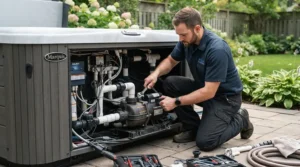
- Record the rating plate. Note voltage, amperage, horsepower, port size and discharge orientation, then photograph the plumbing from several angles.
- Isolate the power. Turn off at the isolator and the consumer unit. Wiring and RCD arrangements for hot tubs can be tricky, and the IET’s hot tub guidance stresses that product standards don’t account for your installation, so don’t improvise.
- Close valves or lower the water. Many circulation pumps lack isolation valves, so be ready for a spill.
- Release the unions and check the O-rings and seats for damage.
- Fit the new pump with fresh O-rings, hand-tight, and keep the head below the waterline.
- Bleed the air by running the pump with the filter lid slightly lifted until the water flows steadily.
- Check for leaks after ten minutes of running, then again after an hour.
The most common mistake in the first 30 days is overtightening unions, which cracks them. Union fittings seal on the O-ring, not the thread, so firm hand-tight with a fresh O-ring beats brute force.
Real-World Scenarios: Matching the Right Pump to Your Tub
Scenario 1: the three-year-old inflatable. A family uses their Lay-Z-Spa four nights a week in a back garden, and the heater pump has died. With a budget of a few hundred pounds, the Lay-Z-Spa Heater Pump Unit is the simplest route, provided they accept losing Wi-Fi if the tub has it.
Scenario 2: the eight-year-old hard-shell with 2 inch plumbing. An owner of a generic-brand tub uses it at weekends and wants a like-for-like swap without adapters. The Gecko Aqua-Flo Circ-Master 50Hz variant matches 2 inch ports, and the cost lands in the mid-£200s at most.
Scenario 3: the Hot Spring-style low-flow loop. An owner runs a branded tub all year in a sheltered garden. Running costs matter more than purchase price, so the Laing E10 makes sense because it uses far less electricity across a decade of continuous use.
Notice what’s missing: a scenario where the cheapest option is automatically right. Budget buying only works when you know exactly what you’re replacing.
How to Choose a Hot Tub Circulation Pump: 6 Steps
- Identify the type. Low-flow (Laing-style), high-flow (Circ-Master or Iron Might class) or integrated inflatable unit. They aren’t interchangeable.
- Match voltage and frequency. UK tubs need 230V/50Hz. US listings at 110–120V/60Hz won’t do.
- Match the port. Measure pipe outside diameter rather than trusting the label.
- Match the flow class. Copy your old pump’s flow rating; bigger isn’t better.
- Check discharge orientation so the new pump physically fits.
- Confirm the warranty and supplier, because most listed pumps carry only a 12-month manufacturer warranty.
Pump Flow Rate: What the Numbers Actually Mean
Pump flow rate is where marketing and physics diverge. Quoted flow is almost always measured at low resistance, and Laing notes its pumps are most accurately rated at 6 ft of head. Add a long hose run, a clogged filter or a restrictive heater and real flow drops. Also watch the units: Bestway’s 350 gal/h equals 1,325 L/h, which means US gallons, not imperial.
| Pump | Flow (L/min) | Flow (US GPM) | Flow (L/h) | Best For |
|---|---|---|---|---|
| Lay-Z-Spa Heater Pump Unit | ~22 | ~5.8 | 1,325 | Inflatables |
| Laing E10 | 38–57 | 10–15 | 2,270–3,400 | Low-flow loops |
| Waterway Iron Might | ~151 | 40 | ~9,085 | High-flow loops |
| Hot Spring Wavemaster | Up to 670 | ~177 | ~40,200 | Jet duty |
Reading this table, the Laing E10 and Waterway Iron Might differ by a factor of three or four, not a rounding error. Plumb the wrong class and either the heater starves or the system is over-driven. The Hot Spring Wavemaster sits in a different league entirely because its job is jets, not filtration.
2 Inch Hot Tub Circulation Pump Replacement: Sizing Traps
2 inch hot tub circulation pump replacement is confusing because “2 inch” can describe the pipe, the union, the thread or the port. A nominal 1.5 inch pump may have 2.375 inch outside-diameter threads, which is why unions matter more than headline sizes. Likewise, the Hot Spring Wavemaster lists 3 inch suction and discharge to fit 2 inch pipe.
Measure the outside diameter of your pipe. Nominal 2 inch pipe measures roughly 60 mm, and nominal 1.5 inch roughly 48 mm. If your pipework is 2 inch and your new pump has 1.5 inch ports, adapters exist: retailers list 2 inch to 1.5 inch union adapters and 1.5 × 2 inch adapter tailpieces. They work, but they reduce bore, and that can choke a high-flow pump.
The cleaner approach is to buy a pump with matching ports. The 50Hz Gecko Aqua-Flo Circ-Master variant lists 2 inch MBT ports for exactly this reason, which makes it the neatest answer to a 2 inch hot tub circulation pump replacement where adapters would otherwise be needed.
Union Fittings and Hose Compatibility
Union fittings and hose compatibility cause more failed weekends than any motor fault. A union is a threaded coupling that clamps an O-ring seal. Replacement parts like split nuts, tailpieces and O-rings come in 1.5 inch and 2 inch sizes, and Master Spa sells each size separately.
Some pumps arrive with unions (the Waterway Iron Might ships with two 1.5 inch unions, and the LX WTC200 includes 1.5 inch unions), while others expect you to reuse yours. Barbed pumps like the Laing E10 don’t use unions at all: ¾ inch and 1 inch barb variants take hose and clamps, and suppliers sell snap-grip clamps for ¾–1¼ inch hose. Pick the wrong barb and your hose either won’t fit or will leak.
Inflatables use their own screw-on hose connections. A different brand’s 32 mm screw fittings won’t necessarily mate with a Lay-Z-Spa unit, and one reseller reviewer found the new valves bigger than the old ones.
Rule of thumb: check union fittings and hose compatibility before ordering, and always fit fresh O-rings.
Inflatable Hot Tub Replacement Circulation Pump: Your Real Options
An inflatable hot tub replacement circulation pump isn’t a standalone purchase. Heater, pump, sensors and controller are one integrated block, which is why Bestway’s pump has a built-in RCD (rated no more than 10 mA) and a 12-month warranty on the pump.
Your realistic options are:
- Genuine heater pump unit: the Lay-Z-Spa Heater Pump Unit is the simplest, although the Wi-Fi caveat applies.
- Tested second-hand modules: specialist spares sellers offer recycled circulation pumps, usually with error-code-specific fixes.
- Small parts: flow sensors and capacitors are sold separately and often solve fault codes without a full replacement.
Don’t expect a standalone external filter pump to take over heating. Those units, such as pool filter pumps rated around 530 gal/h with 32 mm fittings, only filter. And never use an extension lead unless the manufacturer permits it, since many tub makers advise against it.
How Long Does a Budget Pump Last?
How long does a budget pump last? No maker publishes a lifespan for budget pumps, so I’ll be straight about that. Industry sources put typical hot tub pumps at 5–10 years, with circulation pumps around 7–9 years on average. One UK retailer says 7–10 years in well-maintained water. Poor water balance can drastically shorten life, so budget pumps will likely sit at or below the low end.
| Tier | Lifespan guidance | Warranty seen | Running draw | Best For |
|---|---|---|---|---|
| Budget (LX WTC50M) | No maker figure; plan on the low end | Not stated | 0.35 HP class | Short-term fixes |
| Mid (Waterway Iron Might, Gecko Aqua-Flo Circ-Master) | 5–10 years typical | 1 year (Waterway) | ~0.6–0.7 A | Long-term like-for-like |
| Premium (Laing E10) | 5–10 years typical | 1 year | 65–70 W | Running-cost savers |
The table shows warranties cluster at around a year, so lifespan differences come down to design and water care. Running costs matter too: 65 W continuous is roughly 570 kWh a year, while a 140 W-class pump is around 1,226 kWh. As an illustration, a £100 pump lasting four years costs £25 a year; a £200 pump lasting eight years costs the same, with fewer weekends on your back.
Common Mistakes When Buying a Hot Tub Circulation Pump
- Buying by horsepower alone. A 2 HP pump isn’t a better circulator, just a different animal.
- Ignoring voltage and frequency. US listings at 110–120V/60Hz appear in UK searches and are unsuitable.
- Mixing flow classes. Putting a low-flow pump on a high-flow loop starves the heater.
- Ignoring discharge orientation, which can mean replumbing.
- Skipping professional electrical help. The gov.uk Approved Document P covers electrical safety in dwellings in England, and it’s a reminder that new circuits and wiring aren’t a DIY guess.
- Trusting thin listings. If a seller publishes no flow rate, ask before buying.
Hot Tub Safety and Regulations Guide
Electrics first. Hot tub circuits typically need 30 mA RCD protection, and inflatables often supply their own RCD in the plug at 10 mA. Don’t swap a 10 mA device for a 30 mA one. The IET and electrical bodies recommend a registered electrician for hot tub wiring.
Water safety next. Hot tubs are a recognised source of legionella, and the HSE’s spa-pool guidance is aimed at operators, including holiday lets. Private owners aren’t covered the same way, but the lesson applies: keep water circulating and properly disinfected.
Finally, check CE or UKCA marking on any pump you buy, and look at the hot tub product standard, IEC 60335-2-60, mentioned by the IET. Avoid extension leads unless the maker approves them.
FAQ
❓ Can I fit a 1.5 inch pump to 2 inch hot tub pipework?
❓ What flow rate should a hot tub circulation pump deliver?
❓ Can I swap an inflatable's heater pump for a cheaper aftermarket one?
❓ Should a hot tub circulation pump run 24 hours a day?
❓ How much electricity does a hot tub circulation pump use a year?
Conclusion
Choosing a hot tub circulation pump isn’t about buying the most powerful option; it’s about matching the right class of pump to your tub. For 1.5 inch high-flow plumbing, the Waterway Iron Might is the safest like-for-like choice. For 2 inch pipework, the Gecko Aqua-Flo Circ-Master removes the adapter dance. If running costs matter most and your tub has a low-flow loop, the Laing E10 is hard to beat, and for inflatables the Lay-Z-Spa Heater Pump Unit is the practical route.
At the budget end, the LX WTC50M and LX WTC200 can work, but publish little data and carry mixed durability signals, so plan for the low end of the 5–10 year range. The Hot Spring Wavemaster is a jet pump for a specific job, not a general answer. Whichever you choose, check flow class, voltage, ports and fittings before you click, and leave the wiring to someone qualified.
✨ Ready to get your water circulating again?
🔍 Click any highlighted pump above to check current pricing and availability, and get your tub crystal clear and properly heated!
Recommended for You
- Best Swim Spa Kit: 7 Proven Picks For UK Gardens (2026)
- Swim Spa Under £5,000: 7 Honest Options & Reality Check (2026)
- Wood-Burning Stove For Hot Tub: 7 Best UK Picks (2026)
Disclaimer: This article contains affiliate links. As an Amazon Associate, I earn from qualifying purchases. If you purchase products through these links, we may earn a small commission at no additional cost to you.
✨ Found this helpful? Share it with your friends! 💬🤗
