
In This Article
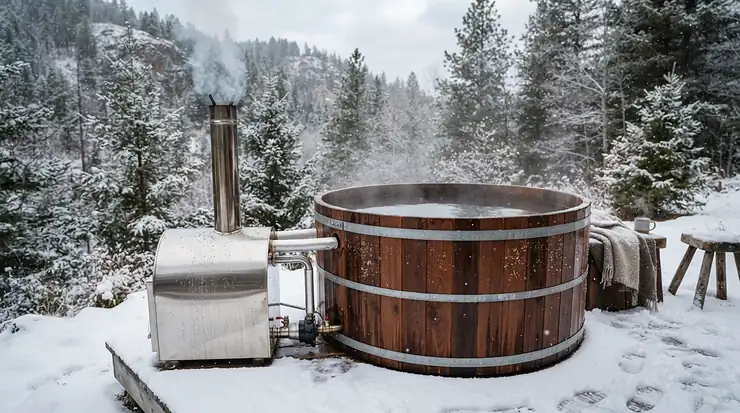
A wood-burning stove for hot tub use is a stainless steel or aluminium firebox that heats the tub’s water directly, either from inside the tub or through a water-jacketed unit bolted to its side. Burning logs warms the water and, on external units, natural circulation carries it around the loop, so no electricity is needed.
There’s something almost defiant about it. In an age of apps that pre-heat your bath from the sofa, you’re standing in the drizzle, feeding split birch into a steel box, and loving every minute. The appeal isn’t only nostalgia. Wood heats a tub in a matter of hours rather than the better part of a day, it works in a field with no power supply, and the flicker beats any LED strip ever made.
But the stove is also the single component most likely to make or break the whole set-up. Pick the wrong metal and you’ll be looking at rust within a season. Pick the wrong size and you’ll be tending a fire for four hours to reach a lukewarm dip. And if you live in a town, the rules on smoke matter more than many buyers realise. Parliament’s Commons Library briefing on domestic wood burning explains how smoke control areas and the 20% moisture “Ready to Burn” standard apply.
This guide covers seven real stoves, the external wood-fired hot tub stove versus internal wood burner hot tub debate, heat-up time, fuel efficiency, stainless steel vs steel, and what to check for a hot tub stove replacement UK owners can actually fit. One honest caveat before we start: I couldn’t verify a stable retail price or a deep pool of independent buyer reviews for most of these stoves, so I’ve said so where it applies rather than papering over the gaps.
Quick Comparison: 7 Wood Stoves for Hot Tubs at a Glance
| Stove | Type | Material | Stated output | Best For |
|---|---|---|---|---|
| Sauneco Ignis-V50 | External | Marine aluminium | 50 kW | Large tubs up to 240 cm |
| Sauneco Ignis S-30 | Internal | Marine aluminium | 30 kW | Tubs up to 180 cm, salt water |
| Baltoscandia 35 kW Outside Stove | External | 304 stainless steel | 35 kW | Owners of Baltoscandia tubs |
| TimberIN Integrated 30 kW | Integrated | 316 stainless steel | 30 kW | Chlorinated water, glass-door fans |
| Gardenvity Octa Heater | External, water-jacketed | 316 stainless (304 kits offered) | S, M or L sizes | DIY and self-build tubs |
| Royal Tubs Internal Stove | Internal | Stainless (grade varies, see below) | Not stated | Families wanting a built-in look |
| Hot Tub Team KI Np-75 | Stainless range | 304 or 316 | Varies by model | Retrofits and replacements |
Read the table as a map, not a league table. The Sauneco Ignis-V50 has the biggest headline output, but bigger isn’t automatically better if your tub holds 1,000 litres and your patience is finite. The Baltoscandia 35 kW Outside Stove is a strong stainless option, yet the maker says it’s designed around its own tubs, which narrows who should buy it. For self-builders, the Gardenvity Octa Heater is the most flexible fit on paper because it comes in three sizes and suits several tub materials.
💬 Just one click — help others make better buying decisions too!😊
Top 7 Wood-Burning Stove for Hot Tub Options: Expert Analysis
1. Sauneco Ignis-V50 — highest output in this line-up
The 50 kW rating is the standout here, and it’s the reason this external stove suits the biggest tubs. Sauneco lists it as suitable for tubs up to 240 cm, with a 2 m stainless chimney included.
The body is marine-grade aluminium at roughly 3 mm thick, measuring about 435 × 750 × 600 mm and weighing 44 kg. The maker claims aluminium conducts heat around 15 times better than stainless steel, making the stove up to 30% more effective. Treat that as a manufacturer claim, not a lab result, but the logic holds: metal that sheds heat quickly into water wastes less of it up the chimney.
Based on the spec comparison, this is a stove for large, family-sized tubs where a 35 kW unit might struggle in January. There’s a counter-argument, though. Royal Tubs, a rival maker, avoids aluminium altogether, arguing it degrades faster under a stove’s sustained heat. Neither side offers independent long-term data, so the fair verdict is “promising, unproven over a decade”.
I couldn’t find enough verified independent reviews of this exact model to summarise, so I won’t pretend otherwise.
Pros:
- ✅ Big output for tubs up to 240 cm
- ✅ Lighter than an equivalent stainless unit
- ✅ Chimney included in the package
Cons:
- ❌ Aluminium longevity is debated between makers
- ❌ Overkill for small two-person tubs
Pricing sits in the upper bracket for external stoves; check current price with the retailer. Value is strong for large tubs, poor for small ones.
2. Sauneco Ignis S-30 — compact internal stove for salt water
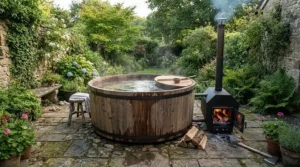
This is the internal cousin: 30 kW, marine aluminium, sat under the water line and designed for tubs up to 180 cm. It’s fed from the top, and the maker states it’s seawater resistant, a genuine differentiator if you’re one of the few UK owners filling a tub with salted water.
The critical instruction is easy to miss. The stove should be roughly 75% submerged before you light it, or it can be damaged. That means no “quick test fire” with a half-filled tub. Internal stoves transfer heat straight into the surrounding water with no plumbing loop, which is why they tend to warm faster than external ones, a point echoed by Field Mag’s guide to wood-fired hot tubs, which describes submersible stoves as heating about twice as fast as external types.
The trade-off is bathing space. Everything inside the tub takes up room, and you’ll need a guard fence so nobody leans against the hot metal.
Verified independent reviews for this model were thin at the time of research, so treat the appeal as spec-led.
Pros:
- ✅ Fast, direct heat transfer into the water
- ✅ Seawater-resistant construction
- ✅ Includes 2 m chimney and lid
Cons:
- ❌ Takes up seating room inside the tub
- ❌ Must be 75% submerged before lighting
Check current price; value is good for small-to-medium tubs where speed matters most.
3. Baltoscandia 35 kW Outside Stove — big water jacket, 304 stainless
Here’s a sturdy external unit in 304-grade stainless steel, 68 cm high, 71 cm long and 41 cm wide, holding around 60 litres of water in its jacket. That jacket volume is meaningful: more water surrounding the fire means more heat soaked up per burn and a stove body that stays far cooler than a bare firebox.
The basic set includes a 1 m chimney (114 mm diameter) with rain cap, two 75 mm flanges and short hoses, and it takes logs up to about 472 mm. Longer logs mean fewer trips to the woodpile mid-soak.
Here’s the catch. Baltoscandia says these stoves are specially designed for its own wooden and fibreglass tubs, and use with other tubs comes with conditions. So this is a brilliant match if you own one of their tubs, and a “phone them first” purchase if you don’t.
No independently verified review pool was available to summarise, so the case rests on the specification.
Pros:
- ✅ Solid 304 stainless construction
- ✅ Generous 60-litre water jacket
- ✅ Accepts long logs, fewer refills
Cons:
- ❌ Designed primarily for the brand’s own tubs
- ❌ Basic chimney is short at 1 m
Check current price; good value if it matches your tub, wasted money if it doesn’t.
4. TimberIN Integrated 30 kW — 316 stainless with a glass hatch
The 316-grade stainless build is the headline. That grade is known for standing up to water, chemicals and chlorine, which matters if you run a sanitiser rather than changing water every soak.
It’s an integrated design rather than a bolt-on, supplied with a 2 m chimney and rain hat, a chimney heat-protection fence and a glass hatch door. That door is more than décor: watching the fire lets you judge when to feed it, rather than guessing and lifting a hot lid.
On paper, 30 kW suits mid-sized family tubs, though you should check the stated compatibility before ordering, because “integrated” implies it’s matched to a specific tub design rather than universal.
A retailer listing was the main source here, so no aggregated customer sentiment could be verified. Please read that as a gap in the evidence, not a clean bill of health.
Pros:
- ✅ 316 stainless resists chlorine and chemicals
- ✅ Glass door shows the fire safely
- ✅ Heat-protection fence supplied
Cons:
- ❌ Integrated fit limits tub compatibility
- ❌ Independent reviews hard to find
Check current price; value rises if you use chemicals in the water.
5. Gardenvity Octa Heater — three sizes for self-builders
Available in S, M and L, the Octa is a water-jacketed external heater in 316 stainless, with a 304 kit option. Sizes matter because the number-one DIY mistake is matching a stove to the tub by guesswork.
The safety design is the clever part. Gardenvity says the fire chamber is wrapped in a water jacket so the outer surface only warms to about water temperature, and the chimney has a lower thermal guard. Even so, they advise keeping 2 m from roofs and flammable items, and that’s sensible whatever brand you buy.
The supplier claims 1–2 hours to heat in summer and 3–4 hours in winter, using roughly 12–25 kg of firewood from cold, and notes the heater suits fibreglass, acrylic, wooden and barrel-style tubs. As those are the seller’s own figures, use them as a planning guide rather than a promise.
I found no verified independent review data for the Octa specifically, so the recommendation stands on design logic and supplier information.
Pros:
- ✅ Three sizes to match your tub
- ✅ Water jacket keeps the body cooler
- ✅ Suits several tub materials
Cons:
- ❌ Heat-up claims come from the seller
- ❌ 304 kits less chemical-resistant than 316
Check current price; the value case is strongest for self-builds.

6. Royal Tubs Internal Stove — built-in look with a safety fence
Built into the tub’s structure, this internal stove separates the fire from bathers with an interior fence, so heat transfers directly to the water while little hands and bare legs stay clear. It has a lid with a wide handle and a side channel for airflow, letting you regulate the burn.
Two things stand out. First, Royal Tubs says a large tub needs roughly 6–8 good-quality logs to heat from cold, a wonderfully tangible planning figure. Second, their own pages describe the standard stainless grade inconsistently: one says 430, another says 304, with upgrades to 316 either way. Confirm the grade in writing before ordering, because 430 is the weakest option if you’ll add chemicals to the water.
Maintenance is light: empty the ash periodically with the supplied tools, and the ash can go on the garden.
No verified independent reviews were available to summarise.
Pros:
- ✅ Interior fence protects bathers
- ✅ Simple ash clearing with supplied tools
- ✅ 316 upgrade available
Cons:
- ❌ Stove grade described inconsistently online
- ❌ Comes as part of a tub, not a standalone swap
Check current price; value depends on the grade you specify.
7. Hot Tub Team KI Np-75 — 45° outlets for smoother flow
The distinctive feature is the 45° water-outlet connections on the KI Np-75 and KJL Np-2 models. Angled outlets help water circulate from heater to tub with less resistance, and on an external stove relying on natural convection, less resistance means faster heating.
Hot Tub Team makes stainless stoves in AISI 304 or 316 and says it has built tubs for more than 25 years. Their external stoves also feature a water channel between the fire and ash doors, plus double walls and flame barriers. Confirm the exact configuration (external or integrated) with the supplier, as their ranges span several formats.
This one earns its place for retrofits. Their range is sorted by tub model and size, which helps if you’re matching an existing tub.
No independently verified reviews could be summarised here either, so weigh the supplier’s claims accordingly.
Pros:
- ✅ Angled outlets ease water circulation
- ✅ Choice of 304 or 316 stainless
- ✅ Range organised by tub model
Cons:
- ❌ Exact configuration needs confirming
- ❌ Little independent review evidence
Check current price; solid value for replacements.
How to Choose a Wood-Burning Stove for Hot Tub Use
- Match output to volume. A bigger stove heats faster, but only if your tub’s plumbing and water volume can use it. Ask the maker for a recommended tub size rather than guessing.
- Choose the type. Internal stoves heat quickly but steal seating room; external units free up the tub but heat more slowly.
- Pick the metal for your water. Fresh water only? 304 will do. Chlorine or salt? 316 is the safer bet.
- Check tub compatibility. Some stoves are designed for one brand’s tubs, as with the Baltoscandia unit.
- Verify chimney and flue details. Length, diameter and heat guard all affect safety.
- Ask about warranty and spares. A stove you can’t repair is a stove you’ll replace.
- Check local smoke rules. Your council can confirm whether you’re in a smoke control area.
External Wood-Fired Hot Tub Stove vs Internal Wood Burner Hot Tub: Which Wins?
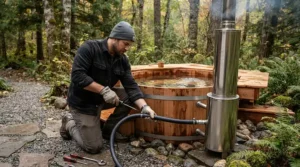
An external wood-fired hot tub stove sits beside the tub and connects with two hoses. Hot water rises out of the top port and cooler water sinks in through the bottom, a natural loop known as the thermosiphon effect. Because hot water is less dense than cold, no pump or mains power is required.
An internal wood burner hot tub design puts the firebox in the water itself. Heat has nowhere to go but into the tub, so efficiency is excellent and heat-up is faster. The price you pay is space, plus the need for a protective fence.
The verdict: choose external for families, rentals and anyone who values an uncluttered soak. Choose internal for small tubs, solo soakers and cold-weather speed. Fibreglass tubs typically pair well with external units, while traditional wooden tubs often use internal ones, so let your tub material guide you.
Stainless Steel vs Steel: Why the Metal Matters
The stainless steel vs steel question isn’t snobbery. Plain “black” steel sits in constant contact with warm water and will rust, flaking into your bath. Hot Tub Team is blunt about this: its stoves use stainless, “not simple black metal”, precisely so rust doesn’t creep into the tub.
Among stainless grades, the difference is chemistry. Royal Tubs notes that 304 includes nickel, and both Gardenvity and Royal Tubs recommend 316 where chemicals are used. Wikipedia’s overview of stainless steel explains how alloying elements like chromium and molybdenum improve corrosion resistance.
| Material | Rust risk | Chemical/salt tolerance | Weight | Best For |
|---|---|---|---|---|
| Plain (black) steel | High | Poor | Heavy | Avoid for hot tubs |
| 430 stainless | Moderate | Limited | Heavy | Fresh water, tight budgets |
| 304 stainless | Low | Good | Heavy | Most fresh-water tubs |
| 316 stainless | Very low | Excellent | Heavy | Chlorine or salt water |
| Marine aluminium | Very low | Seawater-rated (maker) | Light | Weight-conscious builds |
Reading this table, 304 is the sweet spot for most fresh-water gardens, while 316 justifies its premium the moment you add sanitiser. Aluminium is lighter and conducts heat quickly, but its longevity remains disputed between makers, so ask about warranty length before committing.
Heat-Up Time: How Long Until You Can Actually Get In?
Heat-up time depends on tub volume, starting water temperature, stove type and, crucially, your fuel. The figures below come from supplier and specialist sources, so treat them as planning ranges.
| Scenario | Reported time | Source type |
|---|---|---|
| Summer, external stove | 1–2 hours | Supplier (Gardenvity) |
| Winter, external stove | 3–4 hours | Supplier (Gardenvity) |
| Wooden tub, general | 2–3 hours | Retailer (Ticra) |
| External stove, worst case | Up to 3–4 hours | Specialist guide (Field Mag) |
| Electric heater | 12–24 hours | Supplier comparison |
The pattern is clear: wood beats electric by a mile, and internal beats external by roughly a factor of two per Field Mag. Gardenvity puts the average rise at about 8 °C per hour, and bathing temperature is suggested at 37–39 °C. Work backwards from that and you’ll know when to light up. One practical trick from Hot Tub Team: small dry logs give a bigger flame, which heats faster, while larger logs suit later in the burn when the water is around 30 °C.
Fuel Efficiency: Getting More Heat from Every Log
Fuel efficiency comes down to three things: dry wood, the right log size, and a stove that gives its heat to the water rather than the sky.
Dry wood is non-negotiable. UK guidance says wood should contain no more than 20% moisture, which is exactly what the “Ready to Burn” certification checks. Wet wood burns cooler, smokes more and coats the flue with tar. A pin-type moisture meter is a modest outlay that pays for itself in a week.
Use the right species. Ticra recommends well-dried birch for hot tub stoves, which is consistent with what many Nordic tub owners use.
Never burn treated timber. Painted or treated wood produces more smoke and tar, as Royal Tubs warns, and it shouldn’t go near a stove that heats your bathwater.
Consider the design. Water-jacketed and internal stoves keep heat close to the water, so less escapes. As a rough planning yardstick, Gardenvity says 12–25 kg of wood typically heats a cold tub, while Royal Tubs suggests 6–8 quality logs for a large tub. That’s a few pounds’ worth of firewood for an evening, a fraction of an electric heater’s running cost, though I’d stress the figures come from suppliers.
Setting Up and Running Your Stove: A Practical Guide
Positioning. Keep at least 2 m from roofs, fences and anything flammable, a distance recommended by Gardenvity. Level ground matters, so use a paving slab or gravel base.
First fill. Fill the tub past the stove’s connections before lighting. For internal stoves, ensure about 75% submersion, per the Sauneco instruction.
Lighting. Start with kindling and small dry logs for a big flame, then add larger pieces once the water warms. Leave the air control open until it’s roaring.
Monitoring. Check the thermometer, not your instincts. Aim for 37–39 °C, and keep sessions to about 15–20 minutes with plenty of water to drink.
Maintenance schedule. Empty ash after cooling, sweep the chimney regularly, check hose clamps each season and inspect seals.
Common first-30-day mistakes: lighting before the tub is full, overloading with big logs, forgetting the rain cap and ignoring the wood’s moisture.
Hot Tub Stove Replacement UK: What to Measure Before You Order
Replacing an ageing unit isn’t as simple as buying “the same size”. A hot tub stove replacement UK project succeeds or fails on measurements.
- Port spacing and diameter. Several stoves here use 75 mm flanges, so check yours against the new unit.
- Outlet angle. The Hot Tub Team KI Np-75 uses 45° connections, which may or may not match your existing hoses.
- Chimney diameter. The Baltoscandia 35 kW Outside Stove uses a 114 mm chimney, so confirm flue compatibility.
- Output versus volume. Going bigger isn’t always better, so ask the manufacturer.
- Material grade. Upgrade from mild steel to 304 or 316 if rust caused the failure.
- Brand compatibility. Don’t assume one brand’s stove will suit another’s tub.
My advice: photograph the existing stove, measure everything twice, and email the supplier with dimensions before paying. Ask whether they’ll confirm compatibility in writing.
Safety, Regulations and Smoke Control Areas
Wood burning isn’t banned in the UK, but it is regulated. Councils can designate smoke control areas under the Clean Air Act 1993, where only authorised fuels or exempt appliances may be used, and financial penalties can apply. Smoke can also be a statutory nuisance under the Environmental Protection Act 1990.
Whether a particular hot tub stove qualifies as an exempt appliance is something I couldn’t verify for these models, so ask your local council before buying. Defra’s smoke control postcode checker is at smokecontrol.defra.gov.uk.
On fuel, sellers of wood in quantities under 2 m³ in England must supply Ready to Burn wood, and Defra’s guide to Ready to Burn wood and stove use explains why dry fuel reduces smoke. Fit a carbon monoxide alarm nearby if you’re near buildings, keep the chimney clear, and never leave a lit stove unattended around children.
Wood vs Electric: Is a Wood-Burning Stove for Hot Tub Use Really Better?
| Factor | Wood-fired | Electric |
|---|---|---|
| Heat-up | 1–4 hours | 12–24 hours |
| Power needed | None | Mains supply |
| Running cost | Firewood only | Ongoing electricity |
| Effort | Hands-on | Set and forget |
| Ambience | Real flame | Silent |
Gardenvity’s own comparison puts wood at 1–4 hours against 12–24 hours for electric, and the running-cost gap follows from fuel versus electricity. If you value convenience above all, electric wins; if you value speed, atmosphere and off-grid freedom, wood wins convincingly. Remember the comparison comes from a wood-tub supplier, so it leans one way.
Common Problems and Solutions
Slow heating. Usually damp wood or oversized logs. Switch to small dry pieces and check moisture.
Smoky fire. Unseasoned or treated wood is the likeliest culprit; follow the 20% rule.
Rust flecks in the water. Suggests non-stainless steel or a low-grade alloy; upgrade to 304 or 316.
Stove struggling in winter. Winter heat-up is naturally slower, so start earlier or choose a higher output.
Uneven circulation. Check hose routing and connection angles, since sharp bends increase resistance.
Real-World Scenarios: Which Stove for Which Soaker?
The family of five with a large tub. Bigger volume, chilly winters and children nearby. The Sauneco Ignis-V50 offers plenty of output, and an external design keeps the tub interior free. Confirm aluminium warranty terms first.
The couple with a small garden tub, twice a week. The Sauneco Ignis S-30 heats fast, and losing some seat room matters less with two people.
The self-builder on a weekend project. The Gardenvity Octa Heater in the right size, with 316 if you’ll use chemicals.
The owner of a tired old stove. Start with the Hot Tub Team KI Np-75 range and the measurements checklist above.

FAQ
❓ Can I use a wood-burning stove for hot tub heating in a smoke control area?
❓ Does an external wood-fired hot tub stove need electricity?
❓ Can I fit an internal wood burner in my existing hot tub?
❓ Is it safe to bathe while the stove is burning?
❓ How often should I clean a hot tub stove?
Conclusion
Here’s the short version. Match the stove to your tub, not to a headline kilowatt figure. Choose 304 stainless for fresh water and 316 the moment chemicals or salt enter the picture. Pick internal for speed and small tubs, external for space and family use, and burn dry wood every time.
If I had to steer, the Sauneco Ignis-V50 suits large tubs, the Sauneco Ignis S-30 suits compact internal builds, and the Gardenvity Octa Heater is the most flexible option for DIY. The Baltoscandia 35 kW Outside Stove, the TimberIN Integrated 30 kW, the Royal Tubs Internal Stove and the Hot Tub Team KI Np-75 each earn their place under specific conditions covered above. Whatever you pick, confirm compatibility and check current price before you order.
Recommended for You
- Wood-Fired Hot Tub Vs Electric Hot Tub: 7 Best UK Picks (2026)
- Wood-Fired Hot Tub: 7 Best UK Picks For Garden Soaks (2026)
- Hard Shell Hot Tub for Year-Round Use: 7 Best UK Picks (2026)
Disclaimer: This article contains affiliate links. As an Amazon Associate, I earn from qualifying purchases. If you purchase products through these links, we may earn a small commission at no additional cost to you.
✨ Found this helpful? Share it with your friends! 💬🤗
