
In This Article
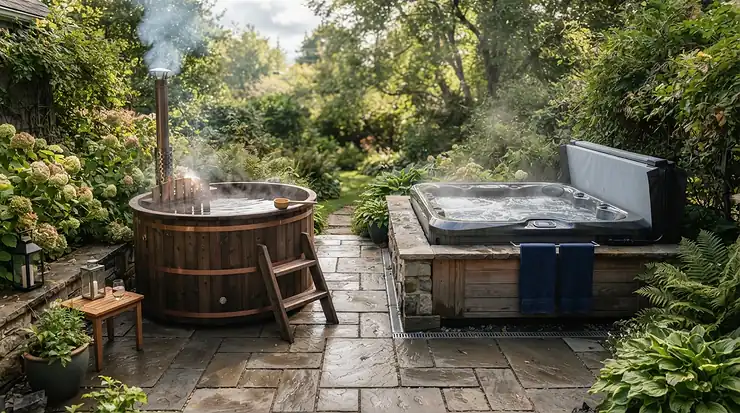
Here’s the question that lands in every UK garden-renovation group chat sooner or later: wood-fired hot tub vs electric hot tub, and which one won’t wreck your energy bills? A wood-fired hot tub is a timber or fibreglass vessel heated by burning logs in an internal or external stove, warming water in one to three hours without touching your electricity supply. An electric hot tub uses a built-in element and pump to heat water and keep it at temperature continuously, plugged into your home’s mains supply.

That difference sounds small on paper. It isn’t. It shapes everything from your December electricity bill to whether you can even put a tub in a garden with no power run to it.
Neither option is objectively “better” — that’s the honest answer, and it’s the one most affiliate sites won’t give you because it doesn’t sell a single product hard enough. What they differ in is control, convenience, and cost structure. An electric tub is a set-and-forget appliance: flick it on, walk away, come back to a steady 38-40°C whenever you fancy a soak. A wood-fired tub asks more of you — splitting logs, tending a fire, watching a thermometer — but in exchange it hands you fuel-cost control that an always-on electric heater simply can’t match, and it works fine on a smallholding with no grid connection at all.
This guide pulls apart the real numbers behind wood-fired hot tub running costs, breaks down what an electric hot tub UK owner actually pays across a year, and puts seven genuine products — three wood-fired, four electric — through an honest spec-and-sentiment comparison. No invented reviews, no rounded-up marketing claims. Just what the specifications, the current energy price cap, and the aggregated customer sentiment actually say.
Quick Comparison Table: Wood-Fired vs Electric at a Glance
| Factor | Wood-Fired Hot Tub | Electric Hot Tub | Best For |
|---|---|---|---|
| Typical heat-up time | 1-3 hours from cold | 4-24 hours from cold, then held constantly | Wood-fired: spontaneous evening soaks |
| Running cost pattern | Pay only when you fire it up | Ongoing standing cost to maintain heat | Electric: on-demand, no planning ahead |
| Power connection needed | None (unless jets/pump added) | Mains electrical circuit, RCD-protected | Wood-fired: off-grid cabins, allotments |
| Temperature precision | Manual, thermometer-checked | Thermostat-controlled, precise | Electric: families wanting exact 38-40°C |
| Ongoing maintenance | Firewood, ash, occasional hoop tightening | Filter changes, chemical balancing, pump servicing | Roughly equal effort, different tasks |
Look at that heat-up row and the running-cost row together and the whole decision starts to make sense: wood-fired tubs trade convenience for control, electric tubs trade control for convenience. If your garden has no power run to it, or you’re the type who’ll happily spend twenty minutes with kindling and a lighter for a properly earned soak, wood wins outright. If you want to text your partner “hot tub’s ready” from the car park after a long shift, electric is doing a job wood-fired simply cannot do — heating unattended, on a schedule, to a precise number.
💬 Found this comparison useful already? A quick share helps other UK garden owners find honest numbers instead of sales copy!😊
Top 7 Wood-Fired and Electric Hot Tubs: Expert Analysis
Seven real, currently available models, spanning budget, mid-range and premium, split fairly between wood-fired and electric so this comparison actually means something.
| Product | Fuel Type | Capacity | Price Range | Best For |
|---|---|---|---|---|
| Baltresto Thermowood Round Hot Tub | Wood-fired | 3-10 people | low-to-mid £2,000s | Budget-conscious first-timers |
| Baltresto Outside Stainless Steel Stove Tub | Wood-fired | Up to 3,000L | £2,500-£3,500 range | Fast, hands-on heating |
| Skärgårds Regal Wood-Fired Hot Tub | Wood-fired | Custom | £5,000+ range | Design-led, low-maintenance wood |
| Lay-Z-Spa Paris | Electric | 4-6 people | under £500 | Cheapest genuine entry point |
| Lay-Z-Spa Hawaii HydroJet Pro | Electric | 4-6 people | £700-£900 range | Real massage jets, not bubbles |
| Lay-Z-Spa Helsinki | Electric | 7 people | £600-£800 range | Big families, biggest seat count |
| Canadian Spa Company Grand Rapids | Electric | 4 people | £2,500-£3,500 range | Durability without a full install |
Reading this table left to right tells its own story: the wood-fired options cluster at the top on price because timber and stove engineering simply cost more to manufacture than an inflatable vinyl liner, but the Lay-Z-Spa Hawaii HydroJet Pro proves electric doesn’t have to mean cheap either once you add proper jets and insulation. The Canadian Spa Company Grand Rapids sits in genuinely wood-fired price territory despite being electric — a reminder that “electric” and “budget” aren’t synonyms once you move to a hard shell.
1. Baltresto Thermowood Round Hot Tub — fastest budget wood-fired build
The standout here is how little assembly stands between delivery and your first soak: this one arrives pre-built. Baltresto builds this round tub from Thermowood spruce — timber that’s been steam- and heat-treated above 180°C, which measurably improves rot resistance and dimensional stability compared with untreated softwood. It’s available across sizes for three to ten people, with either a 24kW marine aluminium or 27kW stainless steel heater fitted inside the tub itself.
Based on the spec comparison, the inside-heater design is a genuine trade-off rather than a flaw: it heats water at roughly 5°C per hour with no external pipework to leak or freeze, but it also physically occupies seating space that an outside-stove design would free up. For a first-time wood-fired buyer prioritising simplicity over maximum bathing room, that trade-off tips in Baltresto’s favour.
Verified customer review volume for wood-fired tubs is thinner on general marketplaces than for mass-market electric models, so treat this cautiously: published retailer testimonials for Baltresto-style barrel and round tubs repeatedly mention fast, even heating and praise the build quality, with several buyers describing assembling accessories as a genuinely enjoyable family project rather than a chore — though these accounts sit on retailer sites rather than a large independent review pool.
Pros:
- ✅ Delivered pre-assembled and ready to fill
- ✅ Inside heater needs no external plumbing loop
- ✅ Thermowood resists rot better than untreated pine
Cons:
- ❌ Inside heater reduces usable seating space
- ❌ Timber hoops need seasonal retightening
Prices for the round Baltresto typically sit in the low-to-mid £2,000s for smaller configurations, climbing for larger builds and premium heater choices — check current price and configuration before ordering, as wood-fired tubs are usually built to order rather than shipped as a fixed SKU. For anyone testing the water on wood-fired ownership without committing to a five-figure Scandinavian import, this is a sensible value entry point.

2. Baltresto Outside Stainless Steel Stove Tub — quickest heat-up on this list
What most buyers overlook about outside-stove designs is that the numbers behind them are unusually well documented: Baltresto’s own testing recorded 1,400 litres heating from 14°C to 40°C in 2 hours 45 minutes on the 27kW aluminium stove, and just 1 hour 30 minutes on the 35kW stainless steel version — a heating-rate difference of roughly 80%. That’s not a marketing estimate, it’s a timed result, and it’s the single most useful data point in this entire product section for anyone comparing wood-fired hot tub running costs against speed.
Mounting the stove outside the tub, rather than inside it like the Baltresto round model above, frees the full interior for seating and adds an adjustable air intake on the 35kW unit that lets you throttle the burn rate — open it up for a fast heat, close it down once you’re at temperature to stop overshooting.
Reviewer sentiment across UK wood-fired retailers consistently frames the outside-stove format as the “serious” choice for anyone planning frequent use, though as with the round model above, this comes from a smaller and less independently verified pool of reviews than mainstream electric tubs enjoy.
Pros:
- ✅ Full interior seating with no heater intrusion
- ✅ Adjustable air supply controls burn speed
- ✅ Heating times are independently timed, not guessed
Cons:
- ❌ Needs extra garden footprint for the external stove
- ❌ More pipework and fittings to inspect each season
Expect to be in the £2,500-£3,500 range once you factor in the stove upgrade over a basic inside-heater model, though exact configuration and delivery costs vary by supplier — always confirm the current price before ordering rather than relying on a headline figure.
3. Skärgårds Regal Wood-Fired Hot Tub — built-in stove, zero assembly stress
Here’s what the spec sheet won’t spell out plainly: the Regal’s defining feature is that Swedish manufacturer Skärgårds integrated the stove directly into the tub’s design, inspired by the classic Kakelugn ceramic stoves used for interior heating in old Scandinavian homes, rather than bolting an external unit onto a separate build. The body is made from glass-fibre-reinforced plastic — the same material used in boat hulls — instead of timber, which sidesteps the swelling, cracking and hoop-tightening that timber tubs eventually demand.
Based on the spec comparison against the two Baltresto models above, this is the tub for buyers who want the wood-fired experience — the crackle, the visible flame, the slower ritual of lighting up — without taking on wood as a maintenance material. Skärgårds ships free to the UK and offers an unusually generous 40-day right to cancel after delivery, which is worth weighing given how much a hot tub purchase depends on trying it in your own garden.
The company recommends eco-certified wood specifically, which dovetails with the UK’s own Ready to Burn rules discussed later in this article — worth knowing before you assume any log will do.
Pros:
- ✅ Integrated stove needs no separate plumbing
- ✅ Fibreglass body skips timber swelling issues
- ✅ 40-day return window is unusually generous
Cons:
- ❌ Among the priciest options in this entire list
- ❌ GRP build feels less rustic to timber purists
The Regal sits at £5,000+ once options are added, often climbing into the £6,000-£8,000 range for larger or fully-equipped configurations — genuinely premium territory, and worth it only if the integrated-stove convenience and fibreglass durability matter more to you than upfront cost.
4. Lay-Z-Spa Paris — cheapest way into electric ownership
The standout feature is right there in the price: this is the most accessible genuine electric hot tub UK shoppers can buy from a major brand. The Paris uses Bestway’s DuraPlus material in a grey finish, seats four to six, spans roughly 196cm, and runs 140 AirJets alongside multicoloured LED lighting and Freeze Shield technology that keeps the pump running through freezing UK nights so the unit doesn’t need draining every cold snap.
Key specs with real-world meaning: the AirJet system pumps air bubbles rather than directed water jets, which delivers a gentle, whole-body fizz rather than targeted pressure on sore shoulders — fine for relaxation, less useful as a substitute for actual massage. The rapid-heat system and power-saving timer let you schedule heating in advance, which matters because inflatable heaters typically draw around 2kW and take considerably longer than a wood stove to bring water up to temperature from cold.
Aggregated customer sentiment across UK retailer and marketplace reviews for this model line consistently mentions quick inflation, straightforward setup, and jets that outperform buyers’ initial expectations for the price point — alongside a recurring theme that running costs feel more manageable than people assume, provided the insulating cover is used properly between sessions.
Pros:
- ✅ Lowest genuine entry price for a heated electric tub
- ✅ Freeze Shield allows year-round outdoor use
- ✅ Setup reportedly takes under an hour
Cons:
- ❌ AirJets give bubbles, not firm directional massage
- ❌ Vinyl liner is less durable long-term than rigid shells
At under £500 at the time of research, the Paris represents strong value for anyone testing whether hot tub ownership suits their lifestyle before committing to a pricier model — always check current price, as Bestway runs frequent promotional cycles across its range.
5. Lay-Z-Spa Hawaii HydroJet Pro — real water jets, not just bubbles
What most buyers overlook when comparing inflatable tubs is that “jets” isn’t a single category — this model is the one genuine exception on the Lay-Z-Spa range, fitted with six directed HydroJets (three per side) that pump pressurised water rather than air, delivering targeted pressure against the back and shoulders that AirJet-only models like the Paris simply can’t replicate.
The second headline spec is EnergySense, Bestway’s thermal-wall insulation technology, independently reported as up to 40% more energy-efficient than comparable inflatable hot tubs of an older design. Paired with the MaxHold UltraFit pump and app-based control that lets you start heating remotely, this is the electric hot tub UK model built specifically to blunt the standing-cost criticism levelled at inflatable spas — heat retention is the single biggest lever on an always-on electric tub’s monthly bill, and this is Lay-Z-Spa’s answer to it.
Reviewer sentiment consistently distinguishes this model favourably from AirJet-only siblings, with buyers specifically calling out the difference in massage intensity once they’ve tried both — a rare case where the marketing claim and the aggregated review sentiment actually line up.
Pros:
- ✅ Genuine directed water jets, not just bubbles
- ✅ EnergySense insulation cuts standing heat loss
- ✅ App control allows remote pre-heating
Cons:
- ❌ One of the priciest inflatable models available
- ❌ HydroJet pump is an extra component that can fail
Expect to pay in the £700-£900 range at the time of research — a meaningful step up from the Paris, but justified for anyone who actually wants massage function rather than a warm bath with bubbles.

6. Lay-Z-Spa Helsinki — biggest seat count for family soaks
The standout advantage is capacity: this is a seven-person tub, which is unusually large for an inflatable design and squarely aimed at families or small groups who’ve outgrown the four-to-six-person norm across most of this category. Inspired by traditional Alpine hot tubs, Bestway prints a wood-effect finish onto the DuraPlus shell — a nod to the aesthetic this whole article is comparing against, minus the actual firewood.
The 180 AirJet system sits near the top of Lay-Z-Spa’s bubble-jet range, and Freeze Shield technology is included as standard, meaning the unit can legitimately stay outdoors and operational through a UK winter rather than needing to be drained and stored. Here’s what the spec sheet won’t tell you directly: a bigger volume of water heated to the same 40°C target simply costs more in electricity than a smaller tub, proportionally, so the Helsinki’s family-friendly size is also its biggest running-cost variable.
Aggregated reviews for large-format inflatables in this bracket tend to praise the space for genuine family use while flagging that heating from empty takes noticeably longer than smaller siblings — consistent with basic thermodynamics rather than a product flaw specific to this model.
Pros:
- ✅ Seats seven — rare for an inflatable design
- ✅ 180 AirJets near the top of the range
- ✅ Wood-effect print without wood maintenance
Cons:
- ❌ Larger volume increases electricity draw to heat
- ❌ Takes up substantial patio or decking space
The Helsinki typically sits in the £600-£800 range, positioning it as a mid-tier electric choice that trades a slightly higher running cost for genuinely usable family capacity.
7. Canadian Spa Company Grand Rapids — hard-shell durability, plug-and-play ease
The standout feature separating this from every other electric model here is construction: a rigid hard shell rather than an inflatable vinyl liner, built for buyers who want electric convenience without the puncture risk and multi-year degradation that vinyl liners eventually show. It’s a four-person plug-and-play unit, meaning it’s designed to run from a standard supply without the full bespoke electrical installation that larger permanent spas require — though a qualified electrician should still confirm your specific circuit and RCD protection.
Canadian Spa fits this model with a thermal blanket and an insulating skirt, a combination that meaningfully reduces standing heat loss compared with an uninsulated shell — directly relevant to anyone weighing energy bills against a wood-fired alternative. It also includes an aromatherapy system with a scented-bead canister (purchased separately), a genuinely differentiating feature none of the other six products on this list offer.
Reviewer sentiment for hard-shell plug-and-play spas in this bracket tends to rate build quality as noticeably sturdier than inflatables, with the trade-off being that the unit is far less portable once installed — moving it isn’t a five-minute deflate-and-fold job.
Pros:
- ✅ Rigid shell outlasts vinyl liners long-term
- ✅ Plug-and-play avoids a full bespoke install
- ✅ Insulating skirt and blanket cut standing losses
Cons:
- ❌ Heavier and far harder to relocate than inflatables
- ❌ Higher entry price than any Lay-Z-Spa model here
At £2,500-£3,500 at the time of research, the Grand Rapids sits closer to wood-fired pricing than to its inflatable electric siblings — the cost of durability and a proper shell, not a pricing quirk.
Wood-Fired Hot Tub Running Costs: The Real Numbers
Let’s do the actual maths, because this is where most articles wave their hands and this one won’t. To heat roughly 1,500 litres of water from a typical UK mains temperature of 10°C up to a comfortable 38°C bathing temperature requires approximately 50 kWh of thermal energy — that’s basic physics, not a brand claim.
Run that through an electric heater at the current Ofgem price cap rate of around 26p per kWh, and one full heat-up from cold costs roughly £13. That figure alone doesn’t tell the whole story, though — electric tubs are designed to be kept warm continuously, so on top of that initial heat-up, standing losses from an averagely insulated model can add £50-£100 a month through a cold UK winter just to hold temperature, according to industry running-cost breakdowns.
Wood tells a different story. Dry, well-seasoned hardwood like birch or ash delivers roughly 4-5 kWh of usable heat energy per kilogram. Accounting for the heat that inevitably escapes up a chimney rather than into the water, heating that same 1,500-litre tub typically takes somewhere in the region of 15-20kg of logs. If you’re sourcing wood cheaply — from your own land, a wood merchant’s bulk rate, or offcuts — that session can genuinely cost a fraction of the electric equivalent, and there’s no standing cost between soaks because you simply don’t light the stove until you want to use it.
That “you only pay when you fire it up” structure is the single biggest financial argument for wood, and it’s why wood-fired hot tub running costs consistently come out lower for households that soak once or twice a week rather than daily. One important legal wrinkle: any firewood you buy in the UK in quantities under two cubic metres must now carry Ready to Burn certification, confirming a moisture content of 20% or less — wet wood burns inefficiently, produces more smoke, and will genuinely cost you more per soak than properly seasoned logs.
| Wood-Fired (1,500L) | Electric (1,500L) | |
|---|---|---|
| Cost per single heat-up | Roughly £3-£6 in cheap/self-sourced logs | Roughly £13 in electricity alone |
| Ongoing standing cost | None between sessions | £50-£100/month in winter, poorly insulated models |
| Best For | Occasional, planned soaks | Frequent, spontaneous soaks |
The gap narrows considerably if you’re buying premium kiln-dried logs at retail prices rather than sourcing cheaply, and it narrows further still with an insulated, EnergySense-style electric model like the Lay-Z-Spa Hawaii HydroJet Pro rather than an older, poorly insulated unit — cost comparisons this stark only hold when you compare a basic electric heater against genuinely cheap firewood.

Electric Hot Tub UK: What You’re Really Paying For
Buying an electric hot tub UK-wide isn’t just buying a heater — you’re buying convenience, precision, and a pump-and-filtration system that runs continuously to keep water clear, none of which a wood-fired tub needs to the same degree. Based on the spec comparison across the four electric models in this guide, the price difference between a Lay-Z-Spa Paris and a Lay-Z-Spa Hawaii HydroJet Pro isn’t really about heating capability at all — both reach the same 40°C ceiling — it’s about insulation quality, jet type, and how much of that heating cost you claw back through better thermal design.
Here’s what the spec sheet won’t tell you plainly: an inflatable tub’s heater typically runs at a fairly modest wattage compared with a hard-shell spa’s, which is precisely why heat-up from cold takes so much longer — often the better part of a day for a large model like the Lay-Z-Spa Helsinki filled from empty. That’s the flip side of the “just plug it in” convenience story: convenience at point of use, patience required at point of setup.
What most buyers overlook is that a thermostatically controlled electric tub actually gives you something wood can’t — precise, repeatable temperature. Reviewers across the AirJet range consistently note that once at temperature, the tub simply holds there without the manual thermometer-checking a wood-fired stove demands, which matters enormously for anyone with young children or anyone who simply wants a predictable soak without babysitting a fire.
Hot Tub Fuel Comparison: Wood vs Electric vs Gas-Boosted
Most articles frame this as a straight two-way fight, but a proper hot tub fuel comparison should acknowledge a third option some UK owners quietly use: gas-boosted heating, where a standard electric tub’s element is supplemented by a separate gas water heater to speed up the initial fill. It’s a niche approach, mostly seen on larger permanent installations rather than the inflatable or wood-fired tubs covered in this guide, and it introduces its own installation and safety requirements that most domestic buyers won’t want to take on.
For the vast majority of UK households choosing between the products in this article, it genuinely comes down to wood versus mains electricity. Wood wins on per-session cost and off-grid flexibility; electricity wins on precision, hands-off convenience, and the ability to schedule a soak from an app without touching a match. Neither fuel type is “greener” in every scenario, either — a wood-fired tub burning damp, poorly sourced logs produces more visible smoke and particulate pollution than a well-insulated electric tub drawing power from a renewable-heavy grid mix, while a wood-fired tub burning dry, sustainably sourced logs can genuinely undercut grid electricity’s carbon intensity.
| Wood-Fired | Electric | Best For | |
|---|---|---|---|
| Fuel source | Logs (self-sourced or bought) | Mains electricity | Wood: off-grid flexibility |
| Setup complexity | No electrician needed | Often needs RCD-protected circuit | Electric: quick plug-and-play models |
| Environmental factor | Depends heavily on wood source and dryness | Depends on your electricity tariff’s grid mix | Roughly tied — depends on your inputs |
The honest takeaway from this comparison is that “which fuel is better” is the wrong question — the right one is “which fuel matches how, where, and how often you’ll actually use the tub.”
Practical Usage Guide: Getting the Most From Either Tub
Whichever type you land on, the first thirty days set the pattern for years of ownership, and most of the mistakes people make are entirely avoidable.
For a wood-fired tub, source or buy Ready to Burn certified logs from day one rather than “seeing what’s in the shed” — damp wood is the single biggest cause of disappointing heat-up times and smoky, unpleasant sessions. Build your fire with logs angled loosely rather than stacked tight, so air can circulate; a furnace filled to roughly two-thirds capacity burns more evenly than one crammed full. Stir the water periodically with a paddle, since wood-fired tubs heat unevenly — warmer at the surface, cooler at the base — and an aero-massage jet, if fitted, does this job for you automatically.
For an electric tub, the single highest-value habit is using the insulating cover religiously between every session, since standing heat loss through an uncovered surface is the biggest driver of the £50-£100 monthly winter cost mentioned earlier. Check and clean the filter weekly rather than monthly — a clogged filter forces the pump to work harder, which both shortens its life and quietly nudges up your electricity bill. Balance water chemistry within the first 24 hours of filling rather than waiting until it looks cloudy, since correcting an already-unbalanced tub takes considerably more chemical and effort than maintaining one from the start.
Real-World Scenarios: Which Tub Actually Fits Your Life?
Picture three genuinely different UK households, because the “right” answer changes completely depending on which one you recognise yourself in.
First, the young family in a new-build with a modest garden and two kids under ten. Predictability and safety matter more than atmosphere here — a thermostatically controlled electric model like the Lay-Z-Spa Paris or Lay-Z-Spa Helsinki (if the garden has room) lets parents set a precise, safe temperature and trust it’ll hold there, with no open flame or fire-tending near young children.
Second, the off-grid smallholding owner with no mains electricity run to their garden building at all, relying on a generator or solar setup for essential loads only. This is the scenario where off-grid use stops being a lifestyle preference and becomes the deciding factor outright — a wood-fired tub like the Baltresto Outside Stainless Steel Stove Tub simply works where an electric model physically cannot, requiring nothing but logs, a match, and a water source.
Third, the couple hosting weekend guests fairly often, budget-conscious but wanting a genuine massage experience rather than gentle bubbles. Based on the spec comparison across every product in this guide, the Lay-Z-Spa Hawaii HydroJet Pro fits this profile precisely — directed jets for a proper post-hike soak, EnergySense insulation to keep weekly running costs sane, and enough capacity for four to six guests without the five-figure price tag of a premium wood-fired build.
Problem → Solution: Fixing the Most Common Hot Tub Headaches
Slow heating on a wood-fired tub is almost always a wood-moisture problem rather than a stove fault — switch to certified Ready to Burn logs and open the air intake fully during the first hour of burning before throttling back once you’re near temperature.
Unexpectedly high electric bills usually trace back to an uncovered tub or a failing insulating cover — replace a compressed, waterlogged cover before assuming the heater itself is faulty, since a worn cover can undo most of what EnergySense-style insulation is designed to achieve.
Cloudy or smelly water, on either fuel type, is nearly always a filtration or chemical-balance issue rather than a heating one — check filter cleanliness first, then test and rebalance pH and sanitiser levels, since imbalanced water is both a health issue and a common cause of premature pump wear.
Uneven temperature in a wood-fired tub is normal physics, not a fault — warm water rises, so stir manually with a paddle or run the aero-massage jets periodically rather than assuming the stove is underpowered.
A tub that won’t hold temperature overnight regardless of fuel type points to cover fit first, then insulation quality of the shell itself — an ill-fitting cover on even the most expensive tub in this guide will bleed heat faster than a budget model with a properly sealed one.

Buyer’s Decision Framework: If This Sounds Like You…
If your garden has no electrical supply and running one in would mean a costly trenching job, choose wood-fired, because it’s the only category on this list that functions without mains power at all.
If you want a soak ready and waiting the moment you walk in from work with zero advance planning, choose electric, because only a continuously-heated tub can guarantee that.
If your household soaks once or twice a week rather than daily, choose wood-fired, because the pay-per-use cost structure rewards infrequent, planned sessions far more than an always-on electric heater does.
If young children or safety-conscious guests will use the tub unsupervised at times, choose electric, because there’s no open flame or stove to manage and the thermostat removes the guesswork.
If you genuinely enjoy the process — splitting logs, tending a fire, watching steam rise into cold air — choose wood-fired, because that ritual is a real part of the value on offer, not a chore to engineer away.
How to Choose Between a Wood-Fired and Electric Hot Tub
- Check your garden’s power access first. If there’s no existing outdoor circuit, factor in electrician costs for an electric tub, or skip that expense entirely with wood-fired.
- Estimate your realistic usage frequency. Daily or near-daily soakers generally save more with electric’s set-and-forget model; occasional users typically save more with wood.
- Decide how much you value precision. Thermostatic electric control suits families and safety-conscious households; manual wood-fired temperature management suits hands-on hobbyists.
- Confirm your firewood source before buying wood-fired. A tub is only as cost-effective as your access to cheap, dry, Ready to Burn certified logs.
- Factor in installation timelines. Electric tubs needing a dedicated circuit can take weeks to schedule with an electrician; wood-fired tubs are typically usable the same day they’re filled.
- Match capacity to actual household size, not aspirational guest numbers — a seven-person Lay-Z-Spa Helsinki heats (and costs) very differently from a four-person unit.
- Read the returns and delivery policy carefully. Wood-fired tubs like the Skärgårds Regal are often built to order, so cancellation windows matter more than with a boxed inflatable.
Common Mistakes When Buying a Wood-Fired or Electric Hot Tub
The most common wood-fired mistake is underestimating log storage space — a season’s worth of dry, seasoned wood takes up considerably more room than buyers expect, and damp storage undoes the moisture-content work you paid for at purchase. The most common electric mistake is buying based on jet count alone without checking insulation quality, which is precisely why the Lay-Z-Spa Hawaii HydroJet Pro‘s EnergySense feature matters more to long-term cost than its headline jet number.
Buyers on both sides frequently skip checking local electrical or fire safety requirements until after purchase — sort this before your tub arrives, not after. Another recurring error is assuming secondhand pricing reflects new-model running costs; older inflatable heaters and pumps are typically less efficient than current EnergySense-equipped models, so a cheap secondhand electric tub can quietly cost more to run than a newer, pricier one. Finally, many buyers compare only the tub’s purchase price and forget delivery, assembly help, and consumables (chemicals, replacement liners, firewood) that accumulate over a tub’s working life.
Safety, Regulations and Compliance for UK Hot Tub Owners
Electric hot tubs are not a DIY electrical job. UK wiring regulations require RCD protection on any hot tub circuit — typically 30mA as a minimum, with some installers recommending a more sensitive 10mA device given the combination of water and electricity involved — and this work falls under Part P of the Building Regulations, meaning it should be carried out or certified by a competent, registered electrician rather than wired in casually. The IET’s own guidance on hot tub wiring makes clear that hot tubs aren’t specifically defined in the national wiring regulations, so a qualified electrician has to make an engineering judgement about the safest setup for your specific installation.
Wood-fired owners have a different compliance picture. Firewood sold in the UK in volumes under two cubic metres must legally carry Ready to Burn certification confirming moisture content of 20% or less — buying loose, uncertified logs from an unverified source isn’t just a performance issue, in bulk it can be a legal one for the supplier. Usefully, gov.uk’s guidance on smoke control areas confirms that outdoor stoves, fire pits and similar appliances aren’t covered by smoke control area restrictions the way an indoor chimney is — good news for garden wood-fired tub owners, though using dry, low-smoke fuel remains sensible practice regardless of where you live. Whichever fuel you choose, check your specific product’s manufacturer instructions and any local council guidance before first use.

FAQ
❓ Is a wood-fired hot tub cheaper than electric in the UK?
❓ How long does a wood-fired hot tub take to heat up?
❓ Can you run a hot tub off-grid with no electricity?
❓ Do electric hot tubs increase your energy bills significantly?
❓ Is firewood for a wood-fired hot tub legal to buy in any quantity?
Conclusion
There’s no single winner in the wood-fired hot tub vs electric hot tub debate, and anyone claiming otherwise is selling something. What this guide has tried to do instead is give you the actual numbers: roughly £13 in electricity per heat-up for a 1,500-litre tub against £3-£6 in cheaply sourced logs for the same job, set against the very real convenience of a thermostat versus the very real limitation of needing mains power in the first place.
If your household soaks occasionally, has access to affordable dry logs, or simply doesn’t have power run to the garden, a wood-fired option like the Baltresto Thermowood Round Hot Tub or the premium Skärgårds Regal genuinely earns its keep. If you want precision, scheduling, and a soak ready without lifting a match, an electric model — particularly an insulation-focused one like the Lay-Z-Spa Hawaii HydroJet Pro — does a job wood-fired simply can’t replicate.
Match the tub to your actual habits rather than the fantasy version of how often you’ll use it, and either category on this list will serve you well for years.
Recommended for You
- Wood-Fired Hot Tub: 7 Best UK Picks For Garden Soaks (2026)
- Hard Shell Hot Tub for Year-Round Use: 7 Best UK Picks (2026)
- Small Hard Shell Hot Tub: 7 Best Picks for UK Gardens (2026)
Disclaimer: This article contains affiliate links. As an Amazon Associate, I earn from qualifying purchases. If you purchase products through these links, we may earn a small commission at no additional cost to you.
✨ Found this helpful? Share it with your friends! 💬🤗
