
In This Article
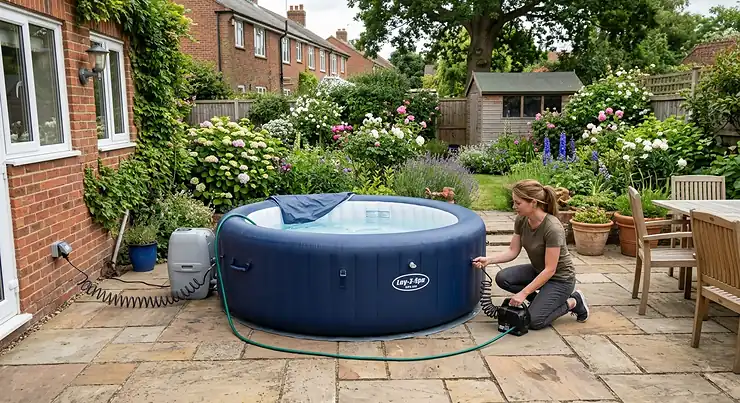
There’s a specific kind of British smugness that comes from sitting in 38°C water while your neighbour hunts for their bins in the drizzle. An inflatable hot tub is exactly what it sounds like: a portable, PVC-walled take on the traditional hot tub that inflates in minutes, plugs into a standard socket, and heats itself up without a builder, a base, or a bank loan. It’s the gateway drug of garden luxury — cheaper than a hard-shell spa by a factor of five or six, and gone from your patio by Monday if you decide you’d rather have the space back.
That accessibility is exactly why the market has exploded, and also why it’s such a minefield to shop in. Every inflatable hot tub on Amazon claims to be quiet, efficient, and easy to run, and precisely none of them will tell you that “efficient” is relative, or that your electricity bill has opinions about how often you use it. This guide pulls apart seven genuinely popular inflatable hot tub models — from a sub-£350 starter to a WiFi-controlled premium unit — with honest analysis of specs, aggregated review sentiment, running costs and heating time, so you know exactly what you’re buying before the delivery van shows up.
We’ll cover which models suit which households, how to keep energy bills under control, and the practical setup mistakes that catch out almost everyone in their first month of ownership. No fluff, no invented five-star reviews — just what the data and the aggregated buyer feedback actually say.
Quick Comparison Table
Before the deep dive, here’s the shape of the market at a glance. Prices are shown as ranges, since Amazon pricing shifts constantly and exact figures go stale within days.
| Model | Capacity | Jets | Price Range | Best For |
|---|---|---|---|---|
| Lay-Z-Spa Miami AirJet | 2–4 people | 120 AirJets | Around £300–£360 | Small gardens, first-timers |
| Intex PureSpa Plus 6-Person | Up to 6 people | 170 bubble jets | Around £400–£520 | Larger groups on a budget |
| Bestway SaluSpa Hawaii HydroJet Pro | 4–6 people | 140 jets + HydroJets | Around £450–£600 | Deep-tissue massage feel |
| MSpa Mono | Up to 6 people | 138 air jets | Around £500–£650 | Design-conscious buyers |
| Lay-Z-Spa Paris AirJet | 4–6 people | 140 AirJets + LED | Around £400–£500 | Evening entertaining |
| Lay-Z-Spa Vegas AirJet | Up to 6 people | 140 AirJets | Around £450–£560 | Year-round, freeze-resistant use |
| Lay-Z-Spa Milan AirJet Plus | Up to 6 people | 140 AirJets | Around £600–£780 | Lower long-term running costs |
Looking at that spread, the honest takeaway is that jet count is the least useful number on the spec sheet — insulation quality and pump efficiency matter far more to your day-to-day experience and your electricity bill than whether you’ve got 120 jets or 170. The Lay-Z-Spa Milan AirJet Plus sits at the top of the price range but claws some of that back through lower running costs, while the Intex PureSpa Plus 6-Person proves that a bigger tub doesn’t have to mean a bigger outlay.
💬 Found a favourite already? Scroll down to the full breakdown before you commit — the pros and cons below might change your mind.💬🤗
Top 7 Inflatable Hot Tubs: Expert Analysis
We’ve picked these seven deliberately to span budget, mid-range and premium, and to cover the handful of brands that actually dominate UK inflatable hot tub sales: Lay-Z-Spa (part of Bestway), Intex, Bestway’s own SaluSpa range, and MSpa. Every product below is genuinely available on Amazon UK at the time of writing — nothing here is invented or approximated from a non-existent listing.
1. Lay-Z-Spa Miami AirJet — best budget entry point for small gardens
The Lay-Z-Spa Miami AirJet is the one most people buy first, and there’s a reason for that beyond price: it’s genuinely small enough to fit on a modest patio without swallowing the whole garden. Built for two to four people, it runs 120 AirJets through a compact round shell, with a digital control panel that handles heating and jet cycles from outside the water.
Here’s what the spec sheet means in practice: at this size, the water volume is small enough that the 2kW-ish heater can bring a cold fill up to a usable temperature in a day rather than three, which matters if you’re impatient (most of us are). The trade-off is headroom — this isn’t a tub you invite six people into, and Bestway markets it honestly as a two-to-four-person spa.
Based on the spec comparison with the rest of this list, the Lay-Z-Spa Miami AirJet is best suited to couples, small flats-with-a-yard situations, or anyone testing whether they’ll actually use a hot tub before committing to a bigger model. Reviewers consistently report that setup takes under half an hour and that the jets, while not as forceful as the HydroJet systems further down this list, are enough for a genuine relaxation session rather than a token bubble.
Pros:
- ✅ Compact footprint fits small patios and gardens
- ✅ Fast to fill and inflate for a first-timer
- ✅ Genuinely low entry price for the Lay-Z-Spa name
Cons:
- ❌ Only comfortably seats two to four adults
- ❌ No freeze-shield technology for winter use
Price sits around £300–£360 depending on retailer stock, and for a first inflatable hot tub, it’s hard to argue with the value here — just don’t expect it to double as a party tub.
2. Intex PureSpa Plus 6-Person — best value for bigger groups
Where the Miami AirJet is deliberately small, the Intex PureSpa Plus 6-Person goes the other way, packing 170 bubble jets and a genuine six-person capacity into Intex’s Fiber-Tech construction — a three-ply laminated material that’s noticeably more puncture-resistant than the budget PVC used on some rivals.
What that spec actually buys you: a built-in hard water treatment system, which is a genuinely useful inclusion if you live somewhere in the South East or East Anglia where mains water runs hard, since it reduces the limescale build-up that otherwise clogs filters and shortens pump life. The heating range tops out around 40°C, in line with the rest of the category, and the insulated cover is there specifically to slow heat loss between sessions rather than just keep leaves out.
On paper, this means the Intex PureSpa Plus is the pick for households who want six-person capacity without paying premium prices. Aggregated Amazon review sentiment for this model is broadly positive, with buyers repeatedly praising the straightforward setup and describing the inflatable walls as reassuringly rigid once filled — though a recurring theme in less favourable reviews is that the jets can make conversation difficult at full power, echoing independent testing from other outlets.
Pros:
- ✅ Full six-person capacity at a mid-range price
- ✅ Built-in hard water treatment protects the filter system
- ✅ Puncture-resistant three-ply Fiber-Tech construction
Cons:
- ❌ Jets can be loud enough to disrupt conversation
- ❌ Basic insulation compared with freeze-shield rivals
Expect to pay somewhere around £400–£520. For the capacity on offer, that’s a genuinely competitive price-per-person figure.
3. Bestway SaluSpa Hawaii HydroJet Pro — best hydrotherapy massage
If the appeal of a hot tub is the massage rather than just the heat, the Bestway SaluSpa Hawaii HydroJet Pro is worth the step up. It combines Bestway’s usual air-bubble jets with a genuine HydroJet system — targeted water jets rather than just air bubbles — plus smart hub app control that lets you fire up the heater from your phone before you’ve even walked outside.
The practical difference between HydroJets and AirJets is worth spelling out: air jets create a broad, gentle fizz across the whole tub, while hydrojets push a focused stream of water at specific points, closer to what you’d get from a proper spa jet nozzle aimed at your lower back. The DuraPlus construction Bestway uses here is also more tear- and stretch-resistant than standard PVC, which matters if you’ve got a garden with cats, brambles, or over-enthusiastic children nearby.
What most buyers overlook about this model is the power-saving timer, which lets you schedule the heater to activate up to 72 hours in advance — genuinely useful for keeping the tub ready for a weekend without running the heater needlessly all week. Reviewers consistently flag the app control as intuitive, though a common complaint in user reviews is that the app occasionally loses connection to the tub’s WiFi module during setup.
Pros:
- ✅ Genuine HydroJet massage, not just air bubbles
- ✅ App control with a 72-hour power-saving timer
- ✅ Tear-resistant DuraPlus construction
Cons:
- ❌ App connectivity issues reported by some users
- ❌ Higher running cost than basic AirJet-only models
Typical pricing runs around £450–£600, which puts it squarely in mid-range territory for a genuinely different jet experience.
4. MSpa Mono — best design-led choice
Every hot tub on this list looks fairly similar — round, grey or blue, functional. The MSpa Mono doesn’t. Its champagne gold accent stripes and matte exterior are a deliberate departure from the Lay-Z-Spa and Intex house style, built using MSpa’s Double Wall Fabric (DWF) drop-stitch technology rather than standard PVC.
Here’s why that construction detail matters beyond aesthetics: drop-stitch fabric uses thousands of high-tension threads running between the inner and outer walls, which gives the shell far more rigidity than a simple air-filled PVC tube. In practice, that means less wobble when someone leans against the side, and a tub that holds its shape better over repeated inflate-deflate cycles. The MSpa Mono also includes a UVC sanitiser alongside the standard chemical dispenser and an all-in-one external control box, which keeps the electronics away from splash zones — a smart piece of engineering most rivals skip.
Based on the spec comparison, this is the model for buyers who want their hot tub to look intentional rather than merely functional, and who’ll use the companion app to manage settings rather than reaching for a physical panel every time. Reviewers who’ve used previous MSpa models note the setup is slightly more fiddly than a Lay-Z-Spa, partly because inflation relies more heavily on the included hand pump.
Pros:
- ✅ Distinctive design that doesn’t look like every other tub
- ✅ Rigid DWF construction resists wobble and stretch
- ✅ UVC sanitiser adds an extra layer of water hygiene
Cons:
- ❌ Setup reported as fiddlier than Lay-Z-Spa equivalents
- ❌ Smaller UK aftersales network than the bigger brands
Expect a price in the region of £500–£650 — a premium over the functional-but-plain competition, and one you’re paying largely for looks and build quality.
5. Lay-Z-Spa Paris AirJet — best for evening ambience
The Lay-Z-Spa Paris AirJet exists for one specific type of buyer: the one who wants their Saturday night soak to look as good as it feels. Its standout feature is a seven-colour LED light system built into the tub floor, cycling automatically or controllable via remote, alongside the standard 140 AirJet massage system.
What the spec sheet doesn’t tell you outright is the trade-off for that lighter, more photogenic exterior shell: it shows dirt and staining more readily than the darker-walled models elsewhere on this list, so you’ll be wiping it down more often if you want it to keep looking as good in the listing photos. The AirJet system itself performs the same job as on other Lay-Z-Spa models — a broad bubble massage rather than the targeted HydroJet feel — and there’s no Whisper Quiet technology fitted here, so at full pump power it’s noticeably louder than the brand’s premium tier.
Honestly, this is a style purchase as much as a functional one, and that’s fine — not every buying decision needs to be justified purely on thermal efficiency. Aggregated reviews consistently single out the light show as the reason people bought it in the first place, with the jets and heating performance described as solid but unremarkable next to the rest of the range.
Pros:
- ✅ Seven-colour LED light show built into the tub floor
- ✅ 140 AirJets for a full-body bubble massage
- ✅ Genuinely fast five-minute self-inflation
Cons:
- ❌ Light-coloured exterior shows dirt and staining
- ❌ No Whisper Quiet tech — runs loud at full power
Pricing typically lands around £400–£500, making the light system a relatively affordable add-on if ambience matters to you more than raw performance.
6. Lay-Z-Spa Vegas AirJet — best all-rounder for year-round use
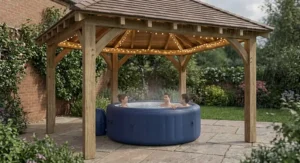
If you want one tub that does most things reasonably well without excelling narrowly at any single feature, the Lay-Z-Spa Vegas AirJet is the sensible middle-of-the-range pick. It seats up to six, runs 140 AirJets, heats to 40°C, and — critically — includes Bestway’s Freeze Shield technology as standard.
The DuraPlus material and circular beam construction give it genuine structural strength once filled, and the massage system here can run simultaneously with the heater and filter — a small but meaningful upgrade over cheaper models that force you to choose between warming the water and getting a massage at any given moment. Freeze Shield deserves its own explanation: it’s a low-power heating mode that kicks in automatically if the water temperature drops toward freezing, preventing the pump and pipework from being damaged by ice on a cold British night rather than trying to maintain full spa temperature. It’s not the same as running the tub warm all winter, but it does mean you can leave it set up through an autumn cold snap without draining it.
What most buyers overlook is the built-in energy-saving timer, which lets you schedule sessions in advance rather than leaving the heater running around the clock waiting for you to fancy a soak. Reviewers consistently describe the Lay-Z-Spa Vegas AirJet as the “does everything competently” option, which, for most households, is exactly the brief.
Pros:
- ✅ Freeze Shield technology extends usable season
- ✅ Massage and heating can run at the same time
- ✅ Energy-saving timer for scheduled sessions
Cons:
- ❌ Seats six “at a push” — four is genuinely comfortable
- ❌ No app or WiFi control included
Expect to pay somewhere around £450–£560, and for a genuinely all-weather, all-purpose tub, that’s reasonable value.
7. Lay-Z-Spa Milan AirJet Plus — best for lower running costs
Sitting at the top of this list on price, the Lay-Z-Spa Milan AirJet Plus justifies that position primarily through insulation, not jet count. It uses the same DuraPlus material as the Vegas but pairs it with a more advanced Freeze Guard system and a WiFi-enabled pump that lets you control heating remotely through Bestway’s app.
Here’s the part that actually matters for your wallet: better insulation directly reduces how often and how hard the heater has to work to hold temperature, which is the single biggest lever on running costs for any inflatable hot tub. The Lay-Z-Spa Milan AirJet Plus also includes a built-in hard water treatment system as standard — a genuinely useful inclusion for hard water regions of southern England, since scale build-up is one of the leading causes of premature pump failure in this category.
Based on the spec comparison, this is the pick for buyers planning to use their tub through fifty-plus weeks a year rather than a single summer, where the higher upfront price gets clawed back through lower ongoing electricity costs. Reviewers repeatedly cite the WiFi control as the standout convenience feature, letting you start heating from indoors so the water’s ready by the time you’re changed.
Pros:
- ✅ Advanced insulation lowers ongoing running costs
- ✅ WiFi app control for remote heating
- ✅ Built-in hard water treatment system
Cons:
- ❌ Highest upfront price on this list
- ❌ App reliant on stable home WiFi to work properly
Pricing sits around £600–£780, which is a genuine premium — but if you’re doing the sums on years of ownership rather than a single summer, the running-cost savings start to close that gap.
Practical Usage Guide: Your First 30 Days
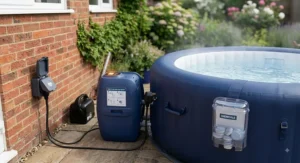
Every inflatable hot tub arrives with an instruction leaflet that assumes you already know what you’re doing, so here’s what actually matters in the first month. Setup itself is straightforward on every model here: unbox on a clean, flat, debris-free surface (stones and thorns are the enemy of PVC walls), inflate using the built-in pump, connect the control box, and fill using a standard garden hose — expect one to two hours depending on your water pressure and the tub’s volume.
The mistake almost everyone makes is underestimating heat-up time on that first fill. From a cold mains-temperature fill, most inflatable hot tubs raise water temperature by only 1–3°C per hour, so getting from a typical 12°C tap-fill to a comfortable 38–40°C can genuinely take a full day or more. Fill it the evening before you actually want to use it, not the afternoon of.
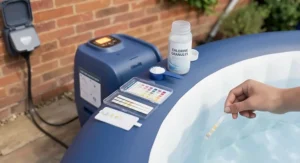
Maintenance settles into a rhythm after that first month: check and rotate filter cartridges roughly every two weeks, test water chemistry (chlorine or bromine, plus pH) at least twice weekly, and give the cover a wipe-down to stop algae building up in the folds. The optimisation trick almost nobody mentions is dropping the set temperature by 2–3°C when you’re not actively using the tub for several days, rather than switching it off entirely — reheating from a full cold fill costs far more energy than maintaining a slightly lower holding temperature.
Real-World Scenarios: Who Should Buy What
Matching tub to household is where most buying guides get vague, so here are three concrete profiles. First, the young couple in a terraced house with a modest patio, using the tub twice a week for a proper unwind: the Lay-Z-Spa Miami AirJet fits both the space and the usage pattern, and its smaller water volume keeps running costs manageable on an occasional-use pattern.
Second, the family of five hosting weekend get-togethers, wanting genuine six-person capacity without a four-figure spend: the Intex PureSpa Plus 6-Person or Lay-Z-Spa Vegas AirJet both make sense here, with the Vegas edging ahead if the tub’s staying up through autumn thanks to Freeze Shield.
Third, the couple who’ve decided a hot tub is now a permanent fixture, used most weeks of the year regardless of weather: this is where the maths genuinely favours the Lay-Z-Spa Milan AirJet Plus. The higher purchase price is offset over eighteen to twenty-four months of ownership by meaningfully lower heating costs, assuming three-plus sessions a week through a full British winter.
✨ Not sure which profile fits you? Skip ahead to the buyer’s decision framework further down — it takes the guesswork out of it.💬🤗
What is an inflatable hot tub?
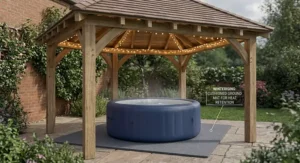
An inflatable hot tub is a portable spa with air-filled PVC or drop-stitch fabric walls, a built-in electric heater and pump, and jet systems that circulate warm, bubbling water. Unlike hard-shell spas, it inflates and deflates for storage, needs no permanent installation, and typically plugs into a standard 13A household socket.
How to Choose an Inflatable Hot Tub: 6 Buying Criteria
- Capacity vs realistic usage. A tub rated for six people is genuinely comfortable for four — buy for your typical session size, not the maximum on the box.
- Insulation quality. Freeze Shield, DuraPlus, or DWF construction all reduce heat loss, which directly lowers running costs over the tub’s lifetime.
- Jet type. AirJets give a broad, gentle massage; HydroJets deliver a more targeted, forceful feel closer to a traditional spa.
- Control method. Physical panels are more reliable; app and WiFi control add convenience but depend on a stable home network.
- Water treatment. A built-in hard water system is worth prioritising if you live in a hard water region, as it protects the filter and pump.
- Footprint and access. Measure your actual patio space, including clearance for the cover to open fully, before ordering.
Inflatable Hot Tub Buying Guide: Common Mistakes to Avoid
The single most common mistake in this category is buying on jet count alone. A 170-jet tub with poor insulation will cost more to run and hold heat worse than a 120-jet model with a proper Freeze Shield system — the massage feel and the running cost are almost entirely separate specs, and marketing tends to blur that distinction deliberately.
The second mistake is skipping the base. Placing an inflatable hot tub directly on cold grass or bare concrete accelerates heat loss through the floor, which the tub’s insulated cover does nothing to address since it only covers the top. A basic foam or insulated base mat, often sold as a cheap accessory, measurably improves heat retention.
The third mistake is underestimating ongoing costs at the point of purchase. Buyers consistently focus on the upfront price and treat electricity, chemicals and filters as an afterthought — yet across a year of regular use, those running costs frequently exceed the price gap between a budget and premium model. The last mistake worth flagging: not checking your outdoor socket is RCD-protected before you fill the tub, which is a genuine electrical safety requirement covered in more depth further down this page.
Top Rated Inflatable Spas: What Actually Drives the Ratings
Looking across aggregated review data for the models in this guide, the pattern is consistent: the top rated inflatable spas on Amazon UK earn their star ratings almost entirely on ease of setup and reliability over the first few months, not on luxury features. Buyers reward a tub that inflates without drama, holds air overnight, and heats predictably — and mark down heavily for anything that leaks, loses pressure, or has a confusing control panel.
This is worth internalising before you shop: the Lay-Z-Spa range dominates the top-rated end of the UK market not because it’s technically superior to Intex or Bestway’s SaluSpa line on paper, but because of sheer install base and a UK-based aftersales team that resolves warranty issues quickly. Reviewers with genuine long-term ownership (six months or more) tend to rate models more critically than first-week reviewers, and their complaints cluster around filter costs and cover durability rather than the headline features.
Inflatable Hot Tub Features Explained
Spec sheets throw a lot of jargon at buyers, so here’s what the recurring terms actually mean. AirJets push air through nozzles around the tub’s base or walls for a broad bubbling sensation; HydroJets push pressurised water through targeted nozzles, closer to a traditional spa jet. Freeze Shield or Freeze Guard systems automatically activate low-power heating if water temperature nears freezing, protecting the pump rather than keeping the tub warm for use. A hard water treatment system reduces limescale build-up in regions with mineral-heavy mains water, extending filter and pump life.
DuraPlus and DWF (Double Wall Fabric) are both branded terms for reinforced tub-wall materials, generally more tear- and puncture-resistant than standard single-layer PVC. Finally, an energy-saving timer lets you schedule heating in advance rather than running the pump continuously — arguably the single most useful feature on this entire list for controlling your electricity bill.
Heating Time: What to Expect
This is the section most listings quietly avoid, because the honest answer disappoints people expecting a same-day soak. From a cold mains fill (typically 8–15°C in the UK depending on season), most inflatable hot tubs on this list heat at a rate of roughly 1–3°C per hour, meaning a rise to a comfortable 38–40°C genuinely takes anywhere from 10 to 30 hours depending on the model, ambient temperature and how insulated your particular unit is.
What most buyers overlook about this figure is that it’s a one-off cost, not a recurring one — once the tub is up to temperature, maintaining it costs far less energy than the initial heat-up, provided you’re not draining and refilling regularly. Models with Freeze Shield or advanced insulation, like the Lay-Z-Spa Milan AirJet Plus and Lay-Z-Spa Vegas AirJet, hold that heat noticeably longer between top-ups than basic AirJet-only tubs, which is where their higher price starts to earn its keep across a full season rather than a single weekend.
Running Costs: The Real Numbers
Running costs are where inflatable hot tub ownership genuinely surprises people, so let’s put real figures against it. Under Ofgem’s electricity price cap for households on a standard variable Direct Debit tariff, the average unit rate is 26.11 pence per kWh as of the third quarter of 2026. A typical inflatable hot tub heater draws somewhere between 1.3kW and 2kW, plus a smaller continuous draw from the circulation pump, which usually runs whenever the tub is filled and connected.
Doing the maths honestly: heating a tub from cold typically consumes somewhere in the region of 15–30 kWh total depending on ambient temperature and insulation, which at current Ofgem rates works out to roughly £4–£8 for that single initial heat-up. Ongoing maintenance heating, once the tub is at temperature, tends to add a more modest daily cost — regular UK household users commonly report monthly increases in the £15–£40 range on their electricity bill during active use, varying significantly with insulation quality, ambient temperature and how often the tub is topped up to full heat versus left on a lower holding setting.
Where the models on this list genuinely differ is in how much of that cost you keep paying. Insulation-focused models like the Lay-Z-Spa Milan AirJet Plus hold heat longer between sessions, which reduces the frequency of expensive full reheats — the single biggest driver of a high electricity bill in this category.
Energy Efficiency: Cutting Your Bills
Energy efficiency in an inflatable hot tub comes down to three levers, and buyers tend to fixate on the wrong one. The heater wattage gets the most attention, but it barely varies across this category — most models sit within a few hundred watts of each other. Insulation quality varies far more, and it’s the bigger lever: a well-insulated cover and reinforced walls can cut heat loss dramatically compared with a basic single-layer PVC shell, which directly reduces how often the heater needs to cycle on.
The third lever, and the one entirely within your control, is usage pattern. Reviewers consistently note that leaving a tub at a slightly reduced holding temperature between sessions, rather than switching it off and reheating from cold each time, produces noticeably lower bills over a month. A well-fitted thermal cover, checked for gaps and properly buckled down after every session, is arguably the single cheapest efficiency upgrade available — cheaper than any tub-to-tub spec difference on this list, and it works on every model here regardless of brand.
Inflatable Hot Tub vs Hard-Shell Hot Tub
The comparison buyers actually need to make before purchasing anything is inflatable versus hard-shell, not model versus model within the inflatable category.
| Factor | Inflatable Hot Tub | Hard-Shell Hot Tub |
|---|---|---|
| Upfront Cost | Around £300–£800 | Typically £3,000+ |
| Installation | DIY, no base required | Professional install, often needs a base |
| Insulation | Moderate, varies by model | Generally superior |
| Portability | Deflates for storage or moving | Permanent fixture |
| Best For | Occasional to regular seasonal use | Year-round, long-term daily use |
The analysis here is fairly clear-cut: inflatable hot tubs win decisively on upfront cost and flexibility, but hard-shell spas win on long-term insulation and durability, which matters if you’re planning multiple daily uses across a decade rather than a season or two of enthusiastic use. If you’re renting, short on garden space, or genuinely unsure whether hot tub ownership will stick, an inflatable model is the financially sensible starting point — you can always upgrade later once you know your actual usage pattern.
🔍 Ready to see today’s stock and current pricing? Check availability on the models above before making your final choice.💬🤗
Long-Term Cost & Maintenance
Total cost of ownership extends well beyond the sticker price. Across a typical year of regular use, expect to budget for filter cartridges (replaced roughly every two to six weeks depending on usage and hardness of your water), chemical treatments for sanitising the water, and the electricity costs already broken down above. Filters for most models here run to a modest sum per pack, but frequent replacement adds up — hard water treatment systems, included on the Intex PureSpa Plus 6-Person and Lay-Z-Spa Milan AirJet Plus, genuinely reduce this ongoing cost by protecting the filter from scale build-up.
Cover care matters more than most buyers expect too: a torn or poorly sealed cover accelerates both heat loss and debris contamination, shortening the interval between full water changes. It’s worth viewing this against the backdrop of wider UK household energy costs, which have remained well above pre-2021 levels even as the price cap has eased — a hot tub’s running cost is a genuine addition to an already stretched budget, not a rounding error. Budgeting realistically, most owners find that a well-maintained inflatable hot tub, bought for £400–£600, costs somewhere in the region of £250–£500 a year to run and maintain with moderate weekly use — figures that make the insulation-focused premium models genuinely worth the extra upfront spend for anyone planning several years of ownership.
Safety & Regulations Guide
Electrical safety is not optional with any water-adjacent appliance, and inflatable hot tubs are no exception. Every model in this guide should be run from an RCD-protected outdoor socket, which cuts power automatically if a fault develops — a genuine safety requirement rather than a nice-to-have, given that garden electrical accidents send thousands of people to UK hospitals each year. If your outdoor socket isn’t already RCD-protected, a plug-in RCD adaptor is a low-cost fix that should be treated as mandatory, not optional, before first use.
Beyond electrics, keep the tub’s surrounding area clear of trip hazards, supervise children closely around the water at all times, and check water chemistry regularly rather than assuming the filter alone keeps things sanitary — untreated warm water is an environment bacteria genuinely thrive in. Most manufacturers, including Bestway and MSpa, sell these products as UKCA and CE marked, confirming they meet UK and EU electrical safety standards, but that marking covers the product as manufactured, not your specific installation or extension lead setup.
Buyer’s Decision Framework
If you’re still torn, use this: if space and budget are tight, choose a two-to-four-person AirJet model like the Lay-Z-Spa Miami AirJet, because compact water volume keeps both footprint and running costs manageable. If you’re hosting regularly and want genuine six-person capacity without a premium spend, choose the Intex PureSpa Plus 6-Person or Lay-Z-Spa Vegas AirJet, because both balance capacity against price sensibly. If you’re planning year-round ownership and the numbers matter more than the sticker price, choose the Lay-Z-Spa Milan AirJet Plus, because its insulation genuinely pays for itself over eighteen-plus months of regular use.

Frequently Asked Questions
❓ How long does an inflatable hot tub take to heat up?
❓ How much does it cost to run an inflatable hot tub in the UK?
❓ Can you leave an inflatable hot tub up all winter?
❓ Do inflatable hot tubs need an RCD-protected socket?
❓ How often should you change the water in an inflatable hot tub?
Conclusion
There’s no single “best” inflatable hot tub, and anyone claiming otherwise hasn’t actually compared the trade-offs properly. What genuinely separates these seven models is insulation quality, jet type, and how honestly the running costs stack up against the purchase price — not the marketing copy on the box. Budget-conscious first-timers are well served by the Lay-Z-Spa Miami AirJet or Intex PureSpa Plus 6-Person, both of which deliver a genuine spa experience without the premium price tag.
For anyone planning to use their tub through more than one British summer, the calculus shifts toward insulation and efficiency, which is where models like the Lay-Z-Spa Vegas AirJet and Lay-Z-Spa Milan AirJet Plus earn their higher price tags back through lower running costs over time. And if design matters as much as function, the MSpa Mono stands genuinely apart from a market that otherwise looks fairly homogeneous.
Whichever you choose, the numbers in this guide — heating times, running costs, and the real trade-offs between models — should let you buy with realistic expectations rather than marketing promises. That’s ultimately what separates a hot tub you use for years from one that becomes an expensive garden ornament by September.
Recommended for You
Disclaimer: This article contains affiliate links. As an Amazon Associate, I earn from qualifying purchases. If you purchase products through these links, we may earn a small commission at no additional cost to you.
✨ Found this helpful? Share it with your friends! 💬🤗
