
In This Article
Somewhere between “I fancy a hot tub” and actually owning one sits a decision that trips up more Brits than it should: wiring. A plug and play hot tub sidesteps that entire headache by running straight off a standard 13A socket, the same one powering your kettle or your telly, rather than demanding a consumer unit upgrade and a call-out fee. No chasing an electrician’s diary. No digging a trench for armoured cable. Just a box, a pump, and roughly the same amount of DIY courage it takes to assemble flat-pack furniture.
That simplicity is precisely why the category has exploded across UK gardens over the past few years, and why Amazon’s own listings for the term have multiplied into a genuinely confusing sprawl of near-identical inflatable shells. Some genuinely earn their keep. Others are a leak waiting to happen. Sorting one from the other means looking past the marketing bubbles (pun fully intended) at real jet counts, real amp draw, and what actual owners report once the novelty wears off.
This guide does exactly that: seven real, currently available models spanning budget to premium, an honest look at what “no wiring” really requires from your electrics, and the safety detail — every UK plug operates on the BS 1363 socket-outlet system that governs every socket in your house — that most listings conveniently skip. Every price mentioned here is a range rather than a snapshot, because Amazon pricing shifts weekly and locking in a figure today would be misleading by the time you read this.
Quick Comparison Table: This Year’s Standout Plug and Play Picks
Before the full breakdown, here’s the shortlist for anyone who wants the headline answer without scrolling through seven product write-ups.
| Pick | Best For | Capacity | Price Range (at time of research) |
|---|---|---|---|
| Lay-Z-Spa Miami | Tightest budget, couples | 2-4 people | Low £200s |
| Intex PureSpa Greystone Deluxe | Families wanting jets + headrests | Up to 6 people | £350-£450 range |
| CleverSpa Waikiki Black Label | Rigid, long-term durability | Up to 4 people | £500-£600 range |
| MSpa Oslo Carbon Grey | Premium hard-shell, WiFi control | 4-6 people | £750-£950 range |
The pattern worth noticing here isn’t just price — it’s what that money actually buys. The jump from Miami to Greystone Deluxe is mostly about jet count and headrests; the jump from Greystone Deluxe to Waikiki Black Label is about build material (soft PVC versus rigid drop-stitch walls); and the jump into Oslo territory buys you app control and a shell that behaves more like a permanent acrylic spa than an inflatable one. None of these are objectively “better” — they’re solving different problems, which is exactly why the full seven below are worth reading before you commit.
💬 Found the right shortlist already? A quick share helps other UK garden owners cut through the same research.
Top 7 Plug and Play Hot Tubs: Expert Analysis
Every model below runs on a standard 13A plug and play hot tub supply — no electrician required for the tub itself, though as you’ll read further down, the socket it plugs into is a different story entirely. Prices are ranges, not snapshots, since Amazon pricing moves constantly.
1. Lay-Z-Spa Miami — best budget entry for couples
The Lay-Z-Spa Miami is Bestway’s stripped-back answer to “I just want to try this before I spend real money,” and it delivers exactly that brief. Built for two to four people with a 120 AirJet massage system, it’s noticeably smaller than its Paris and Helsinki siblings — which, honestly, is the point. A compact water volume means faster heat-up and lower running costs, both of which matter enormously on a first-timer’s budget.
The 120-jet count sounds modest next to premium rivals, but on a tub this size the jet density per litre of water is actually comparable to far pricier options, so the massage effect doesn’t feel noticeably watered down. Based on the spec comparison against Bestway’s own larger models, this is squarely aimed at balconies, small patios, and anyone renting who doesn’t want to commit garden real estate to a six-person spa they’ll use twice a year.
Reviewers consistently report that assembly and inflation take under an hour, with the main complaint being the relatively thin liner material compared with Lay-Z-Spa’s premium range — a fair trade-off at this price point.
Pros:
- ✅ Lowest entry price in the plug and play category
- ✅ Compact footprint suits small gardens and patios
- ✅ Fast fill and heat-up thanks to smaller water volume
Cons:
- ❌ Thinner liner than Bestway’s premium tiers
- ❌ Only comfortably seats 2-4, not a family option
At around low £200s, the Lay-Z-Spa Miami represents genuine value for anyone testing the waters — literally — before committing to a larger investment.

2. Intex PureSpa Greystone Deluxe — best all-rounder for families
Intex has quietly built a reputation for cramming a lot of spa into a mid-range price, and the Intex PureSpa Greystone Deluxe is the clearest evidence of that. With up to 170-180 bubble jets across a square six-person footprint, it edges out most competitors in raw jet count while staying firmly in mid-range pricing territory. The square shape isn’t just an aesthetic choice — it packs more usable seating into a given garden footprint than an equivalent round tub, which matters if your patio is a fixed rectangle rather than an open lawn.
What the spec sheet won’t tell you, but reviewers note repeatedly, is how much of the experience comes down to the included headrests; two contoured headrests ship as standard, a detail budget competitors often charge extra for. Aggregated customer sentiment across major retailers consistently praises the value-for-money proposition and the completeness of the accessory bundle — cleaning kit, insulated cover, ground cloth — though some owners flag that the cover lacks a built-in child-safety lock, worth factoring in if young children have garden access.
Pros:
- ✅ Strong jet count for the mid-range price bracket
- ✅ Full accessory bundle included as standard
- ✅ Square shape maximises seating on rectangular patios
Cons:
- ❌ No built-in child-safety lock on the cover
- ❌ Filter cartridges need frequent changing with heavy use
In the £350-£450 range, this is the model most likely to satisfy a family that wants genuine hydrotherapy without premium pricing.
3. Lay-Z-Spa Paris AirJet — best for evening mood lighting
If the previous two entries are about function, the Lay-Z-Spa Paris AirJet is unapologetically about atmosphere. Its 140-jet AirJet system is respectable on spec alone, but the feature that actually sells this tub is the remote-controlled, colour-changing LED lighting built into the base — the kind of detail that turns a Tuesday night soak into something that photographs well for Instagram.
Fitting four to six people, it sits in the mid-to-upper price bracket among inflatable-shell models, and that premium buys genuine engineering: Bestway’s TriTech three-layer construction is noticeably more puncture-resistant than the single-layer PVC used on cheaper tubs, and the FreezeShield technology means the heating and pump system won’t seize up if a cold snap catches you off guard.
Based on the spec comparison, buyers choosing between this and the Miami are really choosing between “functional and cheap” and “designed to be the centrepiece of a garden party.” The Telegraph named it a standout for parties specifically because of the lighting, and aggregated reviews echo that — most negative feedback centres on the roughly hour-long assembly time rather than performance once running.
Pros:
- ✅ Standout LED lighting system for evening use
- ✅ TriTech three-layer construction resists punctures well
- ✅ FreezeShield protects the system in cold snaps
Cons:
- ❌ Assembly reportedly takes an hour or more
- ❌ Mid-range price puts it above pure budget rivals
Expect to pay in the £450-£550 range, positioning it as the aspirational middle ground of this whole list.
4. CleverSpa Cannes — best space-saving round design
Round hot tubs have one underrated advantage over square ones: they fit into corners and curved patio areas that a square tub simply can’t use efficiently, and the CleverSpa Cannes leans into that. Seating up to six across 130 airjets, it’s built from what CleverSpa brands “Triple-S” PVC fabric, and the grey leatherette exterior finish reads more like furniture than pool toy — a small but genuine differentiator when the tub is going to sit in view of the kitchen window for months at a time.
The standout feature here is CleverSpa’s 365 FreezeGuard technology, which — unlike some rivals that only claim frost resistance down to a specific threshold — is marketed for genuine year-round use in the UK’s unpredictable winters. Here’s what to weigh: round tubs generally offer slightly less total seating capacity per square metre of garden space than square equivalents, so if floor space is genuinely tight, the Greystone Deluxe above may fit more people into the same footprint.
Aggregated review sentiment on the Cannes is broadly positive on build quality and warranty support, with the UK-based aftersales team specifically called out as a strength.
Pros:
- ✅ Year-round FreezeGuard technology built in
- ✅ Leatherette finish looks premium in a garden setting
- ✅ UK-based aftersales team backs the warranty
Cons:
- ❌ Round shape seats fewer people per square metre than square tubs
- ❌ 130 jets trails the highest-spec models on this list
Priced around the £400-£500 range, it’s a strong pick for anyone prioritising all-season use over maximum jet count.
5. CleverSpa Waikiki Black Label — sturdiest drop-stitch build
Every inflatable hot tub on this list shares one structural weakness relative to hard-shell spas: the walls are, fundamentally, air-filled. The CleverSpa Waikiki Black Label addresses that more directly than most by using drop-stitch construction — thousands of tightly woven polyester threads connecting the inner and outer PVC layers — which produces walls that behave far closer to rigid than the looser air-chamber design used in budget inflatables.
Fitting four people with a substantial 140 airjets, the practical upshot is a tub that holds its shape better under load, doesn’t visibly bulge when four adults lean back simultaneously, and should, in theory, resist long-term sagging better than non-drop-stitch competitors.
What most buyers overlook about drop-stitch tubs is that this construction method is the same technology used in premium stand-up paddleboards, chosen specifically for rigidity under pressure — it’s a genuine engineering upgrade, not just marketing language. The CleverLink WiFi app adds remote control over heating schedules, useful if you want the water hot and ready the moment you get home from work.
Pros:
- ✅ Drop-stitch walls hold shape better under load
- ✅ 140 jets is class-leading for a 4-person tub
- ✅ WiFi app lets you pre-schedule heating remotely
Cons:
- ❌ Smaller 4-person capacity limits group use
- ❌ Premium construction pushes it above mid-range pricing
At roughly £500-£600, this is the pick for buyers who’ve read one too many “my inflatable hot tub sagged after a year” review and want to avoid repeating it.
6. Lay-Z-Spa Helsinki — best for larger groups and winter
Bigger tubs generally mean slower heating and higher running costs, which is exactly the trade-off the Lay-Z-Spa Helsinki is engineered to soften. Seating five to seven — genuinely large for the inflatable category — it pairs a substantial 180 AirJet massage system with what Bestway calls rapid heating technology, aiming to claw back some of the heat-up time that larger water volumes usually cost you.
The wood-effect exterior finish is a deliberate style choice too, aimed at buyers who want their tub to read as garden furniture rather than an obvious inflatable, and it tends to suit decking and rustic garden settings better than the glossier leatherette finishes used elsewhere on this list. Based on the spec comparison against the smaller Paris model, the Helsinki’s larger capacity and rapid-heat system make sense specifically for households that entertain regularly; for a couple who’ll use it twice a month, the extra running cost of heating a much bigger water volume simply isn’t justified.
Reviewers who upgraded from smaller Lay-Z-Spa models consistently note the difference in how many people can comfortably stretch out, though several flag that the “rapid” heating claim is relative — still expect the better part of a day from a cold fill.
Pros:
- ✅ Seats up to 7, largest capacity on this list
- ✅ Rapid heating technology partly offsets the bigger volume
- ✅ Wood-effect finish blends into decking and patios
Cons:
- ❌ Higher running costs than smaller tubs on this list
- ❌ Still takes the better part of a day to heat from cold
Expect the £650-£750 range, positioning it as the group-entertaining specialist of the seven.
7. MSpa Oslo Carbon Grey — best premium hard-shell modular
The MSpa Oslo Carbon Grey occupies a genuinely different category from the six tubs above it, even though it still qualifies fully as a 13A plug and play hot tub. Rather than a single inflatable air chamber, it uses a modular hard-panel design — rigid acrylic-style exterior panels wrapped around a softer interior liner — which gives it the visual presence and structural feel of a traditional built-in spa while still packing flat for delivery and requiring no professional installation.
Seating four to six across a 120-140 jet range depending on configuration, its standout feature is full WiFi app control: heating schedules, filtration cycles, and jet intensity can all be managed from a phone, and the smart filtration system automatically runs the pump for an hour every four hours in standby mode to keep water quality up even when nobody’s using it.
Reviewers consistently note the noticeably more premium feel underfoot and against the back compared with purely inflatable rivals, alongside genuinely improved WiFi reliability over MSpa’s earlier generations. The trade-off is assembly complexity — panel-based spas generally take longer to put together than a single-piece inflatable, even without tools.
Pros:
- ✅ Hard-shell panels feel closer to a permanent spa
- ✅ Full WiFi app control of heating and filtration
- ✅ Automatic standby filtration protects water quality
Cons:
- ❌ Highest price point on this list
- ❌ Panel assembly takes longer than single-piece inflatables
At around £750-£950, the Oslo is the pick for buyers who’ve decided a plug and play hot tub is a long-term fixture rather than a seasonal experiment.
Top 7 at a Glance: Specs and Price Ranges
| Product | Capacity | Jets | Price Range | Best For |
|---|---|---|---|---|
| Lay-Z-Spa Miami | 2-4 people | 120 | Low £200s | Tightest budgets |
| Intex PureSpa Greystone Deluxe | Up to 6 | 170-180 | £350-£450 | Families, value |
| Lay-Z-Spa Paris AirJet | 4-6 people | 140 | £450-£550 | Evening ambience |
| CleverSpa Cannes | Up to 6 | 130 | £400-£500 | Corner/round spaces |
| CleverSpa Waikiki Black Label | Up to 4 | 140 | £500-£600 | Long-term durability |
| Lay-Z-Spa Helsinki | 5-7 people | 180 | £650-£750 | Large groups |
| MSpa Oslo Carbon Grey | 4-6 people | 120-140 | £750-£950 | Premium, long-term use |
Read across this table and a clear pattern emerges: price correlates far more strongly with build material and control features than with raw jet count alone. The Intex PureSpa Greystone Deluxe actually out-jets the pricier CleverSpa Cannes, which tells you jet count isn’t the variable worth anchoring your decision on. If you’re choosing purely on capacity-per-pound, the mid-range square tubs win; if you’re choosing on longevity and finish, the drop-stitch and hard-shell models justify their premium.

Practical Usage Guide: No Wiring, No Electrician — From Box to Bubbles
The phrase “no wiring hot tub” undersells just how genuinely simple the physical setup is, though it’s worth walking through what actually happens on delivery day so there are no surprises. Most plug and play models arrive in one to three boxes and follow a broadly identical sequence: unroll the liner on a flat, debris-free surface, connect the pump and control unit, inflate using the built-in pump (no separate compressor needed on any model in this guide), then fill using an ordinary garden hose. This is genuinely an easy install hot tub category by design — nothing here requires tools beyond what ships in the box, and Bestway, CleverSpa, Intex and MSpa all provide video walkthroughs for exactly this reason.
Where people trip up isn’t the inflation — it’s the first 30 days after. Water chemistry needs checking within the first 24 hours of filling, not left until the water looks cloudy. The filter cartridge, whatever brand you’ve bought, should be rinsed every few days initially rather than left for a full week, since a fresh liner sheds a surprising amount of manufacturing residue in its first fills. And critically: every plug and play tub needs to sit on a completely flat, firm surface — a slight lawn slope that looks negligible to the eye becomes a genuinely uneven water level once 800-plus litres are loaded in, which stresses seams unevenly over time.
Real-World Scenarios: Who Actually Suits a Plug and Play Hot Tub
Specs only tell half the story — the other half is whether a given tub actually fits your life. Three scenarios worth recognising:
The renter with a small patio. No consumer unit upgrade, no permanent installation, and the whole thing packs down into a bag small enough to go in a car boot on moving day. The Lay-Z-Spa Miami or a similarly compact model suits this buyer specifically because low running costs matter more than jet count when you’re paying your own electricity bill in a flat you don’t own long-term.
The family who entertains most weekends. Capacity and jet density matter far more here than portability. The Intex PureSpa Greystone Deluxe or Lay-Z-Spa Helsinki make more sense — the extra running cost of a bigger tub is offset by getting genuine use out of it multiple times a week rather than sitting mostly empty.
The couple who wants it to feel permanent. If the tub is staying in exactly one spot for years, not being deflated and stored each winter, the case for spending more up front strengthens considerably. The MSpa Oslo Carbon Grey‘s hard-shell design and app control suit exactly this buyer — someone treating the purchase as closer to a garden fixture than a seasonal accessory.
Standard Socket Compatibility: What “Plug and Play” Actually Needs
Every model reviewed above is built to run from a standard socket hot tub connection — meaning an ordinary UK BS 1363 three-pin outlet rated to 13A, the exact same socket type used throughout your home. There’s no special plug, no adapter, and no compatibility gap to check before buying. The UK’s dominant domestic socket system uses a fused, polarised 13A plug with a user-replaceable fuse, and every tub on this list ships with that standard fitting already attached, drawing no more than the 13A ceiling that socket type is rated for.
Here’s what the “standard socket” claim doesn’t cover, though: it means the plug fits, not that any random socket in your garden is safe to use it in. An indoor socket accessed by running a lead out through a door or window is not a compatible installation, whatever the plug shape suggests — that’s an extension lead safety problem, covered in full two sections below. Genuinely compatible use means either a dedicated outdoor socket or a correctly rated, outdoor-appropriate extension lead run in full, never coiled, from an RCD-protected circuit.
Understanding Amp Rating: Why 13A Is the Magic Number
The amp rating conversation is where plug and play tubs earn their name, and where most buyers stop researching a step too early. A 13A supply delivers roughly 3kW of continuous power — enough to run the heating element and pump simultaneously on every tub reviewed here, but nowhere near the output of a 32A hardwired spa, which typically needs a dedicated circuit installed by a qualified electrician. That gap explains the entire trade-off underpinning this whole category: 13A tubs heat more slowly (expect the better part of a day, sometimes longer, from a cold fill) in exchange for skipping the electrician call-out entirely.
| Feature | 13A Plug & Play | 32A Hardwired |
|---|---|---|
| Installation | Standard socket, no electrician | Dedicated circuit, electrician required |
| Heat-up time | Roughly 18-36 hours from cold | Considerably faster, same-day |
| Running cost | Generally lower | Generally higher |
| Portability | Fully portable, deflates for storage | Fixed installation |
| Typical shell type | Inflatable or modular hard-shell | Acrylic, permanent |
Reading across this table, the honest takeaway is that a 13A plug and play hot tub is the right call for the majority of UK households specifically because most people don’t need same-day heat-up, and the installation savings alone can run into several hundred pounds once you factor in an electrician’s call-out and any consumer unit work an older property might need. Using a residual current device with all outdoor electrical equipment is standard safety advice regardless of amp rating, so an RCD-protected socket isn’t optional on either type — it’s the baseline for both.
Extension Lead Safety: The Rules You Can’t Bend
If there’s one section of this guide worth reading twice, it’s this one. Extension lead safety isn’t a footnote for plug and play hot tub owners — it’s the single most common way people undo all the safety built into the tub itself. Extension leads are meant for situations where reaching a wall socket genuinely isn’t possible, and standard household leads bring real risks when misused outdoors, and a hot tub sitting metres from your nearest socket, drawing a sustained 13A load for hours at a time, is precisely the scenario those warnings exist for.
A few non-negotiables, all grounded in UK electrical safety guidance rather than manufacturer marketing:
- Never use an indoor-rated extension lead outdoors. Standard PVC-sheathed leads aren’t built for damp, and water ingress at a connector is a genuine electrocution risk.
- Always fully unwind a cable reel before use. A coiled reel carrying a sustained 13A load traps heat and can overheat even when the total draw looks fine on paper.
- Never daisy-chain two extension leads together. Each additional connection is another failure point, and the first lead in the chain ends up carrying the combined load of everything downstream.
- Only use one hot tub per extension lead, on its own socket — never a shared multi-way adaptor also running other appliances.
- The circuit feeding the socket needs RCD protection, full stop, whether that’s a dedicated outdoor socket or an indoor one via a rated outdoor extension lead.
Outdoor extension leads, cable reels, and connectors need to be genuinely suitable for outdoor use — weather-resistant, with moulded connections that keep moisture out and correctly rated for the equipment plugged into them. For more detail on getting this right, Electrical Safety First’s garden electrical safety guidance is worth ten minutes before your tub arrives, and their dedicated extension lead advice covers the daisy-chaining and overloading risks in more depth than any product listing will.

Garden Power Sockets: Getting the Install Right
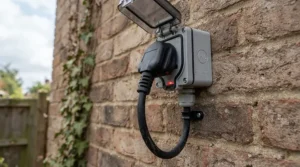
For anyone without a suitable outdoor socket already in place, this is genuinely the best money spent in the entire purchase. Garden power sockets built specifically for this purpose — IP66-rated, weatherproof, RCD-protected — solve every extension lead risk above in one go, and industry pricing generally sits in the £50-£150 range for the job, a short job usually completed in a couple of hours by a qualified electrician. Positioning matters too: convention (and most manufacturer guidance) recommends the socket sit around two metres from where the tub will stand, never closer than one metre, keeping the electrical connection comfortably clear of splash zones.
If you’re renting or genuinely can’t have permanent electrical work done, a rated outdoor extension lead run in a single, fully unwound length from an existing RCD-protected socket is the only acceptable fallback — never a permanent solution, but a legitimate temporary one if every rule in the section above is followed without exception. The cost difference between doing this properly and cutting corners isn’t really about money at all; it’s the difference between a relaxing evening and a genuinely dangerous one.
How to Choose a Plug and Play Hot Tub
Cutting through seven product write-ups into a decision framework, here’s what actually matters, in order:
- Capacity first. Buying for two people who occasionally have guests round is a different brief than buying for a family of five — oversizing wastes money on running costs, undersizing means guests standing around waiting for a turn.
- Shape suits your space, not the other way round. Square tubs pack more seating into rectangular patios; round tubs suit corners and curved layouts.
- Build material for your timeline. If you’re planning to keep it for years in one spot, drop-stitch or hard-shell construction earns its premium. If it’s a one-summer experiment, standard inflatable is fine.
- Jet count matters less than jet placement. A tub with fewer, well-distributed jets often feels better than one with more jets clustered in one zone — read aggregated reviews specifically for massage feel, not just the headline number.
- Confirm your electrical setup before you buy, not after. Know whether you have (or will install) a proper outdoor socket before the tub arrives.
- Factor in winter use if relevant. Not every model is rated for genuine cold-weather operation — freeze-protection technology varies meaningfully between brands.
- Read the accessory list carefully. Cover, pump, filters, and ground cloth are sometimes bundled and sometimes sold separately; this materially affects the real cost of ownership.
Common Mistakes When Buying a Plug and Play Hot Tub
The single most common mistake is buying on jet count alone, treating it like a horsepower figure that simply goes “bigger is better” — as the comparison table above shows, that’s not how it actually plays out in real-world comfort. A close second is skipping the electrical check entirely, assuming “plug and play” means “plug into literally anything nearby,” then discovering on delivery day that the nearest socket is an indoor one twelve feet from where the tub needs to sit. A third, quieter mistake is underestimating water chemistry costs — chlorine or bromine, test strips, and filter cartridges are an ongoing expense that doesn’t show up on the product page price tag but adds up meaningfully over a season. Finally, buyers regularly skip checking ground levelness before ordering, only to discover once the tub is half-filled that their patio has more of a slope than it looked.
Plug and Play vs Hardwired 32A Hot Tubs
The comparison table earlier in this guide covers the technical differences, but the practical decision usually comes down to one question: how much do you value speed versus simplicity? A 32A hardwired spa heats faster and typically runs a more powerful, continuous jet system, because it isn’t constrained by a 13A ceiling the way every tub on this list is. That extra performance comes at a real cost, though — not just the electrician’s fee, but the fact that hardwired spas are fixed installations. You can’t take them when you move house, and retrofitting an older property with a dedicated 32A circuit sometimes means a consumer unit upgrade too, adding further cost and disruption. For the vast majority of UK buyers — renters, first-timers, anyone without a compelling reason to need same-day heat-up — a plug and play hot tub delivers most of the experience at a fraction of the installation complexity and cost.
Long-Term Cost, Maintenance, and Garden Rules
Running costs on a 13A tub generally land in the region of a couple of pounds a day when actively heating and running jets regularly, though this varies with tub size, ambient temperature, and how often the cover stays on. Ongoing chemical costs (chlorine or bromine, pH balancers, test strips) typically add a modest monthly sum on top of electricity, and filter cartridges need replacing roughly every few weeks with regular use. Worth knowing before you buy: in most cases a portable, freestanding hot tub placed on a patio or level ground doesn’t require planning permission in the UK, since it isn’t considered a permanent structure, though that changes if you’re in a listed building, a conservation area, or planning to sink the tub into the ground or build a permanent enclosure around it. If any of those apply, Planning Portal’s official guidance is worth checking before you order rather than after.
Frequently Asked Questions
❓ What is a plug and play hot tub?
❓ Can I run a plug and play hot tub off an extension lead?
❓ How many amps does a plug and play hot tub use?
❓ Do plug and play hot tubs need a special socket?
❓ Are plug and play hot tubs cheaper to run than hardwired ones?
Conclusion
A plug and play hot tub isn’t a compromise version of a “real” spa — for most UK gardens, it’s the more sensible choice entirely. The seven models covered here span genuinely different budgets and priorities, from the Lay-Z-Spa Miami‘s low-commitment entry price to the MSpa Oslo Carbon Grey‘s hard-shell, app-controlled permanence, with the Intex PureSpa Greystone Deluxe, Lay-Z-Spa Paris AirJet, CleverSpa Cannes, CleverSpa Waikiki Black Label, and Lay-Z-Spa Helsinki filling the considerable ground between them. What separates a good purchase from a regretted one usually isn’t the tub itself — every model here is a genuine, currently available product with real specs behind it — it’s whether the electrical setup underneath it was done properly. Get the socket right, respect the amp rating, and skip the extension lead shortcuts, and a plug and play hot tub delivers exactly what the name promises: minimal fuss, maximum bubbles.
Recommended for You
- Hot Tub Under £2000: 7 Best Buys for UK Gardens (2026)
- Hot Tub Under £5000: 7 Best UK Picks for Every Garden (2026)
- Hard Shell Hot Tub: 7 Best UK Picks That Won’t Crack (2026)
Disclaimer: This article contains affiliate links. As an Amazon Associate, I earn from qualifying purchases. If you purchase products through these links, we may earn a small commission at no additional cost to you.
✨ Found this helpful? Share it with your friends! 💬🤗
