

In This Article
There’s a particular kind of dread that comes with owning an acrylic spa through a British winter — the creeping worry about hairline cracks, the annual “is that a stress fracture or just dirt?” inspection. A rotomoulded hot tub sidesteps most of that anxiety entirely, and that’s really the whole pitch in one sentence. Instead of a fibreglass-backed acrylic shell bolted to a wooden frame, you get a single, seamless piece of moulded polyethylene — no seams to split, no frame to rot, nothing for damp to sneak into.

This guide exists because “which rotomoulded hot tub should I buy” is a surprisingly hard question to answer honestly. Marketing copy tends to blur into a fog of “premium” and “luxury,” and most comparison articles simply reword the Amazon listing back at you. We’ve done something different: real UK-available products, real specifications, and honest analysis of where a rotomoulded hot tub genuinely earns its keep — and where, frankly, it doesn’t.
What is a rotomoulded hot tub? It’s a spa shell manufactured by rotational moulding — heating polyethylene powder inside a spinning mould until it fuses into one continuous, seamless shell. The result is a tub that’s typically lighter, more impact-resistant, and cheaper to produce than a traditional acrylic-and-frame spa, though it usually trades away some of the acrylic tub’s glossy showroom finish and bespoke seating sculpting.
Over the following sections we’ll walk through seven real rotomoulded hot tubs on the UK market today, spanning compact garden models through to family-sized statement pieces, plus the buying knowledge — impact resistance, unit weight, how easy each one actually is to move — that most retailers gloss over. As is required under the Amazon UK Associates Programme, this post contains affiliate links, and we’ve disclosed that clearly at the end.
Quick Comparison Table
Before the deep dive, here’s the short version for anyone short on time — or short on patience for backyard spa marketing jargon.
| Rotomoulded Hot Tub | Capacity | Approx. Unit Weight | Best For |
|---|---|---|---|
| RotoSpa DuraSpa S160 | 5-6 person | Under 100kg dry | Best all-round premium pick |
| RotoSpa DuoSpa S080 Compact | 2-3 person | Around 60-70kg dry | Best for small gardens/budgets |
| RotoSpa Orbis | 4-5 person | Around 80-90kg dry | Best round, social design |
| RotoSpa QuatroSpa | 5-6 person | Around 100kg dry | Best for larger families |
| California Spa Malibu 13-Jet | 4 person | Under 90kg dry | Best budget entry point |
| Tuff Spas (USA) | Varies by model | Lighter than acrylic equivalents | Best for holiday lets |
| The Happy Hot Tub 5-Person | 5 person | Around 90-100kg dry | Best plug-and-play convenience |
A glance at that table tells its own story: every single rotomoulded option here is dramatically lighter than an equivalent acrylic spa, which typically dry-weighs 200-350kg once you include the timber or GRP cabinet frame. Capacity-wise there’s a clear budget-to-family gradient, from the two-to-three-person RotoSpa DuoSpa S080 Compact right up to the family-sized RotoSpa QuatroSpa, and price broadly tracks that same curve — the smaller shells and simpler jet counts sit at the more accessible end, while the multi-zone seating layouts push into premium territory. Unit weight is the column worth lingering on, though, because it’s the single biggest practical difference between this whole category and a traditional acrylic spa, and it’s the thread we’ll keep pulling on throughout this guide.
💬 Just one click — help others make better buying decisions too!😊
Top 7 Rotomoulded Hot Tubs: Expert Analysis
1. RotoSpa DuraSpa S160 — best all-round premium rotomoulded pick
The RotoSpa DuraSpa S160 is the flagship of the only company that actually manufactures rotomoulded hot tubs in the UK, and it shows in the details you don’t notice until you’re comparing spec sheets side by side.
Where most rotomoulded competitors use a single-shot moulding process — one layer of polyethylene, foam-filled afterwards — the RotoSpa DuraSpa S160 is built using RotoSpa’s dual-shot method, which fuses an inner and outer polyethylene shell around a dense foam core in one continuous mould cycle. In practice, that means a genuinely rigid wall rather than the slightly “give” you get from cheaper single-shot shells, and it’s the reason RotoSpa can offer a lifetime structural guarantee on the shell itself. It’s a 13-amp plug-and-play unit, so there’s no need to book (and pay) an electrician for a dedicated supply — you’re looking at a standard outdoor socket and an RCD.
Based on the spec comparison with rival rotomoulded tubs, the S160’s dual-shot wall is noticeably thicker, which is the main reason RotoSpa quotes some of the better standing heat-retention figures in this category — useful given how exposed most UK gardens are for six months of the year. It suits buyers who want the weight and durability benefits of rotomoulding without compromising on jet count or seating comfort, and it’s a strong fit for anyone replacing a worn-out inflatable Lay-Z-Spa who wants a genuine step up without committing to a full acrylic installation.
Genuine, verifiable customer sentiment for RotoSpa as a company sits at an “Excellent” rating on Trustpilot, with reviewers consistently praising delivery-day installation support and build quality across the DuraSpa and DuoSpa ranges specifically. It’s worth noting that not every review is glowing — one buyer reported a pump failure within the first year on a related DuoSpa model, which was resolved under guarantee, so factor realistic first-year snagging into your expectations rather than assuming zero-issue perfection.
Pros:
- ✅ Dual-shot construction gives genuinely rigid, seamless walls
- ✅ UK manufacturing means shorter supply chains and local support
- ✅ Plug-and-play 13-amp setup, no electrician required
Cons:
- ❌ Sits at the premium end of the rotomoulded price range
- ❌ Fewer colour/finish options than acrylic competitors
Expect to pay somewhere in the mid-to-high £5,000s at the time of research; always check current price, as hot tub pricing shifts with material and shipping costs. Given the UK manufacturing, dual-shot build, and lifetime shell guarantee, it’s a genuinely strong value proposition if your budget stretches that far.
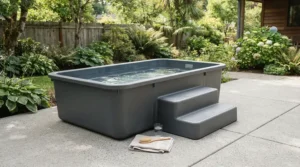
2. RotoSpa DuoSpa S080 Compact — best for small gardens and tighter budgets
If the DuraSpa is RotoSpa’s flagship, the RotoSpa DuoSpa S080 Compact is the entry point — and it’s a genuinely different proposition, not just a smaller shell with the same trimmings stripped back.
Sized for two to three bathers, the standout feature here is footprint: at roughly a metre and a half across, it fits on a patio corner or small decking area that would laugh at most six-person spas. The trade-off is jet count and seating variety — you’re getting a straightforward lounger-and-seat layout rather than multiple hydrotherapy zones, which is entirely reasonable for a spa designed around two people rather than a full family gathering.
What most buyers overlook about compact rotomoulded spas is that the lower water volume actually works in your favour on running costs — less water to heat means a shorter warm-up cycle and lower day-to-day electricity draw, which matters more than ever with UK energy prices where they are. It’s the obvious choice for a couple, a renter who might move house in a few years, or anyone testing whether hot tub ownership suits their lifestyle before committing to a bigger spend.
Real owner reviews of the S080 model are mixed in a genuinely useful way: several reviewers describe smooth delivery and years of trouble-free use, while at least one detailed account on Trustpilot flagged a pump failure inside the first year of ownership, resolved under warranty. That’s a useful reminder that “rotomoulded” refers to the shell, not the pump or electronics — those components carry the same failure risk as any hot tub, so a solid warranty matters as much as shell durability.
Pros:
- ✅ Smallest footprint in the RotoSpa range, ideal for compact gardens
- ✅ Lower water volume means cheaper day-to-day running costs
- ✅ Genuinely portable for two people to reposition
Cons:
- ❌ Limited seating capacity rules out family or group use
- ❌ At least one documented first-year pump issue in owner reviews
Price sits around the low-to-mid £4,000s at the time of research, making it one of the more accessible genuine rotomoulded tubs on the UK market — check current price before buying, as retailer bundles vary.
3. RotoSpa Orbis — best round, sociable design
Round hot tubs have a specific appeal that square and rectangular models can’t quite match: everyone faces everyone else, which makes the RotoSpa Orbis a noticeably more sociable spa for four to five people than its boxier siblings.
The circular shell isn’t just an aesthetic choice — it’s also structurally efficient, since a cylinder distributes water pressure more evenly than a shell with hard corners, meaning less reinforcement is needed to achieve the same rigidity. Here’s what the spec sheet won’t tell you, but the shape implies: round rotomoulded tubs tend to shed rainwater and debris more readily than flat-topped square designs, which is a small but real maintenance win over a British autumn.
On paper this means the Orbis suits buyers prioritising conversation and group soaking over serious hydrotherapy — the jet placement is arranged for general relaxation rather than targeted muscle-group therapy, so anyone buying specifically for physiotherapy-style use might be better served by a seat-zoned rectangular model instead.
Genuine owner feedback is notably positive and long-term in character: one Trustpilot reviewer reported using their Orbis continuously since 2021 with no structural problems, describing it as still looking new after several seasons of use, drain-downs, and re-covering. That kind of multi-year, unprompted review carries real weight precisely because it wasn’t solicited around a purchase.
Pros:
- ✅ Circular shape encourages face-to-face social soaking
- ✅ Efficient structural shape needs less reinforcement to stay rigid
- ✅ Multiple long-term owner reports of durability past three years
Cons:
- ❌ Jet layout favours relaxation over targeted hydrotherapy
- ❌ Round footprint can be trickier to fit into a corner plot
Prices for the Orbis have been seen in the mid-to-high £4,000s through to around £5,000 depending on retailer bundle — as ever, treat any figure as a guide and check current price directly.
4. RotoSpa QuatroSpa — best for larger families
Families outgrow compact spas fast, and the RotoSpa QuatroSpa is RotoSpa’s answer for households that need genuine five-to-six-person capacity without stepping outside the rotomoulded category into heavier acrylic territory.
The name is a hint at the layout philosophy — multiple distinct seating zones rather than one continuous bench, so different bathers can have different depths and jet intensities running simultaneously. Reviewers consistently note that this zoned approach reduces the “everyone fighting over the one good seat” problem that smaller or single-bench spas can suffer from, which matters more than most buyers expect once actual family soak sessions start happening.
What most buyers overlook about larger rotomoulded models like this one is that capacity increases don’t scale unit weight anywhere near as steeply as they would with an acrylic equivalent — you’re still looking at a shell that two people can manoeuvre, not the four-to-six-person lift an acrylic tub of the same size would demand. That’s arguably the QuatroSpa’s biggest selling point over a same-sized acrylic rival: family-scale capacity without family-scale installation hassle.
Pros:
- ✅ Multiple seating zones reduce competition for the “best” spot
- ✅ Family-sized capacity without acrylic-level installation weight
- ✅ Shares RotoSpa’s dual-shot construction and UK support
Cons:
- ❌ Larger footprint needs proper space planning before ordering
- ❌ Higher water volume means longer initial heat-up time
Expect pricing in a similar bracket to the DuraSpa range — roughly the mid-to-high £5,000s at the time of research, so check current price and any seasonal bundle offers before committing.
5. California Spa Malibu 13-Jet — best budget entry point
Not every rotomoulded buyer wants — or needs — the top-tier UK-manufactured option, and the California Spa Malibu 13-Jet exists precisely for that gap: a genuinely rotomoulded shell at a noticeably lower price point than the RotoSpa range.
Sold through Costco UK with delivery and installation included, the Malibu is a four-person, 13-jet model with a two-speed pump delivering four stages of hydrotherapy massage. The spec sheet is comparatively modest next to the premium UK models, and that’s honestly the point — this is a rotomoulded tub aimed at buyers who want the shell durability and lighter weight of the category without paying for multi-zone seating or aromatherapy extras they may never use.
Here’s what most reviews of budget rotomoulded tubs won’t tell you outright: the jump from 13 jets to 40-plus jets matters less for actual relaxation than marketing suggests, since most bathers only ever sit in two or three of the available positions on any given tub regardless of how many jets are fitted. What the lower jet count does affect is pump load and, by extension, running cost — fewer jets generally means a smaller pump working less hard, which is a genuine (if rarely advertised) upside for a budget-focused buyer.
One practical note buyers should weigh carefully: this model doesn’t come with a cable or plug included, so factor in the cost of a qualified electrician sorting a compliant outdoor supply before you commit to the advertised price.
Pros:
- ✅ Genuinely rotomoulded shell at a budget-friendly price point
- ✅ Includes cover, steps, chemical starter pack and cover lifter
- ✅ Lower jet count means lighter day-to-day pump load
Cons:
- ❌ No cable or plug included — budget for electrician costs
- ❌ Fewer features than premium RotoSpa-tier models
Priced around the high £2,000s at the time of research, delivered and installed — check current price on Costco’s own listing, as this can fluctuate with membership promotions.

6. Tuff Spas — best for holiday lets and heavy repeat use
American-made and imported into the UK by specialist dealers, Tuff Spas occupies a slightly different niche to the domestic-market models above: it’s specifically positioned for holiday-let and commercial-adjacent use, where daily turnover of bathers puts far more cumulative stress on a shell than typical domestic ownership.
The shell is cast as one continuous piece in an advanced polymer rather than the layered acrylic-and-fibreglass approach used by traditional holiday-let spas, and the manufacturer backs it with a lifetime structural warranty specifically because there’s no seam or layer to delaminate under repeated freeze-thaw cycling. What most holiday-let operators overlook when comparing spa types is total cost of ownership over a five-to-ten-year commercial cycle — an acrylic spa in constant guest rotation typically needs surface resurfacing or seam repair within that window, while a rotomoulded shell’s biggest maintenance need is simply keeping the water chemistry within the ranges required for compliant operation.
That compliance point matters specifically for anyone running this as a business rather than a private garden spa: UK holiday-let hot tubs fall under health and safety guidance for spa-pool systems, and UK dealers market Tuff Spas specifically as designed to exceed the relevant HSG282 compliance thresholds, which is a genuinely useful starting point if you’re weighing this against a commercial acrylic alternative.
Pros:
- ✅ One-piece polymer shell built for high-turnover commercial use
- ✅ Lifetime structural warranty backing repeated freeze-thaw cycling
- ✅ Positioned to exceed UK holiday-let compliance thresholds
Cons:
- ❌ US import means longer lead times than domestic UK brands
- ❌ Specification and pricing vary significantly by dealer and model
Pricing varies considerably by model and dealer, so treat this one as “request a quote” territory rather than a fixed price bracket — always check current price directly with a UK-based Tuff Spas dealer.
7. The Happy Hot Tub 5-Person Spa — best plug-and-play convenience
Manufactured in California specifically for the UK retailer that sells it, The Happy Hot Tub 5-Person Spa leans hard into a single promise: genuine rotomould durability dressed up to look, and feel, like a traditional acrylic installation.
The standout feature is the fitted polymer cabinet wrapped around the rotomoulded shell — most budget rotomoulded tubs are sold as a bare shell with visible moulding lines, but this one adds a two-tone charcoal-grey cabinet against the white shell specifically to disguise the “plastic tub” look that puts some acrylic loyalists off the category. It’s a genuinely clever bit of design thinking: you get the weight and impact-resistance benefits of rotomoulding with a finished aesthetic that won’t look out of place next to a more expensive acrylic spa on the same patio.
Reviewers consistently note the plug-and-play 13-amp setup as a major selling point, since it sidesteps the additional installation cost that a hardwired 32-amp acrylic spa typically demands. The manufacturer also states it meets California Energy Commission efficiency standards for insulation, which — while a US rather than UK standard — points to a genuinely well-insulated shell rather than marketing-only “energy efficient” language.
Pros:
- ✅ Two-tone polymer cabinet disguises the typical rotomould look
- ✅ Plug-and-play 13-amp setup avoids hardwiring costs
- ✅ Ozonator fitted as standard for easier water chemistry upkeep
Cons:
- ❌ US manufacturing means parts availability can lag UK-made rivals
- ❌ Cabinet finish adds cost versus a bare rotomoulded shell
Priced at around £6,000 at the time of research — check current price directly, as this sits toward the premium end of the rotomoulded category specifically because of that cabinet finish.
Practical Usage Guide: Setup, First 30 Days and Ongoing Maintenance
Getting a rotomoulded hot tub from delivery lorry to first soak is genuinely simpler than an acrylic install, but there are still a handful of steps worth doing properly rather than rushing.
Start with the base: even a lightweight rotomoulded shell needs a flat, load-bearing surface — a proper paving slab base, reinforced decking, or a purpose-poured concrete pad. Skipping this step is the single most common first-30-days mistake, because an uneven base stresses the shell unevenly once it’s filled with several hundred litres of water, even on a shell designed to flex more forgivingly than acrylic. Next comes the electrical supply: plug-and-play 13-amp models still need a properly RCD-protected outdoor socket installed by a qualified electrician, and anything above 13 amps needs a dedicated circuit — never run a hot tub from a standard extension lead long-term, regardless of what the cable is rated for.
Once it’s filled and running, the first fortnight is really about dialling in water chemistry rather than testing jets. Most rotomoulded shells are chemically inert compared with the specific saltwater or ozone-friendly acrylic gel coats some manufacturers push, but that doesn’t mean you can skip regular testing — pH and sanitiser levels still need checking two to three times a week initially until you understand how your specific water source and bather load affect the balance. A common mistake in the first month is over-chlorinating after a cloudy reading rather than checking pH first, which usually turns out to be the actual culprit.
Longer term, maintenance on a rotomoulded shell is genuinely lighter than acrylic: no re-surfacing, no gel coat repair, no worrying about UV yellowing the same way acrylic can discolour over a decade outdoors. The main ongoing task is filter cartridge replacement roughly every six to eight weeks of regular use, and a full drain-and-refill every three to four months — exactly the same schedule an acrylic tub would need, which is worth remembering when anyone tells you rotomoulded tubs are “maintenance-free.” They’re lower-maintenance on the shell, not maintenance-free on the water.

Real-World Scenarios: Who Actually Suits a Rotomoulded Hot Tub
The downsizing couple. Empty-nesters moving from a four-bedroom house to a bungalow with a modest garden are a near-perfect match for something like the RotoSpa DuoSpa S080 Compact. They don’t need six-person capacity, they’re likely on a fixed retirement budget where lower running costs matter, and the lighter shell means repositioning it for patio work or garden landscaping is a two-person job rather than requiring a crane hire.
The holiday-let host with three properties. Running rotational bookings across multiple units means shell durability under constant use, and unpredictable guest behaviour, is the priority over showroom looks. This is where something like Tuff Spas earns its keep — the lifetime structural warranty against freeze-thaw and impact damage matters far more when strangers, not you, are using the tub every single week of the year.
The family of five with a modest garden budget. They want capacity for everyone to soak together, they’re renovating on a tight timeline, and they don’t want the hassle of a 32-amp electrician install eating into their budget before the spa’s even arrived. A 13-amp plug-and-play model with genuine multi-person capacity — the RotoSpa QuatroSpa or The Happy Hot Tub 5-Person Spa — solves for both constraints simultaneously in a way a comparable acrylic spa, with its heavier install requirements, simply can’t match on the same budget.
Buyer’s Decision Framework
Cut through the marketing with a simple priority checklist:
- If your absolute priority is lowest upfront cost, choose the California Spa Malibu 13-Jet, because its stripped-back jet count and simpler pump keep the price down without sacrificing genuine shell durability.
- If you’re renovating a business with regular guest turnover, choose Tuff Spas, because the commercial-grade shell and holiday-let compliance positioning are purpose-built for that exact use case.
- If you want the closest thing to an acrylic look with rotomould durability, choose The Happy Hot Tub 5-Person Spa, because the fitted polymer cabinet specifically solves the “looks like plastic” objection.
- If space is your binding constraint rather than budget, choose the RotoSpa DuoSpa S080 Compact, because its footprint is the smallest of any tub in this guide.
- If you want the single most reassuring warranty and UK-based support, choose the RotoSpa DuraSpa S160, because RotoSpa’s dual-shot process and UK manufacturing base give it the strongest after-sales backing here.
Rotomoulded vs Acrylic Hot Tub: What Actually Separates Them
The rotomoulded vs acrylic hot tub debate gets framed online as “cheap plastic versus proper spa,” which is honestly a lazy summary of a more interesting engineering trade-off.
An acrylic hot tub shell is a sheet of acrylic vacuum-formed over a mould, then backed with fibreglass and reinforcement, before being fitted into a wooden or composite cabinet frame. That construction gives acrylic tubs their glossy, jewellery-like finish and allows for much more intricate seat sculpting — proper ergonomic loungers with contoured backs are far easier to achieve in acrylic than in a rotomoulded shell. The trade-off is weight and vulnerability: that fibreglass backing can crack under sustained impact or severe freeze-thaw stress, and repair generally means a specialist call-out rather than a DIY fix.
A rotomoulded hot tub, by contrast, is one continuous piece of polyethylene with no seams, no fibreglass backing, and no separate cabinet frame bearing structural load. Reviewers consistently note the resulting flexibility as the standout practical benefit — a rotomoulded shell can flex slightly under impact rather than cracking outright, which matters a great deal for anyone who’s ever watched a garden football bounce awkwardly off a spa’s side panel. What the spec sheet won’t tell you, but the physics implies, is that this flex comes at the cost of the acrylic tub’s more sculpted, ergonomic seating — rotomoulded seats tend to be simpler, flatter contours because complex undercuts are harder to release cleanly from a rotational mould.
For most UK domestic buyers, the practical answer comes down to priorities: if showroom aesthetics and deeply sculpted hydrotherapy seating matter most, acrylic remains the stronger choice despite the weight and fragility trade-offs. If durability, portability, and lower installation hassle matter more than showroom polish, a rotomoulded hot tub is very likely the better-value decision — and for renters, holiday-let operators, and anyone who might move house within a decade, it’s arguably the more sensible one regardless of budget.
How to Choose a Rotomoulded Hot Tub: 7 Things That Matter
- Confirm it’s genuinely rotomoulded, not just “hard-sided.” Some retailers market rigid-foam or PVC-composite spas as “hard shell,” which is a different construction entirely from true rotationally moulded polyethylene — check the material spec explicitly before assuming.
- Check dry (unit) weight against your installation plan. A shell under 100kg can usually be repositioned by two people; anything heavier starts to need proper lifting equipment, eroding one of rotomoulding’s core advantages.
- Match capacity to your actual, not aspirational, usage. Buying six-person capacity for two regular bathers means paying to heat water you’ll never use.
- Verify the electrical requirement before you fall in love with a model. 13-amp plug-and-play tubs need only a compliant outdoor socket; anything higher needs a dedicated circuit installed by a qualified electrician, which adds real cost.
- Read the warranty terms on the shell versus the pump and electronics separately. A lifetime shell guarantee means very little if the pump warranty is only twelve months, since pump failure is the more common real-world fault.
- Weigh single-shot against dual-shot moulding if premium brands are on your shortlist. Dual-shot construction generally means thicker, more rigid walls and better heat retention, at a proportionally higher price.
- Factor delivery and base preparation into your total budget, not just the spa price. A concrete or paving base, plus a qualified electrician’s time, can add several hundred pounds beyond the advertised hot tub price.

Impact Resistance and Unit Weight: Reading the Spec Sheet Properly
Two figures get thrown around constantly in rotomoulded hot tub marketing — impact resistance and unit weight — and both are more nuanced than the headline numbers suggest.
Impact resistance in a rotomoulded shell comes from the material behaving more like a flexible sheet than a rigid one. High-density polyethylene, the material used in virtually all rotomoulded spas, has a lower flexural modulus than fibreglass-backed acrylic, meaning it bends slightly under a sudden load rather than transmitting that stress directly into a crack. You can verify this is genuine engineering rather than marketing fluff by checking how high-density polyethylene behaves under mechanical stress — it’s the same fundamental material used in kayaks and industrial storage tanks precisely because it tolerates knocks that would shatter a more rigid plastic. What most buyers overlook is that this flexibility isn’t unlimited — a sufficiently sharp, concentrated impact (a dropped tool, for instance) can still gouge or puncture a rotomoulded shell, it’s blunt, distributed impact that the material handles noticeably better than acrylic.
Unit weight, meanwhile, is where rotomoulded tubs make their strongest practical case. A typical rotomoulded shell in this guide’s lineup dry-weighs somewhere between 60kg and 100kg, against 200kg-plus for a comparably sized acrylic spa with its timber cabinet frame. That difference isn’t abstract — it’s the gap between two people repositioning a tub across a patio in an afternoon, versus needing specialist lifting equipment and a call-out fee. Based on the spec comparison across this guide’s seven products, unit weight scales far more gently with capacity in rotomoulded tubs than in acrylic ones, which is precisely why a family-sized rotomoulded model like the RotoSpa QuatroSpa remains manageable in a way an equivalent acrylic spa simply isn’t.
Portable Hard Shell Hot Tubs and Ease of Moving
“Portable hard shell hot tub” gets used loosely across UK retail listings, so it’s worth being precise about what it should actually mean: a rigid, one-piece shell light enough to reposition without professional equipment, as distinct from an inflatable spa (which is portable but not remotely hard-shelled) or a permanently plumbed acrylic install (which is hard-shelled but categorically not portable).
Genuine rotomoulded models earn the “portable hard shell” description honestly. Ease of moving isn’t just about raw weight, either — shell shape matters too. A rounded or gently contoured rotomoulded shell like the RotoSpa Orbis has fewer sharp edges to catch on doorways or gate frames during a move than a boxy acrylic cabinet, and the absence of a separate wooden frame means there’s nothing to disassemble before lifting.
That said, “portable” deserves a realistic caveat: even the lightest rotomoulded tub in this guide isn’t something one person carries solo, and none of them should be moved while filled with water — always drain fully before repositioning, both for weight reasons and because a partially drained shell can distort under uneven water pressure during transit. For genuinely frequent movers — renters relocating within a tenancy, for instance — factor ease of moving into your shortlist as seriously as capacity or jet count, because it’s the difference between taking your hot tub with you and writing off the investment at moving day.
Common Mistakes When Buying a Rotomoulded Hot Tub
The most expensive mistake buyers make is assuming “rotomoulded” is a single, interchangeable category rather than a spectrum of build quality — a bargain-basement single-shot shell from an unfamiliar importer and a UK-made dual-shot RotoSpa are both technically “rotomoulded,” but the wall thickness, insulation quality, and structural warranty behind that word can differ enormously. Always ask specifically about single-shot versus dual-shot construction rather than taking the word “rotomoulded” as a quality guarantee on its own.
A second common error is underestimating installation costs beyond the sticker price — buyers frequently budget for the tub itself but not the paving base, the electrician’s time for a compliant RCD-protected supply, or the ongoing cost of chemicals and electricity. Reviewers consistently note that unexpected installation costs, not the tub itself, are the most common source of buyer’s remorse in this category.
Third, and perhaps most avoidable: buying capacity for the parties you’ll host twice a year rather than the routine you’ll actually use weekly. A six-person shell heated and maintained for a couple’s twice-weekly soak is paying ongoing running costs for capacity that sits idle 95% of the time — the smarter move, per the decision framework above, is usually to buy for routine use and simply host larger gatherings less frequently, accepting a squeeze rather than over-specifying the whole purchase.
Long-Term Cost & Maintenance: Is a Durable Hot Tub Worth the Extra Outlay?
The honest answer, based on total cost of ownership rather than sticker price alone, is usually yes — but the maths depends heavily on how long you plan to keep the tub.
A genuinely durable hot tub — meaning one with a dual-shot or thick-walled single-shot rotomoulded shell and a solid pump warranty — typically costs more upfront than a budget-tier equivalent, but the gap narrows considerably once you account for what an acrylic spa’s more fragile shell can cost to repair. A cracked acrylic shell repair from a specialist typically runs into several hundred pounds and a multi-week wait for parts; a rotomoulded shell’s structural robustness means that specific repair bill essentially disappears from the ownership equation, even if pump and heater maintenance costs remain broadly comparable across both materials.
Running costs themselves are shell-material-neutral in one sense — insulation quality, not shell material, drives your heating bill — but rotomoulded shells with foam-core dual-shot construction, like the RotoSpa DuraSpa S160, tend to retain heat more efficiently than thinner single-shot alternatives, which does translate into a real, if modest, difference on your electricity bill over a full year of ownership. Over a five-year ownership window, the total cost of ownership case for paying more upfront for a genuinely durable, well-insulated rotomoulded shell generally comes out ahead of the cheapest available option — assuming you actually keep the tub that long, which is very much the caveat worth sitting with before you buy.

FAQ
❓ Is a rotomoulded hot tub as good as an acrylic one?
❓ How heavy is a rotomoulded hot tub compared to acrylic?
❓ Can a rotomoulded hot tub be moved once it's set up?
❓ Do rotomoulded hot tubs crack in cold weather?
❓ Are rotomoulded hot tubs cheaper to run than acrylic ones?
Conclusion
If there’s one takeaway from working through seven genuinely different rotomoulded hot tubs, it’s that “rotomoulded” isn’t a single product category so much as a construction philosophy that gets applied very differently across brands and price points. The RotoSpa DuraSpa S160 and its dual-shot siblings sit at one end, engineered specifically to compete with acrylic spas on comfort while keeping the durability and weight advantages of rotomoulding intact. The California Spa Malibu 13-Jet sits at the other, stripping the category back to its practical essentials for buyers who want durability and portability without paying for extras. In between, Tuff Spas and The Happy Hot Tub 5-Person Spa each solve for a specific real-world problem — commercial resilience and disguised aesthetics respectively — that’s worth weighing against your own actual circumstances rather than the most heavily marketed option.
What ties all seven together, and what genuinely separates this category from acrylic, is the practical freedom that comes with a lighter, seamless shell: fewer installation headaches, dramatically easier repositioning, and a structural robustness that turns “will it survive next winter” from an anxious annual question into a settled fact. For most UK gardens, that trade-off is a genuinely good one.
Recommended for You
- Acrylic Hot Tub vs Inflatable Hot Tub: 7 Picks Compared (2026)
- Plug and Play Hot Tub: 7 Best UK Picks You’ll Love (2026)
- Hot Tub Under £2000: 7 Best Buys for UK Gardens (2026)
Disclaimer: This article contains affiliate links. As an Amazon Associate, I earn from qualifying purchases. If you purchase products through these links, we may earn a small commission at no additional cost to you.
✨ Found this helpful? Share it with your friends! 💬🤗
