
In This Article
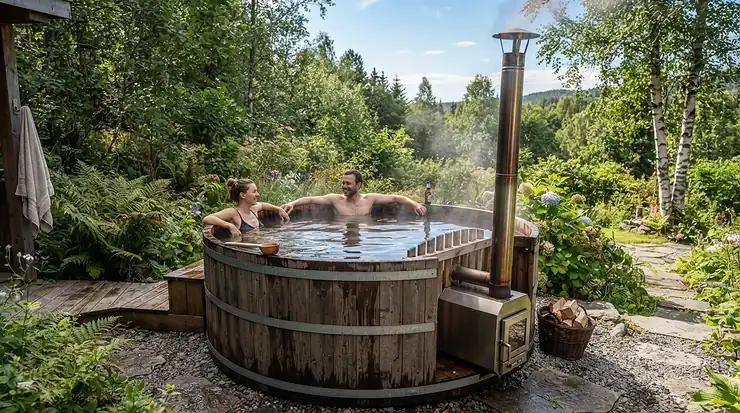
There’s a particular kind of quiet that settles over a garden once the light drops and steam starts curling off a tub of hot water — and if you’ve never lit a fire specifically to heat bathwater, you’re missing out on one of the strangest, most satisfying rituals a British back garden can offer. A wood-fired hot tub does exactly what it says: no electrics, no pump humming away, just logs, flame, and a couple of hours of patience before the water’s warm enough to climb into.

That patience is precisely why interest has surged. With electricity prices still eye-watering, an off-grid soak that costs little more than a bag of kiln-dried logs has obvious appeal. But “wood-fired hot tub” covers a huge spread of products — from a compact two-person barrel you could genuinely call an affordable wood-fired hot tub UK buyers can stretch to, right up to fibreglass-lined showpieces with jets, lighting and a five-figure price tag. This guide walks through seven real, currently available models, breaks down what tub capacity actually means for your household, and covers the unglamorous but essential stuff — delivery and setup — that most listings skate over. Before you buy anything, it’s worth knowing what a wood-fired hot tub is, so let’s start there.
What is a wood-fired hot tub? It’s a garden bathing vessel — usually timber-clad with a fibreglass, acrylic or wood-stave inner shell — heated by an internal or external wood-burning stove instead of an electric element. Water circulates naturally between the stove and tub as it warms, typically reaching soaking temperature in one to three hours with no mains power required.
Installing one rarely needs formal sign-off, though it’s worth a quick check of your permitted development rights before you commit, particularly if you’re near a boundary or in a conservation area — the Planning Portal’s guidance on hot tub permissions is the clearest starting point.
Quick Comparison Table
| Model | Capacity | Price Range | Best For |
|---|---|---|---|
| Woodpecker Off-Grid Tub | 4-5 people | Around £2,700-£3,400 | Best affordable wood-fired hot tub UK pick |
| LayzeeTubs Wood-Fired Ofuro | 2 people | Under £3,000 | Cheap wood burning hot tub for couples |
| TubTub 2-Person | 2 people | £3,100-£3,400 | Entry-level wood-fired tub with LED/jets |
| Royal Tubs Square Hot Tub | 4-6 people | £3,800-£4,800 range | Best tub capacity for families |
| LayzeeTubs “René” XL 225cm | 6-8 people | £3,600-£4,200 range | Biggest usable capacity |
| Outdoor Elite 4-6 Person | 4-6 people | Around £4,300-£4,700 | Best all-round premium pick |
| Skärgårds Regal | 4-6 people | £5,500+ | Design-led splurge |
Reading across this table, the spread is obvious: you’re paying roughly £1,500 more to go from a no-frills two-person soak to a lit, jetted six-seater, and most of that premium buys insulation quality, seating engineering and finish rather than raw heating performance. If capacity is your main driver, the LayzeeTubs “René” XL 225cm and Royal Tubs Square Hot Tub earn their keep; if budget is the priority, the Woodpecker Off-Grid Tub and LayzeeTubs Wood-Fired Ofuro do the job for considerably less outlay.
💬 Found a favourite already? A quick click helps you compare live prices before anyone else grabs the good delivery slots! 😊
Top 7 Wood-Fired Hot Tubs: Expert Analysis
1. Woodpecker Off-Grid Tub — best affordable wood-fired hot tub UK pick
The clue is in the name: Woodpecker built this as a genuinely off-grid product, and it shows in how little you need to get it running. Beyond the tub and stove, there’s nothing else to plumb in or wire up.
Spec-wise, it’s a mid-size timber-clad barrel seating four to five, with an internal wood-burning stove and a stainless-steel liner option for buyers who want to add bathing salts without worrying about corrosion. That stainless upgrade matters more than it sounds — cheaper mild-steel liners can pit over a couple of seasons if you’re a regular Epsom-salt bather, so it’s a genuine practical distinction, not just marketing. Based on the spec sheet, this sits closer to entry-level than premium, and that’s exactly its appeal.
Aggregated review sentiment on Trustpilot is largely positive, with several owners specifically praising how quickly the water heats once they’d worked out the right amount of wood, and describing regular use through winter months. A handful of reviews flagged slower-than-expected responses from customer service during busy periods, which is worth factoring into your expectations around delivery communication.
Pros:
- ✅ Genuinely affordable entry point into wood-fired ownership
- ✅ Stainless liner option resists salt-water corrosion
- ✅ Heats faster than owners typically expect
Cons:
- ❌ Customer service response times can lag at peak season
- ❌ Fewer built-in extras than pricier rivals
Expect to pay somewhere in the low-to-mid £3,000s at the time of research, though prices shift, so always check the current price before ordering. For sheer value relative to a working wood-fired soak, the Woodpecker Off-Grid Tub is difficult to beat.

2. LayzeeTubs Wood-Fired Ofuro — cheap wood burning hot tub for couples
If two people is all you need to seat, don’t pay for six seats you’ll never fill. The LayzeeTubs Wood-Fired Ofuro is a compact, deep-soak design borrowed from the Japanese ofuro tradition — you sit rather than lounge, which means a smaller footprint and, crucially, a smaller water volume to heat.
That water volume is around 700 litres, which the spec sheet lists as heating in roughly an hour during summer and one to two hours in winter — genuinely fast for a wood-fired unit, largely because there’s simply less water to warm than in a six-seater. The shell is fibreglass-lined thermowood or spruce, paired with an external stainless stove. What most buyers overlook about compact ofuro-style tubs is that the deep, upright seating position is actually kinder to your back than reclining designs, since your spine stays supported rather than stretched flat.
Real customer feedback for LayzeeTubs’ range consistently highlights delivery reliability and the two-man assembly service, though buyers should note the company is upfront that these are made-to-order units, so cancellation flexibility is limited once you’ve placed an order.
Pros:
- ✅ Fastest heat-up time in this line-up, summer or winter
- ✅ Small footprint suits compact gardens and patios
- ✅ Deep, upright seating is comfortable for longer soaks
Cons:
- ❌ Only seats two — no option to expand later
- ❌ Made-to-order, so orders can’t be cancelled once confirmed
Priced under £3,000 at the time of research, this is about as close as the wood-fired category gets to a genuinely cheap wood burning hot tub without stepping down into inflatable territory.
3. TubTub 2-Person — entry-level wood-fired tub with LED and air massage
Where the Ofuro strips things back, TubTub’s 2-Person model adds a few creature comforts without pushing the price far past entry-level territory. It pairs a fibreglass shell and external wood-fired stove with a seven-colour LED lighting system and an air massage system — bubbles, essentially, powered by a small pump.
Here’s the honest caveat: that pump and lighting rig needs a standard 13-amp outdoor plug, so this isn’t the fully off-grid experience some buyers expect from a “wood-fired” tub — you’re heating with wood but still need a power point nearby for the extras. Reviewers who’ve bought it seem to treat that as a fair trade-off given how quickly it heats, with the manufacturer citing roughly an hour under optimum conditions.
Based on the spec comparison with the Ofuro above, TubTub’s advantage is entirely in the add-ons — lighting and bubbles — rather than raw heating speed or capacity, so it suits buyers who want ambience as much as warmth.
Pros:
- ✅ Seven-colour LED lighting adds genuine evening ambience
- ✅ Air massage system included as standard, not an add-on
- ✅ Comes with two-tier steps and an insulated cover
Cons:
- ❌ Requires mains power for lights and pump, despite wood heating
- ❌ Air massage motor is another component that can eventually need servicing
At roughly £3,200 at the time of research, it slots neatly between the barebones budget options and the larger family tubs further down this list.
4. Royal Tubs Square Hot Tub — best tub capacity for families
Round tubs are the default in this category, which makes the Royal Tubs Square Hot Tub stand out simply by shape. A square footprint packs in more usable seating per square metre of garden than an equivalent round tub — the corners aren’t wasted space the way they would be in a circular design — which is exactly why it earns the nod for tub capacity among family-sized buyers.
Royal Tubs manufactures in the UK, which the brand leans on for shorter delivery lead times than some of the imported European tubs in this list. The build uses high-quality pipework and fittings designed for straightforward long-term maintenance, and the company offers full delivery and installation to your chosen spot in the garden — worth knowing if you don’t fancy manhandling a few hundred kilos of timber and water tank yourself.
What most buyers overlook about square designs specifically is that they’re genuinely easier to fit against a fence line or wall than round tubs, since you’re not leaving awkward curved gaps around the perimeter.
Pros:
- ✅ Square shape maximises usable seating for its footprint
- ✅ UK manufacturing typically means shorter lead times
- ✅ Delivery and professional installation included
Cons:
- ❌ Square panelling can be marginally more exposed to warping than curved staves
- ❌ Less common shape means fewer third-party cover options
Expect a price in the £3,800-£4,800 range depending on finish and stove upgrade, positioning this firmly as a mid-range family pick.
5. LayzeeTubs “René” XL 225cm — biggest usable capacity in this line-up
At 225cm across, the “René” XL is built for six to eight people, and it’s the clearest answer in this guide to “how big can a wood-fired tub realistically get without tipping into commercial territory.” The fibreglass liner keeps maintenance simpler than a raw timber interior, and LayzeeTubs backs it with a ten-year warranty against outdoor weathering.
Because it’s a larger water volume, heating takes proportionally longer than the compact Ofuro model above — reasonable, given there’s simply more litres to warm through the same stove. What the spec sheet won’t tell you, but the size comparison makes obvious, is that a tub this large also drinks noticeably more logs per session, so factor firewood cost into your running-cost thinking, not just the upfront price.
Reviewers frequently mention the free UK delivery and the reassurance of a decade-long warranty as deciding factors, particularly for buyers who plan to host regularly rather than soak solo.
Pros:
- ✅ Genuinely seats six to eight without feeling cramped
- ✅ Ten-year warranty against outdoor weathering
- ✅ Fibreglass liner simplifies long-term cleaning
Cons:
- ❌ Higher firewood consumption per heating session
- ❌ Needs more garden space than any other tub here
At the time of research this was discounted to around £3,795 from a £5,995 list price, though promotional pricing changes constantly, so treat that as a guide rather than a guarantee.

6. Outdoor Elite 4 to 6 Person — best all-round premium pick
This is the tub built to be the centrepiece rather than a garden accessory. The Outdoor Elite 4 to 6 Person pairs a Scandi-inspired spruce trim with a fibreglass top cover, polyurethane foam insulation, and twelve air nozzles with an optional Jacuzzi-style jet upgrade — genuinely closer to a spa experience than most wood-fired competitors.
The insulated fibreglass cover isn’t just cosmetic — it measurably speeds up heating by trapping warmth the stove has already generated, which the manufacturer cites as bringing heat-up time down to as little as 1.5 to 2.5 hours depending on conditions. Two stainless-steel straps around the exterior maintain the barrel’s shape over time, addressing one of the more common failure points on cheaper timber tubs: staves bowing outward as the wood naturally moves with humidity.
Reviewers and the brand’s own product notes both point to the matching two-tiered steps and integrated bottle holder as small but appreciated touches for anyone using it socially rather than solo.
Pros:
- ✅ Insulated cover noticeably speeds up heating
- ✅ Steel straps guard against stave warping long-term
- ✅ Optional Jacuzzi jets for genuine spa-level massage
Cons:
- ❌ Among the pricier options in this round-up
- ❌ Jet upgrade adds further cost on top of the base price
Priced around £4,499 at the time of research, this is the tub to pick if you want the fullest feature set without stepping into boutique Scandinavian territory.
7. Skärgårds Regal — design-led splurge
Skärgårds is a Swedish brand with a genuinely different engineering approach: rather than a simple external stove pumping heated water into the tub, the Regal’s stove has upper and lower channels connected directly to the tub’s double walls, letting water circulate naturally as it heats. It’s a subtler, quieter system than a bolt-on external heater, and it shows in the finish — this is the tub buyers choose when they want a piece of outdoor furniture, not just a bathing appliance.
On paper this means slightly more sophisticated plumbing than the other six tubs here, which typically translates to a smoother, more even heat distribution rather than hot pockets near the stove intake. The trade-off is price: Scandinavian-engineered wood-fired tubs consistently sit at the top of the market, and Skärgårds is no exception.
Because it’s a specialist import, verified UK customer review volume is thinner than for the domestic brands in this list — what’s available leans positive on build quality and design, but buyers should weigh that smaller review sample honestly rather than assume it matches the larger brands’ track record.
Pros:
- ✅ Integrated dual-channel stove gives more even heat distribution
- ✅ Premium Scandinavian design and materials throughout
- ✅ Quieter operation than bolt-on external heater systems
Cons:
- ❌ Significant premium over UK-manufactured alternatives
- ❌ Smaller pool of verified UK reviews to draw on
Prices for Skärgårds tubs of this size typically start above £5,500, firmly positioning the Regal as the aspirational pick in this line-up rather than a starter purchase.
Top 7 Products Comparison
| Model | Heat-Up Time | Power Needed | Best For |
|---|---|---|---|
| Woodpecker Off-Grid Tub | ~2-3 hrs | None | Budget-first buyers |
| LayzeeTubs Wood-Fired Ofuro | ~1-2 hrs | None | Couples, small gardens |
| TubTub 2-Person | ~1 hr | 13A outdoor plug | Lighting/bubbles fans |
| Royal Tubs Square Hot Tub | ~2-3 hrs | None | Families, tight boundaries |
| LayzeeTubs “René” XL | ~2-3 hrs | None | Large groups |
| Outdoor Elite 4-6 Person | ~1.5-2.5 hrs | 13A outdoor plug (jets/lights) | Full-feature premium |
| Skärgårds Regal | ~2-3 hrs | None | Design-focused buyers |
The pattern worth noting here is that heat-up time correlates more with water volume than price — the two-person tubs consistently warm fastest regardless of budget tier, simply because there’s less to heat. If speed matters more to you than seating, don’t assume paying more automatically buys a faster soak; check the litre capacity, not just the headline price.

Affordable Wood-Fired Hot Tub UK: What “Budget” Actually Buys You
Setting expectations early saves disappointment later. A genuinely affordable wood-fired hot tub UK buyers can access sits in the low-to-mid £3,000s, not the £1,000 territory some inflatable-tub comparisons might suggest. Anything advertised much below that band is typically a basic timber barrel with a five-year realistic lifespan and a higher chance of leaking, since untreated wood naturally shrinks and swells with humidity.
What budget buyers should actually prioritise is a stainless or fibreglass inner liner over raw wood staves — it costs more upfront but avoids the recurring leak repairs that eat into any savings within a couple of seasons. The Woodpecker Off-Grid Tub and LayzeeTubs Wood-Fired Ofuro both hit this sweet spot: real savings versus the premium tier, without falling into the “cheap now, expensive later” trap of untreated timber.
How to Choose a Wood-Fired Hot Tub
- Confirm your realistic capacity first. Count the people who’ll actually use it weekly, not the maximum you might host twice a year — oversized tubs take longer to heat and burn more wood every single session.
- Check the inner shell material. Fibreglass and acrylic liners resist leaks and clean easily; raw timber staves look rustic but need more attentive care.
- Work out your delivery access. Measure gates, side passages and any narrow routes to your intended spot — most suppliers need at least 1.2m clearance for a two-person delivery team.
- Decide if you want any electrics at all. Some “wood-fired” tubs still need a 13-amp supply for lighting or air jets — true off-grid buyers should check this before ordering.
- Factor in stove position and chimney clearance. Internal stoves heat faster but eat into seating space; external stoves free up the tub interior but need more garden footprint.
- Read genuine review platforms, not just the retailer’s site. Aggregated sentiment on Trustpilot or similar gives a fuller picture than curated testimonials.
- Budget for firewood as an ongoing cost. It’s cheap per session, but a large tub used weekly through autumn and winter adds up — the Which? hot tub buying guide is a useful independent reference for weighing running costs generally.
Practical Usage Guide: Setup, First Soak and Avoiding Rookie Mistakes
Getting a wood-fired hot tub from delivery day to your first proper soak involves more patience than most buyers expect, so it’s worth planning the sequence rather than winging it.
Start with the base. Every model in this guide needs a flat, stable, load-bearing surface — a full tub easily weighs over a tonne once filled, so decking or slabs rated for that load matters more than aesthetics. Fill the tub with a hose before you light anything; lighting an empty or part-filled stove risks warping the metal and, on internal-stove models, scorching the shell.
Once full, build a small, steady fire rather than a roaring one — a modest, consistent burn heats water more evenly than a blaze that dies down after twenty minutes. Most owners find a genuine rookie mistake is over-packing the firebox early on, which can smoke excessively without actually heating faster. Give it the full quoted heat-up window before topping up with more logs; checking too early just lets heat escape every time you lift the lid.
For the first thirty days, keep an eye on water clarity and consider a simple filtration or chemical routine even on a basic model — stagnant untreated water in warm conditions is exactly the environment public health guidance warns about, and the HSE’s guidance on legionella in spa-pool systems is a genuinely useful reference even for domestic, occasional-use owners rather than just commercial operators.
Delivery and Setup: What UK Buyers Should Expect
Delivery and setup vary more between brands than almost any other factor in this category, and it’s worth interrogating before you order rather than after. Most of the UK-based suppliers in this guide — including Royal Tubs and the LayzeeTubs range — include a two-person delivery team who’ll position the tub and, in many cases, assist with basic assembly, but nearly all of them specify a minimum access width (commonly around 1.2 metres) and reserve the right to leave the tub at the nearest accessible kerbside if your garden route doesn’t allow safe manoeuvring.
Lead times differ too: UK-manufactured tubs like Royal Tubs’ range tend to ship faster than imported Scandinavian models like the Skärgårds Regal, which can take several weeks longer given the distance and any customs processing involved. Ask specifically about assembly responsibility before ordering — some suppliers deliver a fully built tub ready to fill, while others deliver in kit form expecting the buyer to complete final assembly, and that distinction matters enormously if you’re not confident with basic DIY.
Real-World Scenarios: Matching a Tub to Your Life
The young couple with a small courtyard garden. Limited space, limited budget, and honestly, just the two of them most weekends. The LayzeeTubs Wood-Fired Ofuro fits both the footprint and the wallet, and its fast heat-up means a spontaneous Friday-night soak doesn’t require a Wednesday-afternoon head start.
The family of five who host constantly. Weekend barbecues, cousins visiting, birthday soaks — capacity and durability matter more than speed. The Royal Tubs Square Hot Tub or LayzeeTubs “René” XL both earn their keep here, with the square design edging it for gardens where space is at a premium.
The couple building a proper garden retreat. Budget isn’t the constraint; getting the full spa experience is. The Outdoor Elite 4-6 Person with its optional jets, or the Skärgårds Regal for buyers who want design pedigree as much as function, both suit this brief.
Common Mistakes When Buying a Wood-Fired Hot Tub
Buyers frequently underestimate ongoing costs, focusing entirely on the upfront price while ignoring firewood, occasional liner treatment, and cover replacement every few years. Another recurring mistake is skipping the access-width check before ordering, only to discover on delivery day that a side gate is six centimetres too narrow for the delivery team’s trolley. Finally, many first-time buyers assume “wood-fired” automatically means zero ongoing electricity use, when several models — including two in this guide — still need a standard outdoor plug for lighting or jets.
Long-Term Cost and Maintenance
Beyond the purchase price, ongoing costs split into three buckets: firewood, liner or stave maintenance, and cover replacement. A modest household using their tub weekly through the cooler months might get through several hundred pounds of logs a year, though buying a full trailer-load rather than small retail nets is noticeably cheaper per burn. Fibreglass and acrylic-lined tubs need little beyond a periodic wipe-down and occasional descaling; raw timber staves benefit from an annual oiling to reduce shrink-swell leaking. Covers typically last three to five years before UV exposure and weather degrade the insulation, at which point a replacement is a worthwhile investment rather than a luxury, since a failing cover directly slows every future heat-up.
Safety, Regulations and Fuel Compliance
Two regulatory areas are worth knowing before you buy. First, water hygiene: even a small domestic tub used only by family can develop bacterial risks if left stagnant and warm, so basic testing or a simple chemical routine is sensible good practice rather than overkill. Second, fuel: if you’re buying firewood in small retail quantities rather than a bulk trailer-load, England’s rules require it to be sold with a Ready to Burn certification confirming a moisture content of 20% or less — wetter wood burns dirtier, smokes more, and heats less efficiently. The government’s approved fuels and smoke control information is worth a quick check, particularly if your property falls within a smoke control area.

Frequently Asked Questions
❓ How long does a wood-fired hot tub take to heat up?
❓ Is a wood-fired hot tub cheaper to run than an electric one?
❓ Do I need planning permission for a wood-fired hot tub?
❓ What's the cheapest type of wood-fired hot tub available?
❓ How often does the water need changing in a wood-fired hot tub?
Conclusion
There’s no single “best” wood-fired hot tub — only the best one for your garden, your budget and how often you’ll realistically use it. If cost is the deciding factor, the Woodpecker Off-Grid Tub and LayzeeTubs Wood-Fired Ofuro prove you don’t need a five-figure budget to get a genuine off-grid soak. If you’re hosting regularly, tub capacity should drive the decision toward the Royal Tubs Square Hot Tub or the LayzeeTubs “René” XL. And if this is a once-in-a-decade garden investment, the Outdoor Elite 4-6 Person or the Skärgårds Regal deliver the fullest, most considered experience.
Whichever you choose, the fundamentals matter more than the marketing: check the liner material, confirm delivery access, budget honestly for firewood, and give the water the same hygiene attention you’d give any garden spa. Do that, and a wood-fired hot tub earns its keep in your garden for years, not just one warm summer.
Recommended for You
- Hard Shell Hot Tub for Year-Round Use: 7 Best UK Picks (2026)
- Small Hard Shell Hot Tub: 7 Best Picks for UK Gardens (2026)
- Built-In Hot Tub For Garden: 7 Best UK Picks (2026)
Disclaimer: This article contains affiliate links. As an Amazon Associate, I earn from qualifying purchases. If you purchase products through these links, we may earn a small commission at no additional cost to you.
✨ Found this helpful? Share it with your friends! 💬🤗
