
In This Article
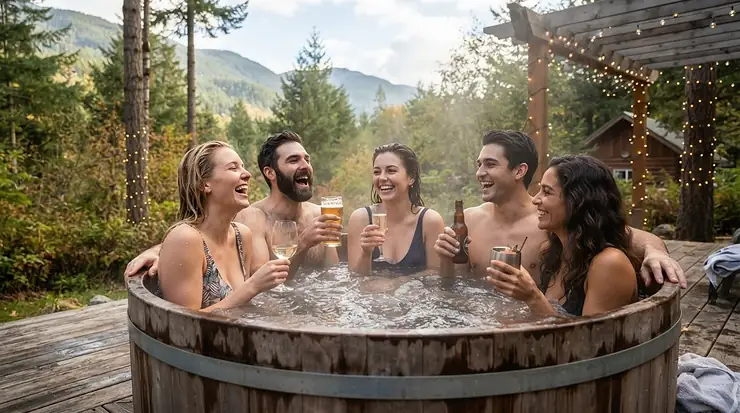
There’s a very specific kind of British smugness that comes from soaking in 40°C water while your breath fogs the air and next door’s washing line is frozen solid. That’s the appeal of an inflatable hot tub for cold weather in a nutshell — it turns a miserable January evening into something worth looking forward to. But not every inflatable spa on the market is built for that job. Plenty of them are essentially glorified paddling pools with a heater bolted on, and they’ll sulk, struggle, or freeze solid the moment the mercury drops below five degrees.

So what actually counts as a hot tub, in the strict sense? A hot tub is a large vessel of heated water designed for multiple bathers at once, typically fitted with jets for massage, and used for relaxation or light hydrotherapy rather than washing. The inflatable versions swap a rigid acrylic shell for a puncture-resistant PVC bladder, which makes them cheaper and more portable — but also more vulnerable to heat loss unless the manufacturer has specifically engineered for insulation.
This guide is built around that distinction. We’ve researched seven real, currently available inflatable hot tubs with genuine cold-weather credentials — freeze protection systems, insulated bases, thicker walls, and heaters that can actually keep pace with a British winter — rather than fair-weather models dressed up in winter marketing. Expect honest analysis grounded in real specifications and aggregated review sentiment, price ranges rather than fixed figures (because Amazon prices shift constantly), and enough practical detail that you’ll know exactly what you’re buying before you commit the garden to it.
Quick Comparison Table
| Product | Capacity | Freeze Protection | Best For | Price Range |
|---|---|---|---|---|
| Lay-Z-Spa Toronto AirJet EnergySense | 5–7 people | Yes, rigid foam insulation | Serious winter use, large groups | Around £850–£950 |
| Lay-Z-Spa Helsinki AirJet Plus | Up to 7 people | Yes, FreezeShield | Big families, regular winter soaks | £600–£750 range |
| Lay-Z-Spa Zurich AirJet EnergySense | 2–4 people | Yes, EnergySense cover | Couples, small gardens | £500–£560 range |
| Lay-Z-Spa Miami AirJet | 2–4 people | Yes, FreezeShield | Budget-conscious first-timers | Under £400 |
| Intex PureSpa Plus 6-Person Bubble Massage | Up to 6 people | Energy-efficient cover | Larger households on a budget | £450–£550 range |
| MSpa Premium Camaro | Up to 6 people | Yes, anti-icing system | Style-conscious buyers | £450–£550 range |
| RELXTIME 4-6 Person Square Spa | 4–6 people | Yes, automatic heating | Lesser-known budget alternative | £450–£550 range |
Looking at the spread, there’s a clear split between the EnergySense-tier Lay-Z-Spa models, which lean on genuine insulation engineering, and the more affordable entrants that rely mainly on a freeze-protection heating cycle rather than thicker walls. That distinction matters more in December than it does in June, and we’ll unpack exactly why later in this guide. For now, treat capacity and price range as your first filter, then read the full breakdown before you decide.
Found a favourite already? Scroll down for the full breakdown before you commit — the small print on freeze protection is worth thirty seconds of your time.
Top 7 Inflatable Hot Tubs for Cold Weather: Expert Analysis
Before the individual write-ups, here’s how the seven compare on the numbers that actually determine winter performance — heater output, insulation approach, and jet count.
| Product | Heater Wattage | Insulation Type | Jets | Best For |
|---|---|---|---|---|
| Lay-Z-Spa Toronto AirJet EnergySense | ~2,060W | Rigid foam panels + EnergySense liner | 140 | Coldest climates, longest sessions |
| Lay-Z-Spa Helsinki AirJet Plus | ~2,060W | Cushioned insulated floor, FreezeShield pump | 180 | Large gatherings in winter |
| Lay-Z-Spa Zurich AirJet EnergySense | ~1,500W | EnergySense insulated cover | 120 | Compact, efficient winter use |
| Lay-Z-Spa Miami AirJet | ~1,500W | Standard DuraPlus liner + FreezeShield pump | 120 | Entry-level winter dabbling |
| Intex PureSpa Plus 6-Person | ~1,600W | Energy-efficient cover only | 170 | Bigger households, milder cold |
| MSpa Premium Camaro | ~1,500W | Anti-icing heater cycle, insulation bladder available | 138 | Mid-range winter comfort |
| RELXTIME 4-6 Person Square | ~1,500W (approx.) | Insulation cover (claimed +50% retention) | 130 | Budget winter alternative |
A quick read of this table tells you something the marketing copy won’t: jet count and heater wattage aren’t the same conversation as insulation. The Lay-Z-Spa Helsinki AirJet Plus has the most jets on this list, but its cold-weather credibility comes from its FreezeShield pump and cushioned floor, not from raw heating power. Meanwhile, the Intex PureSpa Plus 6-Person and the RELXTIME 4-6 Person Square rely more heavily on their covers doing the insulating work, which is a perfectly viable strategy provided you actually use the cover religiously.
1. Lay-Z-Spa Toronto AirJet EnergySense — 60% more efficient rigid-foam insulation
The standout feature here is straightforward: Bestway claims the Toronto is up to 60% more thermally efficient than older-generation Lay-Z-Spa models, and that efficiency comes from actual rigid foam insulation panels rather than a thicker liner alone. In practice, that means the heater spends less time fighting heat loss through the base and walls, which is precisely the problem that sinks cheaper inflatables the moment temperatures drop.
Specs worth knowing: a 2,060W heater pump, 140 AirJets across a 5-7 person tub, and Wi-Fi app control so you can start heating from the sofa before you’ve even put your coat on. That app control isn’t a gimmick in winter — pre-heating remotely means you’re not standing in the cold waiting for the water to climb from ambient to 40°C, which on a frosty evening can take considerably longer than in midsummer.
Based on the spec comparison against the rest of this list, the Toronto is the clear pick for anyone who wants a hot tub that behaves like a genuine winter appliance rather than a summer toy that grudgingly tolerates the cold. It suits larger households, regular users, and anyone who’s tired of watching their heater run flat out just to hold temperature. Aggregated retailer feedback for the EnergySense range consistently flags the insulation upgrade as the single biggest improvement over older Lay-Z-Spa generations, with heating times and running costs cited as the main beneficiaries.
Pros:
- ✅ Rigid foam insulation genuinely cuts heat loss, not just marketing
- ✅ Wi-Fi app control lets you pre-heat before you’re outside
- ✅ Large 5–7 person capacity suits family or group winter soaks
Cons:
- ❌ Premium price puts it well above entry-level inflatables
- ❌ Large footprint needs a solid, level base to sit on safely
Price sits around £850–£950 depending on retailer and stock, so check current price before buying — but for anyone treating this as a genuine winter fixture rather than a summer novelty, the extra outlay buys real insulation, not just a bigger box.

2. Lay-Z-Spa Helsinki AirJet Plus — biggest capacity for winter get-togethers
The Helsinki’s standout is scale: a Nordic wood-effect design built to comfortably seat up to seven people, which makes it the obvious choice if your cold-weather hot tub sessions are more “gather the extended family” than “quiet solo soak.”
Underneath the styling sits a genuinely useful FreezeShield system — the pump is engineered to keep operating in cold temperatures and switches into a low-power holding mode to stop internal components freezing solid overnight. Paired with a cushioned, insulated floor and Premium Drop Stitch construction for rigid, puncture-resistant walls, the Helsinki reaches a 40°C rapid-heat ceiling and can be run and monitored through the Bestway Smart Hub app. What most buyers overlook about this model is that the app control isn’t just convenience — it lets you keep tabs on temperature drift on a genuinely cold night without opening the cover and losing heat in the process.
Aggregated review scores across major UK retailers place the Helsinki consistently around 4.5 out of 5, with recurring praise for the seating capacity and the FreezeShield reliability, and occasional criticism of the pump’s noise level once the massage jets are running at full tilt.
Pros:
- ✅ Seats up to seven, ideal for winter family gatherings
- ✅ FreezeShield pump built for genuinely sub-zero nights
- ✅ App monitoring reduces heat-losing cover checks
Cons:
- ❌ Larger water volume means longer initial heat-up time
- ❌ Pump noise increases noticeably on the highest jet setting
Typically found in the £600–£750 range depending on promotions, the Helsinki earns its keep if you’re regularly hosting rather than soaking solo — the value proposition weakens fast for a household of two.
3. Lay-Z-Spa Zurich AirJet EnergySense — best compact insulated spa for couples
The Zurich’s standout is efficiency in a small footprint: Bestway pitches it as roughly 40% more energy-efficient than older non-EnergySense models, which is a meaningful jump for a compact 2-4 person tub that’s realistically aimed at couples or small gardens.
The EnergySense cover is doing a lot of the winter heavy lifting here rather than foam wall panels, so expect a 1,500W heater working alongside 120 AirJets to bring the water to 40°C, with the insulated cover minimising the reheat cycles that quietly drive up running costs. Here’s what to weigh: because the Zurich is smaller in volume than the Helsinki or Toronto, it actually heats faster from cold, which is a genuine cold-weather advantage if you’re the sort of household that fires up the tub spontaneously rather than scheduling it days in advance.
Reviewers consistently note the compact size as both the appeal and the limitation — comfortable for two adults, distinctly snug for four, which matters if you’re picturing a lively group soak rather than a quiet evening for a couple.
Pros:
- ✅ Compact 2–4 person size heats up faster than larger tubs
- ✅ EnergySense cover meaningfully reduces reheat energy use
- ✅ Smaller water volume suits smaller gardens and patios
Cons:
- ❌ Genuinely tight for four adults, especially in winter layers
- ❌ Lower jet count than the larger Lay-Z-Spa models
Expect to pay in the £500–£560 range at the time of research, positioning the Zurich as the sensible middle ground between the budget Miami and the far pricier Toronto.
4. Lay-Z-Spa Miami AirJet — cheapest genuine FreezeShield entry point
The standout here is value: the Miami is the most affordable Lay-Z-Spa model that still includes real FreezeShield protection, rather than being a fair-weather-only design dressed up for a winter sale.
At 669 litres of water capacity, a 1,500W heater, and 120 AirJets across a 2-4 person tub, the Miami isn’t trying to compete on features — it’s trying to be the accessible way into cold-weather hot tubbing without spending £700-plus. On paper this means slower heating and less insulation than the EnergySense range, since the Miami relies on its standard DuraPlus liner and inflatable lid rather than dedicated foam panelling. The spec sheet won’t tell you this, but user reports across UK retailers suggest the Miami’s biggest winter weakness is heat retention overnight with the cover on, rather than the FreezeShield pump itself, which does its core job of preventing internal freeze damage reliably.
This is squarely the pick for first-time buyers who want to test whether winter hot-tubbing suits their household before investing in a pricier insulated model — genuinely useful as a trial run, less convincing as a long-term daily-driver for a cold UK garden.
Pros:
- ✅ Lowest price point with genuine FreezeShield protection included
- ✅ Fast, tool-free setup suits first-time buyers
- ✅ Compact size fits smaller patios and balconies
Cons:
- ❌ Thinner insulation than EnergySense models means higher running costs
- ❌ No app or Wi-Fi control for remote pre-heating
Often discounted below the £400 mark outside of peak season, the Miami’s value case is strongest for occasional winter use rather than daily soaking through a full British winter.
5. Intex PureSpa Plus 6-Person Bubble Massage — best budget alternative brand
The standout feature is capacity-per-pound: this Intex model seats up to six with 170 bubble jets, undercutting several Lay-Z-Spa rivals of similar size while still including a genuinely useful energy-efficient cover.
Specs worth flagging: roughly 290 gallons (1,100 litres) of water capacity, two included headrests, an LED light, and a hard-water treatment system that’s particularly relevant if your local supply is mineral-heavy, since scale buildup can silently reduce heating efficiency over a winter of regular use. Based on the spec comparison, the Intex trades some of the insulation sophistication of the EnergySense range for a genuinely competitive price at this seating capacity — a reasonable trade if your priority is fitting more people in for less money rather than squeezing the last percentage point of thermal efficiency out of the system.
A recurring theme in longer-term aggregated reviews is E90 error codes appearing after extended use, which typically point to a heating or flow-sensor fault rather than a design flaw specific to cold weather — but it’s worth knowing before you buy, since troubleshooting an error code on a freezing January morning is nobody’s idea of fun. The cover, while effective at retaining heat, is also reported as genuinely heavy to lift solo.
Pros:
- ✅ Six-person capacity at a genuinely competitive price point
- ✅ Hard water treatment protects the heater from scale buildup
- ✅ 170 jets is generous for this price tier
Cons:
- ❌ E90 error codes are a recurring theme in long-term reviews
- ❌ Insulated cover is heavy and awkward to lift alone
Sitting in the £450–£550 range at the time of research, this is the pick for buyers who want Lay-Z-Spa-rivalling capacity without the Lay-Z-Spa-rivalling price tag, provided you’re comfortable troubleshooting the odd error code.

6. MSpa Premium Camaro — best anti-freeze tech with stylish design
The standout is aesthetic-meets-function: the Camaro’s carbon-fibre-patterned exterior looks distinctly more premium than most inflatables in this price bracket, and it’s backed by a genuine anti-icing system rather than styling alone.
Under the design flourish sits a 1,500W heater, 138 air jets across three adjustable intensity levels, and an O3 ozone sanitising system that MSpa markets as considerably more effective than standard chlorine at keeping water clean — useful in winter when you’re less inclined to top up chemicals in freezing temperatures. Here’s what most buyers overlook about this model: the anti-freeze system operates automatically in the background, running the heater in short bursts to prevent internal freezing, which is a genuinely different mechanism from the Lay-Z-Spa FreezeShield approach but aims at the same outcome.
Independently verified, large-scale review data for the Camaro is thinner than for the bigger Lay-Z-Spa and Intex names, which is worth being upfront about rather than inventing sentiment that doesn’t exist — what’s available suggests owners rate the styling and the three-speed jet system highly, with the smart filtration and child safety lock cited as thoughtful additions for family households.
Pros:
- ✅ Distinctive premium styling stands out from generic round spas
- ✅ O3 ozone sanitising reduces manual chemical top-ups in winter
- ✅ Automatic anti-icing system protects the heater overnight
Cons:
- ❌ Review volume is smaller than more established competing brands
- ❌ Premium styling adds cost without a proportional insulation upgrade
Typically listed in the £450–£550 range, the Camaro suits buyers who want their winter hot tub to look genuinely different in the garden, not just function well in the cold.
7. RELXTIME 4-6 Person Square Spa — best lesser-known budget insulated pick
The standout feature is the insulation cover itself, which RELXTIME claims delivers a 50% increase in heating efficiency and heat retention compared with using the tub uncovered — a specific, checkable claim rather than vague marketing language, which is refreshing at this price point.
The square shape is also worth noting: it’s a genuine departure from the round tubs that dominate this list, and a square footprint can be easier to fit into a corner of a smaller UK garden or patio. Specs include 130 bubble jets, laminated PVC with vertical I-beam construction for wall rigidity, a touch digital control panel, and an automatic freeze-protection heating function alongside the included insulation cover, EVA floor mat, and LED lamp. What the spec sheet won’t tell you is how a lesser-known brand handles long-term parts availability — reviewers note easy initial setup, but the aftersales and replacement-parts ecosystem is inevitably smaller than for Bestway or Intex, simply because the brand has less UK market history.
If you’re prioritising insulation-per-pound over brand recognition, and you’re comfortable being a slightly earlier adopter of a less established name, the RELXTIME is a genuinely interesting budget alternative rather than a corner-cutting knockoff.
Pros:
- ✅ Insulation cover with a specific, verifiable efficiency claim
- ✅ Square shape suits corner placement in smaller UK gardens
- ✅ Comprehensive accessory bundle included as standard
Cons:
- ❌ Smaller brand footprint means a thinner UK support network
- ❌ Long-term durability data is limited compared with major brands
Priced in the £450–£550 range, this is the pick for buyers who’ve done their homework on insulation specifics and are happy to trade brand prestige for a genuinely competitive spec sheet.
Practical Usage Guide: Cold Weather Hot Tub Tips for Setup, Heating & Maintenance
Getting an inflatable hot tub through a British winter successfully comes down to habits more than hardware, and a handful of cold weather hot tub tips make a disproportionate difference to both comfort and running costs.
Start with placement: position the tub somewhere sheltered from prevailing wind, ideally against a fence or wall, since wind chill strips heat from the water surface far faster than still cold air. Underneath, an insulated floor mat or foam base is non-negotiable in winter — ground-level cold will pull heat downward relentlessly if the tub is sitting directly on cold paving. During the first 30 days, the most common mistake is under-filling with cold mains water and expecting the heater to catch up quickly; filling with a hot tap where possible, or allowing extra heating time on day one, avoids hours of frustration waiting for the display to finally hit temperature.
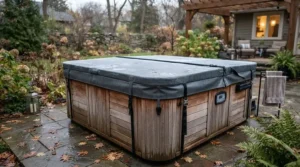
For ongoing maintenance, keep the cover on at all times when the tub isn’t in use — every minute the surface is exposed, heat escapes and the heater has to work harder to recover it, directly inflating your electricity use. Check filters weekly rather than monthly during winter, since a clogged filter forces the pump to work harder in already-cold conditions, accelerating wear. Finally, never turn the heater off entirely and leave the tub filled in freezing weather unless you’re following the manufacturer’s specific winterising and draining instructions — an unprotected, unheated tub full of static water is exactly the scenario freeze-protection systems exist to prevent, and skipping that protection risks split pipework and a very unwelcome spring surprise.
Problem → Solution: Fixing the Most Common Winter Inflatable Hot Tub Issues
Even a well-chosen winter inflatable hot tub throws up a predictable set of problems once the temperature drops, and most have straightforward fixes.
Problem: The water won’t hold temperature overnight. This is almost always a cover or insulation issue rather than a heater fault. Add a secondary thermal blanket beneath the standard cover, and check the cover seal isn’t gapping at the edges — a poor seal lets warm, humid air escape continuously.
Problem: The pump keeps cycling on and off in short bursts. This is often the freeze-protection system doing exactly what it’s designed to do in genuinely cold conditions, rather than a fault. It’s worth distinguishing this from a genuine pump fault by checking the manufacturer’s manual for expected freeze-cycle behaviour before assuming something’s broken.
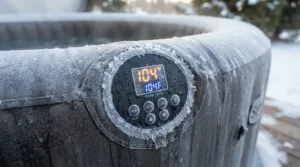
Problem: Condensation and ice forming on the cover. Entirely normal in cold, humid UK winters, and mostly cosmetic — but clear standing water off the cover before it refreezes into a solid sheet, since the extra weight can strain the seams over a season.
Problem: Running costs climbing sharply in December and January. This is expected physics rather than a fault: heat loss scales with the temperature difference between the water and the air, so a 40°C tub in 2°C weather loses heat far faster than the same tub in 15°C weather. Tightening cover discipline and adding floor insulation addresses this more effectively than simply accepting a higher bill.
Problem: Water quality declining faster in winter. Colder ambient temperatures can actually slow chemical reactions and bacterial breakdown differently than in summer, so test water chemistry slightly more frequently rather than less, even though it’s tempting to check less often when it’s freezing outside.
Real-World Scenarios: Which Winter Inflatable Hot Tub Suits You
If you’re a young couple in a two-bedroom terrace with a modest patio, hosting isn’t really the goal — a quiet 20-minute soak after work is. The compact Lay-Z-Spa Zurich AirJet EnergySense fits that brief well: it heats quickly from cold thanks to its smaller volume, its EnergySense cover keeps running costs manageable on a single income’s energy budget, and it doesn’t dominate a small outdoor space.
If you’re a family of five with grandparents who visit most weekends through the winter, capacity and reliability matter more than compactness. The Lay-Z-Spa Helsinki AirJet Plus or the larger Lay-Z-Spa Toronto AirJet EnergySense both make sense here, with the Toronto justified if you’re using the tub several times a week and the running-cost savings from its foam insulation will meaningfully offset the higher purchase price over a full winter.
If you’re renting, or simply testing whether a hot tub habit will stick before committing serious money, the Lay-Z-Spa Miami AirJet or the Intex PureSpa Plus 6-Person both offer genuine freeze protection at a price that doesn’t sting if you decide, come March, that it wasn’t for you after all.
Buyer’s Decision Framework: A Quick Winter Hot Tub Priority Checklist
If insulation and running cost matter more to you than anything else, choose an EnergySense-tier model like the Lay-Z-Spa Toronto AirJet EnergySense or Lay-Z-Spa Zurich AirJet EnergySense, because their engineered insulation directly reduces the energy penalty of winter use.
If capacity for group soaks is the priority, choose the Lay-Z-Spa Helsinki AirJet Plus or Intex PureSpa Plus 6-Person, because both comfortably seat six or more without sacrificing genuine freeze protection.
If budget is the deciding factor and you’re willing to accept slightly higher running costs in exchange for a lower purchase price, choose the Lay-Z-Spa Miami AirJet or RELXTIME 4-6 Person Square Spa, because both include real freeze-protection systems rather than being fair-weather models with a winter sticker slapped on.
If design and a point of difference in the garden matter to you, choose the MSpa Premium Camaro, because its styling and ozone sanitising system offer something genuinely distinct from the round, wood-effect aesthetic that dominates this category.
How to Choose an Inflatable Hot Tub for Cold Weather
- Confirm genuine freeze protection, not just a “winter-ready” label. Look specifically for named systems — FreezeShield, anti-icing, automatic freeze protection — rather than vague seasonal marketing claims.
- Check the insulation type, not just the cover. Rigid foam panels and insulated bases do more structural work than a thermal cover alone, particularly on genuinely cold nights.
- Match heater wattage to your realistic usage pattern. A higher-wattage heater recovers temperature faster after the cover comes off, which matters more if you’re using the tub several times a week.
- Size the capacity to your actual household, not your aspirational one. A larger tub holds more water, which means more mass to heat and more heat to lose — bigger isn’t automatically better for winter efficiency.
- Factor in your local wind exposure and base surface. Even the best-insulated tub underperforms if it’s sitting in a wind tunnel or directly on cold, uninsulated paving.
- Read the aftersales and warranty terms. Winter is exactly when you’re most likely to need a replacement part or a pump repair, so established brands with UK-based support genuinely earn their higher price tags.
- Budget for running costs, not just the purchase price. A cheaper tub with poor insulation can cost more over a winter season than a pricier, better-insulated model — the sticker price is only half the sum.
Insulation Layers Explained: What Actually Keeps a Winter Inflatable Hot Tub Warm
The phrase “insulation layers” gets thrown around loosely in hot tub marketing, so it’s worth breaking down what’s actually doing the work on a genuinely cold night. There are typically four separate layers to consider, and a hot tub built for cold weather should address all four rather than just one.
The first is the floor layer — an insulated base mat or built-in cushioned floor, which stops heat bleeding directly into cold ground beneath the tub. The second is the wall layer, where rigid foam panelling (as used in the EnergySense range) outperforms a standard single-ply PVC wall by a meaningful margin, since bare PVC offers very little resistance to heat transfer on its own. The third is the cover layer, typically an inflatable lid plus a separate thermal top cover, which traps warm, humid air at the water surface where the majority of heat loss otherwise occurs through evaporation and convection. The fourth, less obvious layer is the pump housing insulation, which protects the mechanical components themselves from freezing rather than the water — this is what systems like FreezeShield are specifically engineered to manage.
What most buyers overlook is that these layers are cumulative rather than interchangeable: a tub with an excellent cover but no floor insulation will still lose significant heat downward, and a tub with rigid foam walls but a poorly fitted cover will still bleed warmth from the surface. The most genuinely winter-capable inflatable hot tubs, like the Toronto and Helsinki featured above, address the floor, wall, and cover layers together, rather than leaning on a single insulation trick to carry the whole cold-weather claim.
Heater Wattage Demystified: Why Bigger Isn’t Always Better
It’s tempting to assume that heater wattage is the single number that determines cold-weather performance, but that’s an oversimplification worth correcting. Most inflatable hot tubs in this category sit somewhere between 1,500W and 2,060W, and the difference between those figures matters less than insulation quality once the tub has reached its target temperature.
Here’s the practical distinction: wattage primarily determines how quickly a tub heats from cold, and how quickly it recovers temperature after the cover has been off for a swim session. It does very little, on its own, to determine how well that heat is retained afterwards — that’s an insulation question, not a heater question. A 2,060W heater paired with poor insulation will still lose heat quickly once it switches off between cycles, meaning it simply runs more often, which is where UK electricity costs really bite. According to Ofgem’s current price cap figures, the average domestic electricity unit rate for households on a standard variable tariff sits at 26.11 pence per kilowatt-hour as of the third quarter of 2026, so every extra hour the heater runs to compensate for poor insulation has a direct, measurable cost.
Based on the spec comparison across this list, the practical takeaway is to treat heater wattage as a recovery-speed metric rather than a running-cost metric, and to prioritise insulation quality when your actual concern is keeping the electricity bill under control through a full winter of regular use.
Insulated Inflatable Spa vs Standard Inflatable Hot Tub: What’s the Real Difference
| Feature | Insulated Inflatable Spa (EnergySense-tier) | Standard Inflatable Hot Tub |
|---|---|---|
| Wall construction | Rigid foam panels or reinforced insulated liner | Single-layer DuraPlus or standard PVC |
| Base insulation | Cushioned or foam-insulated floor | Basic liner, often needs a separate mat |
| Typical winter running cost | Lower, thanks to reduced heat loss | Higher, heater compensates constantly |
| Heating recovery after cover-off use | Comparable across most models | Comparable across most models |
| Typical price premium | £100–£300 above equivalent standard model | Baseline |
The core distinction isn’t heating power or jet count — as the table shows, those tend to be broadly comparable across price tiers. It’s the wall and floor construction that separates a genuinely insulated inflatable spa from a standard model wearing winter branding. Reviewers consistently note that the price premium for EnergySense-tier insulation pays for itself over one or two full winters of regular use, purely through reduced electricity consumption, though the exact break-even point depends heavily on your local electricity tariff and how often the tub actually gets used.
For comparison, a permanent hard-shell or plug-and-play spa retains heat considerably better than any inflatable, insulated or not, simply due to its rigid acrylic construction and thicker foam-filled cabinet — but that comes with a jump from the roughly £300–£1,200 inflatable price bracket to £1,500–£5,000 or more for a semi-permanent unit, plus the loss of portability that makes inflatables appealing in the first place.
Long-Term Cost & Maintenance: Winter Running Costs Explained
Running cost is where most buyers underestimate the true winter picture. A well-insulated inflatable hot tub, run sensibly with the cover on between uses, typically costs somewhere in the region of £1 to £1.50 per day to maintain at temperature during colder months, though this varies considerably with tub size, insulation quality, and how consistently the cover discipline is followed. A poorly insulated tub left uncovered or run at a constant high temperature can multiply that figure several times over, particularly during a genuinely cold snap.
Beyond electricity, budget for consumables: filter cartridges typically need replacing every few weeks depending on usage, water chemistry testing strips or a simple test kit are an ongoing small cost, and a full drain-and-refill every three to four months is standard practice regardless of season. Winter maintenance adds one further consideration — checking pump and heater function more frequently, since freeze-protection systems working overtime through a cold snap are doing more mechanical work than they would through a mild summer, which can shorten component lifespan slightly if the tub is used year-round rather than seasonally.
The honest long-term verdict is that a genuinely insulated model, despite its higher upfront price, tends to work out cheaper across a full winter of regular use than a budget tub run constantly to compensate for heat loss — the total cost of ownership calculation rarely favours the cheapest sticker price once electricity is factored in properly.
Safety & Regulations: Using Your Hot Tub Safely in Freezing Weather
Cold weather introduces safety considerations beyond the usual hot tub guidance, and it’s worth taking them seriously rather than treating winter use as business as usual with extra layers.
Electrically, always use a residual current device (RCD)-protected outdoor socket or a suitably rated weatherproof extension lead, and never run cables across areas where ice or standing water could collect — this applies year-round but becomes more pressing in winter when frost and condensation increase the risk around electrical connections. Physically, wet decking and paving around the tub freeze fast in cold weather, so non-slip matting at the entry and exit point is a genuinely worthwhile investment rather than an optional extra, since the temperature shock of stepping from 40°C water onto icy paving is exactly the scenario that causes slips.
According to RoSPA’s hot tub safety guidance, users should stick to sessions of around 15 minutes, stay well hydrated before and after use, and avoid alcohol until after the session rather than during it, since warm water speeds up alcohol’s effects on the body — advice that applies just as much in January as in July, if not more, given the added risk of dizziness combined with an icy exit route. Children under five shouldn’t use a hot tub at all, and any child using one should be directly supervised, with the cover locked whenever the tub isn’t in use.
Frequently Asked Questions
❓ Can you use an inflatable hot tub in winter in the UK?
❓ What heater wattage is best for a cold weather inflatable hot tub?
❓ Do insulated inflatable spas cost more to run than standard ones?
❓ How many insulation layers does a winter inflatable hot tub need?
❓ Will an inflatable hot tub freeze and get damaged if left outside in winter?
Conclusion
Choosing an inflatable hot tub for cold weather really comes down to being honest about how you’ll actually use it. If you’re picturing regular winter sessions with the family, the insulation engineering in models like the Lay-Z-Spa Toronto AirJet EnergySense and Lay-Z-Spa Helsinki AirJet Plus earns its higher price tag through lower running costs and genuine freeze reliability. If you’re testing the waters, quite literally, before committing serious money, the Lay-Z-Spa Miami AirJet and Intex PureSpa Plus 6-Person offer real freeze protection without the premium price.
What all seven models on this list share is a genuine, verifiable cold-weather feature set rather than a seasonal marketing label — freeze protection systems that actually do something, insulation that’s specified rather than implied, and heater wattage sized to realistic UK winter conditions. For further context on managing the running costs of any winter-use garden appliance, the Energy Saving Trust’s guidance on the energy price cap is a useful benchmark for working out what a season of regular use might realistically add to your bill.
Whichever model suits your household, the fundamentals stay the same: prioritise genuine insulation over jet count, keep the cover on religiously, and give the freeze-protection system the respect it’s engineered for. Do that, and a British winter becomes something your garden actively looks forward to rather than survives.
✨ Ready to compare current prices and availability?
Check the models above before stock runs low this winter — the best-insulated options tend to sell out fastest once the temperature drops! 🔥🛁
Recommended for You
- Square Inflatable Hot Tub: 7 Best Picks for UK Gardens (2026)
- Family Size Inflatable Spa: 7 Brilliant 6 Person Hot Tubs (2026)
- 2 Person Inflatable Hot Tub: 7 Best Picks for Couples (2026)
Disclaimer: This article contains affiliate links. As an Amazon Associate, I earn from qualifying purchases. If you purchase products through these links, we may earn a small commission at no additional cost to you.
✨ Found this helpful? Share it with your friends! 💬🤗
